Showing posts with label Nymph. Show all posts

Thursday, September 28, 2023

10 Works, September 27th. is Jean-Baptiste Nattier's day, his story, illustrated with footnotes #212

Jean-Baptiste Nattier (27 September 1678, Paris - 23 May 1726, Paris) was a French history painter.

His father was the portrait painter, Marc Nattier and his mother was the miniaturist, Marie Courtois. His brother, Jean-Marc Nattier, also became a painter. Both brothers received their first art lessons from their father.

Jean-Baptiste Nattier  (1678–1726)
Joseph and Potiphar’s wife, c. 1711
Oil on canvas
73,5x92 cm
Hermitage Museum, St. Petersburg

Joseph was taken to Egypt by the Ishmaelite traders, he was purchased by Potiphar, an Egyptian officer. Potiphar was captain of the guard for Pharaoh, the king of Egypt. Joseph works hard for his master, Potʹi·phar. So when Joseph grows older, Potʹi·phar puts him in charge of his whole house. 

Joseph was a very handsome and well-built young man, and Potiphar’s wife soon began to look at him lustfully. “Come and sleep with me,” she demanded. Joseph refused. “Look,” he told her, “my master trusts me with everything in his entire household. No one here has more authority than I do. He has held back nothing from me except you, because you are his wife. How could I do such a wicked thing? It would be a great sin against God.”

So when her husband comes home, she lies to him and says: ‘Joseph tried to lie down with me!’ Potʹi·phar believes his wife, and he is very angry with Joseph. So he has him thrown into prison. More on Joseph and Potiphar

Attributed to Jean Baptiste Nattier (French, 1678–1726)
Cimon and Pero
Oil on Canvas
95.5 x 74.5 cm. (37.6 x 29.3 in.)
Private collection

Roman Charity is the exemplary story of a woman, Pero, who secretly breastfeeds her father, Cimon, after he is incarcerated and sentenced to death by starvation. She is found out by a jailer, but her act of selflessness impresses officials and wins her father's release.

The story is recorded by the ancient Roman historian Valerius Maximus, and was presented as a great act of filial piety and Roman honour. A painting in the Temple of Pietas depicted the scene. Among Romans, the theme had mythological echoes in Juno's breastfeeding of the adult Hercules, an Etruscan myth. More on Roman Charity

From 1704 to 1709, he studied at the Académie de France à Rome and, in 1712, was received as a member of the Académie royale de peinture et de sculpture upon presentation of his painting, Joseph sollicité par la femme de Putiphar (See above). 

Jean-Baptiste Nattier (1678-1726)
The Death of Adonis, c. 1718
Oil on shaped canvas made up to a rectangle
34 x 41in. (87.6 x 106cm.)
Private collection

Sold for USD 30,000 in Jun 2020

In Greek mythology, Adonis was the god of beauty and desire. Originally, he was a god worshipped in the area of Phoenicia (modern – day Lebanon), but was later adopted by the Greeks. According to the most popular belief, he was the son of Theias, king of Syria, and Myrrha (also known as Smyrna), Theias’ daughter.

Adonis was a great hunter and Artemis got jealous of his hunting skills. So Artemis sent a wild boar which eventually killed Adonis in one of his hunting expeditions. A different version of the myth has it that the boar was sent by Ares, as he was the lover of Aphrodite. Adonis bled to death in Aphrodite’s arms. Anemones sprang out of the tears of Aphrodite while she was mourning the death of her lover.  More on the Death of Adonis

Jean Baptiste Nattier
Boreas Abducting Oreithyia
Oil on canvas
100 x 90 cm
Private collection

Estimate for 26,000 - 35,000 EUR in November 2021

Failing to win the hand of the lovely Athenian princess Orethyia, one of the daughters of King Erechtheus, by gentle means, Boreas, the cold wind god of the North, decided to revert to his true nature of wildness and cold rage. The story is told by Ovid in the sixth book of the Metamorphoses, and Nattier admirably evokes the passion and fury of the tale. Boreas swoops down, concealed by dark and stormy clouds, and forcibly snatches up Oreithyia. Boreas carried her back to his northern realm, where she later bore him twin sons. More on Boreas Abducting Oreithyia

Jean-Baptiste Nattier  (1678–1726)
Romulus being taken up to Olympus by Mars
Oil on canvas
99 × 96.5 cm (38.9 × 37.9 in)
Museum of John Paul II Collection

The time came for Romulus to hand on the new Roman state to his successor; Mars therefore called a council of the gods, and proposed that the founder of Rome should be transformed into a god, which Jupiter approved.

With Romulus now the Roman god Quirinus, Hersilia, his queen, mourned his loss. Juno therefore instructed Iris to descend and invite Hersilia to join Romulus/Quirinus on Olympus.

Only Jean-Baptiste Nattier painted the apotheosis of the founder of Rome, in his Romulus being taken up to Olympus by Mars from about 1700. Mars is embracing Romulus, with the standard of Rome being borne at the lower left, and the divine chariot ready to take Romulus up to the upper right corner, where the rest of the gods await him. More on this painting

With this and training from his father and uncle he became an award-winning artist. He became well know for depicting his woman subjects in portraits as mythological goddesses. Examples of such can be seen in the Uffizi Gallery in his works, Henriette of France as Flora and, Marie Adelaide of France as Diana. Henriette (1727 – 1752) was the first daughter of King Louis XV and Queen Maria Leczinska of France and Marie Adelaide (1732 – 1800) their third. Both portraits show near perfect depictions of his subjects’ likeness, while still rendering a mythological ambience in the work. He also completed more straight-forward portraits of the Queen of France, Maria Leczinska (See below).

French School, 18th Century, Circle Jean Baptiste Nattier
Cleopatra
Oval canvas
87.5 x 77 cm
Private collection

Cleopatra VII Philopator (69 – August 12, 30 BC), was the last active pharaoh of Ptolemaic Egypt, briefly survived as pharaoh by her son Caesarion. After her reign, Egypt became a province of the recently established Roman Empire.

Cleopatra was a member of the Ptolemaic dynasty, a family of Macedonian Greek origin that ruled Egypt after Alexander the Great's death. The Ptolemies spoke Greek throughout their dynasty, and refused to speak Egyptian, which is the reason that Greek as well as Egyptian languages were used on official court documents such as the Rosetta Stone. By contrast, Cleopatra did learn to speak Egyptian and represented herself as the reincarnation of the Egyptian goddess Isis.

Cleopatra originally ruled jointly with her father Ptolemy XII Auletes, and later with her brothers Ptolemy XIII and Ptolemy XIV, whom she married as per Egyptian custom, but eventually she became sole ruler. As pharaoh, she consummated a liaison with Julius Caesar that solidified her grip on the throne.

After Caesar's assassination in 44 BC, she aligned with Mark Antony in opposition to Caesar's legal heir Gaius Julius Caesar Octavianus (later known as Augustus). With Antony, she bore the twins Cleopatra Selene II and Alexander Helio. Antony committed suicide after losing the Battle of Actium to Octavian's forces, and Cleopatra followed suit. According to tradition, she killed herself by means of an asp bite on August 12, 30 BC. More on Cleopatra

Nattier rose to prominence after executing engravings of Peter Paul Rebuns’, Marie de Medicis Cycle, and also in painting portraits of  Peter the Great, The Russian Tsar (1672 – 1725) (See below) and his wife the Empress Catherine (1684 – 1727) in Amsterdam (Encyclopedia Britannica). He was also commissioned by Peter the Great to paint historical works such as, Battle of Pultawa and The Battle of Lesnaya.

Attributed to Jean-Marc Nattier  (1685–1766)
Portrait of Peter I (1672–1725)
Oil on canvas Edit this at Wikidata
Height: 142.5 cm (56.1 in); Width: 110 cm (43.3 in)
Hermitage Museum  

Peter the Great , Peter I, ruled the Tsardom of Russia and later the Russian Empire from 7 May 1682 until his death in 1725, jointly ruling before 1696 with his elder half-brother, Ivan V.

Through a number of successful wars, he expanded the Tsardom into a much larger empire that became a major European power, that also laid the groundwork for the Imperial Russian Navy after capturing ports at Azov and the Baltic Sea. More on Peter I.

Jean Marc Nattier
The Battle of the Forest/ Battle of Lesnaya, 1717 
Pushkin Museum

The Battle of Lesnaya was one of the major battles of the Great Northern War. It took place between a Russian army commanded by Peter I of Russia, and a Swedish army commanded by Adam Ludwig Lewenhaupt and Berndt Otto Stackelberg.. The Swedes were escorting a supply column of more than 4,500 wagons for their main army in Ukraine. More on The Battle of Lesnaya 


Jean-Baptiste Nattier (1678-1726)
Portrait of Marie Rose Larlan de Rochefort, Marquise de Nétumières, c. 1748
Oil on canvas
39 ½ x 31 ½ in. (100.2 x 80.6 cm.)
Private collection

Nattier’s portrait of the Marquise de Nétumières was painted when the sitter was about 30 years old, and many of its delights are particular to the artist’s sumptuous yet modest portrayal of her. Despite the agitated excitement of the little black hound barking on her lap, her expression conveys a calm and direct openness and intelligence, and an inviting warmth of personality that accounts for much of the painting’s appeal. The beautiful, nuanced rendering of fabrics, subtle palette of various dark blues – including ‘Nattier Blue’, the color that still carries the artist’s name – and chocolate browns, and the gently rendered fall of natural light all contribute to its allure. The warm sfumato that envelops the marquise heightens the creaminess of her complexion, creating soft atmospheric effects that emphasize her refined beauty and function as a metaphor for the sweet charm of the sitter’s character that her contemporaries often cited. More on this painting

He painted many portraits, another of which is in the Uffizi Gallery; Marie Zephirine of France (See below), a granddaughter of King Louis XV, who died at only five years old. Nattier was an official portraitist for the King’s daughters and their children.

Jean-Baptiste Nattier (1678-1726)
Portrait of Princess Marie Zéphyrine of France (1750-1755), c. 1751
Oil on canvas
Height: 70.0 cm; Width: 82.0 cm
Uffizi Gallery

Marie Zéphyrine of France was a Daughter of France, the daughter of Louis, Dauphin of France, and Maria Josepha of Saxony.

Marie Zéphyrine died at Versailles due to an attack of convulsions, in the early hours of the morning of 2 September, having been baptised just days before by the Abbot of Chabannes. She was not officially mourned; a Daughter of France could only be mourned if she was over the age of 7. She was buried at the Royal Basilica of Saint Denis outside the capital of Paris. More on Marie Zéphyrine

He became involved the sexual scandals surrounding Benjamin Deschauffour, who was convicted for operating a pederastic network and executed. Nattier was imprisoned in the Bastille and his membership in the Académie was rescinded. Rather than suffer the fate of Deschauffour (whose corpse was publicly burned in the Place de Grève), he committed suicide by cutting his throat with an oyster knife.

His professional belongings at the Acadėmie were returned to his family. 
More on Jean-Baptiste Nattier


Please visit my other blogs: Art Collector, Mythology, Marine Art, Portrait of a Lady, The Orientalist, Art of the Nude and The Canals of Venice, Middle East Artists, 365 Saints, 365 Days, and Biblical Icons, also visit my Boards on Pinterest

Images are copyright of their respective owners, assignees or others. Some Images may be subject to copyright

I don't own any of these images - credit is always given when due unless it is unknown to me. if I post your images without your permission, please tell me.

I do not sell art, art prints, framed posters or reproductions. Ads are shown only to compensate the hosting expenses.

If you enjoyed this post, please share with friends and family.

Thank you for visiting my blog and also for liking its posts and pages.

Please note that the content of this post primarily consists of articles available from Wikipedia or other free sources online.


Thursday, June 10, 2021

24 Works, Today, June 2nd. is Charles Landelle's day, his story, illustrated with footnotes #151

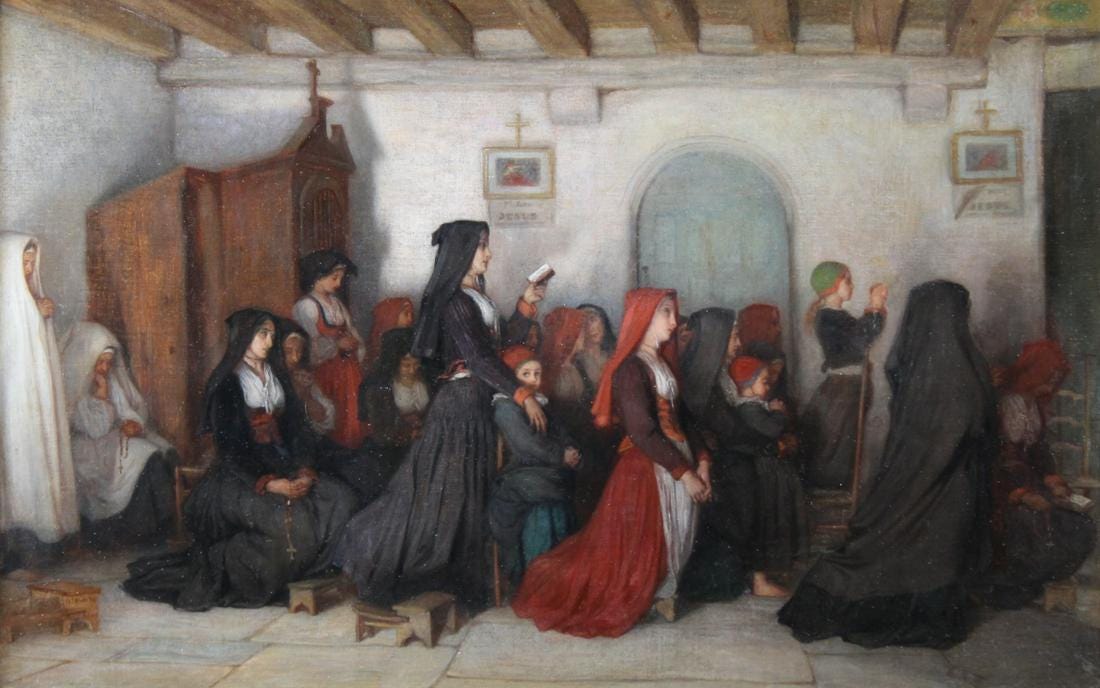
Charles Zacharie Landelle (France, 1821 - 1908)
Women at Prayer
Oil on canvas
11.5 x 18 in
Private collection

Catholic women and children in prayer with nuns in the background.

Zacharie Charles Landelle (2 June 1821 – 13 October 1908) was a French painter who specialized in portraits. He is best known for his Orientalist works.

He was born in Laval, where his father was employed by the préfecture. In 1827, his family moved to Paris when his father was transferred and he would not return to his hometown until near the end of his life. In 1837, at the age of sixteen, he was admitted to the École des Beaux-arts, where he studied with Paul Delaroche and Ary Scheffer. After trips to Italy and the south of France, he copied the Old Masters at the Louvre. He began by painting portraits largely as a means of supporting himself.

Charles Zacharie Landelle, 1812-1908
La Renaissance, c. 1853
Oil on canvas
H. 264, l. 198
Musee National du Chateau, Fontainebleau | France
Commissioned in 1848 for the decoration of the Salle des Bijoux of the Louvre museum

Charles Zacharie Landelle, 1812-1908
VAE VICTORIBUS! WOE TO THE VICTORS! c. 1871
Oil on canvas
25 3/4 by 15 5/8 in., 64.4 by 39.5 cm.
Private collection

Vae victoribus! Victory is a poor advisor, and nations tend to slip on the blood they have shed. Rome under its Caesers did not suspect that its Vae victis would apply in equal measure to Rome itself. After every victory, there's a new tomorrow. Waterloo follows Austerlitz. And so, too, our cry: Victor, beware! More on Vae victoribus

Charles Zacharie Landelle (French, 1812-1908)
The Storm, c. 1879
Oil on canvas
51 1/8 x 32 in. (130 x 81 cm.)
Private collection

Charles Zacharie Landelle (France, 1821 - 1908)
Young woman in a landscape, c. 1844
Oil on canvas
85 x 57.5 cm
Private collection

Charles Zacharie Landelle (France, 1821 - 1908)
A Quick Rest by the Fountain, c. 1865
Oil on canvas
55 by 39 3/4 in , 139.7 by 101 cm 
Private collection

Charles Zacharie Landelle (France, 1821 - 1908)
Beautiful woman reading
Oil on canvas
52 x 120 cm
Private collection

These were a great success and he had his first exhibit at the Salon in 1841. His works came to the attention of King Louis-Philippe and he was awarded a medal. Soon, he became an official painter and received numerous state commissions. His portrait sitters also now came from a higher level of society. In 1852, Napoleon III bought several of his works and became a great admirer. Thanks to him, Landelle was awarded the Legion of Honor in 1855.

Charles Zacharie Landelle (France, 1821 - 1908)
La sirène, c. 1879
Oil on canvas
H 134 x W 85 cm
Russell-Cotes Art Gallery & Museum

According to Greek myths, sirens were powerful and erotic creatures, and many unsuspecting sailors would fall prey to their seductive beauty. The common belief was that they would devour sailors after their ships would crash into the rocks, as most men couldn't resist the temptation of their sweet melodies and angelic faces. More on The Fisherman and The Siren

Charles Zacharie Landelle (France, 1821 - 1908)
Ismenie, Nymph of Diana, c. 1878
Oil on canvas
 130.0 x 87.0 cm
Art Gallery of NSW

A nymph in Greek and Latin mythology is a minor female nature deity typically associated with a particular location or landform. Different from other goddesses, nymphs are generally regarded as divine spirits who animate nature, and are usually depicted as beautiful, young nubile maidens who love to dance and sing; their amorous freedom sets them apart from the restricted and chaste wives and daughters of the Greek polis. They are beloved by many and dwell in mountainous regions and forests by lakes and streams. Although they would never die of old age nor illness, and could give birth to fully immortal children if mated to a god, they themselves were not necessarily immortal, and could be beholden to death in various forms. More on nymphs

Charles Zacharie Landelle (France, 1821 - 1908)
FONTANA
Oil on canvas
H x W in cm 55 x 38
Museum of Fine Arts of Reims

At the foot of large rocks, a young naiad leaning on an urn, with a stream.

In Greek mythology, the Naiads are a type of female spirit, or nymph, presiding over fountains, wells, springs, streams, brooks and other bodies of fresh water.

They are distinct from river gods, who embodied rivers, and the very ancient spirits that inhabited the still waters of marshes, ponds and lagoon-lakes, such as pre-Mycenaean Lerna in the Argolis.

Naiads were associated with fresh water, as the Oceanids were with saltwater and the Nereids specifically with the Mediterranean, but because the ancient Greeks thought of the world's waters as all one system, which percolated in from the sea in deep cavernous spaces within the earth, there was some overlap. Arethusa, the nymph of a spring, could make her way through subterranean flows from the Peloponnesus, to surface on the island of Sicily. More on Naiads

In 1857, he married Alice Letronne (1832–1882), daughter of the archaeologist Jean-Antoine Letronne who had served as Garde Général of the Archives Nationales and helped save them during the February Revolution. They had two sons who both predeceased their father.

In 1859, he received a major commission from the Emperor to decorate the salon of the Élysée Palace. He painted six doorways with allegories of the Four Elements plus Peace and War. He was very prolific overall, producing somewhere between 2,000 and 3,000 works, counting duplicates. One painting was redone in twenty-three different versions.

Attributed to Charles Zacharie Landelle (France, 1821 - 1908)
Orientalist street scene
Oil on panel
33 x 24 cm. 
Private collection

Charles Zacharie Landelle (France, 1821 - 1908)
Al Kantara
Oil on original canvas
32 x 54 cm 
Private collection

El Kantara is a town and commune in Biskra Province, Algeria. The 1911 Baedeker travel guide described it as "one of the most important caravan-stations in E. Algeria." The town is well known for the eponymous gorge nearby, described by locals as the "Mouth of the Desert". The area was named El Kantara by Arab conquerors. More on El Kantara

After voyages to North Africa and the Middle East in 1860, he produced a number of Orientalist works. He also visited Morocco in 1866, but went as part of an official delegation rather than as a painter. In 1875, he went to Egypt and sailed the Nile with the explorer Auguste-Édouard Mariette. Every year after, he made painting trips to Algeria. He became known as the peintre des fellahs (painter of fellahs).

Charles Zacharie Landelle (France, 1821 - 1908)
THE FELLAHA
Oil on canvas
131 x 84 cm 
Private collection

A Fellah is a farmer or agricultural laborer in the Middle East and North Africa. The word derives from the Arabic word for "ploughman" or "tiller".

Due to a continuity in beliefs and lifestyle with that of the Ancient Egyptians, the fellahin of Egypt have been described as the "true Egyptians".

A fellah could be seen wearing a simple Egyptian cotton robe called galabieh (jellabiya). The word galabieh originated around 1715–25 and derived from the Egyptian slang word gallabīyah. More on the Fallah

Charles Zacharie Landelle (France, 1821 - 1908)
L'ORIENTALE/ THE ORIENTAL
Oil on canvas
55.5 by 38.5cm., 22 by 15in 
Private collection

Charles Zacharie Landelle (France, 1821 - 1908)
Juive de Tanger/ Tangier Jewess, c. 1866
Oil on canvas
H x W in cm 61.4 x 50.6
Museum of Fine Arts of Reims

Young woman of three-quarter length left, in bust, in traditional costume.

Charles Zacharie Landelle (France, 1821 - 1908)
JEUNE FILLE À LA COURONNE DE LIERRE/ YOUNG GIRL WITH IVY CROWN
Oil on canvas
37,79 x 27,16 in 
Private collection

Charles Zacharie Landelle (France, 1821 - 1908)
Algérienne jouant de la Darbouka/ Algerian woman playing the Darbouka, c. 1886-1887
Oil on canvas
54 1/4 x 38 in. (137.5 x 96.5 cm.) 
Private collection

The darbouka is a percussion instrument with a determined sound that is part of the membranophones . According to its variants, it is a vase strangled in its middle and covered at one of its ends with a membrane, widespread throughout North Africa , and in the Middle East and the Balkans .

It would date from 1100 BC. AD and it is one of the main percussion instruments of the Arab world. More on the darbouka

Charles Zacharie Landelle (France, 1821 - 1908)
Odalisque
Oil on canvas
37.5 x 45.8 cm. (14¾ x 18 in.)
Private collection

An odalisque was a chambermaid or a female attendant in a Turkish seraglio, particularly the court ladies in the household of the Ottoman sultan. An odalık was not a concubine of the harem, but a maid, although it was possible that she could become one. An odalık was ranked at the bottom of the social stratification of a harem, serving not the man of the household, but rather, his concubines and wives as personal chambermaids. Odalık were usually slaves given as gifts to the sultan by wealthy Turkish men. Generally, an odalık was never seen by the sultan but instead remained under the direct supervision of his mother, the Valide Sultan. More on An odalisque


Charles Zacharie Landelle (France, 1821 - 1908)
Odalisque au collier de perles/ Odalisque with a pearl necklace, c. 1864
Oil on canvas
94 x 145 cm ; 37 by 57 in 
Private collection

He later began a campaign to create an art museum in Laval, which he inaugurated in 1895, along with President Félix Faure. Today, it is known as the Musée des Sciences [fr].

Charles Zacharie Landelle (France, 1821 - 1908)
Judith, c. 1887
Oil on canvas
H 138 x W 99.5 cm
Russell-Cotes Art Gallery & Museum

The Book of Judith is the Old Testament of the Bible. The story revolves around Judith, a daring and beautiful widow, who is upset with her Jewish countrymen for not trusting God to deliver them from their foreign conquerors. She goes with her loyal maid to the camp of the enemy general, Holofernes, with whom she slowly ingratiates herself, promising him information on the Israelites. Gaining his trust, she is allowed access to his tent one night as he lies in a drunken stupor. She decapitates him, then takes his head back to her fearful countrymen. The Assyrians, having lost their leader, disperse, and Israel is saved. Though she is courted by many, Judith remains unmarried for the rest of her life. More on The Book of Judith

Charles Zacharie Landelle (France, 1821 - 1908)
La Vierge et les saintes femmes allant au sépulcre/ The Virgin and the holy women going to the sepulcher
Oil on panel
h: 21,60 w: 15,90 cm 
Private collection

The sepulcher is a small room or monument, cut in rock or built of stone, in which a dead person is laid or buried.

On the third day after the Crucifixion, women visiting Christ's tomb are greeted by two angels surrounded by a blazing light of celestial radiance [Luke 24:4]. The angels deliver the astonishing news of the Resurrection. Each woman reacts differently to the miraculous announcement, contemplating the profound significance of what they have heard.

Charles Zacharie Landelle (French, 1812-1908)
In Mourning
Oil on canvas
51 x 32½ in. (129.5 x 82.6 cm.)
Private collection

Charles Zacharie Landelle (France, 1821 - 1908)
Les Femmes de Jérusalem captives à Babylone/ Women of Jerusalem held captive in Babylon
H. 232; L. 163
Oil on canvas
Musee Ingres, Montauban, France

Illustration from the Psalm of David 136 On the banks of the rivers of Babylon, we sat and wept, remembering Zion. From the willows of the country we had hung our harps. There our overcomers asked us for songs, and our oppressors for joy: Sing to us some of the songs of Zion. How would we sing the songs of the Lord in a foreign land? If I forget you, Jerusalein, let my right hand be forgotten. May my tongue stick to my palate, if I do not remember you, if I do not make Jerusalem the main subject of majesty. Andemel, remember the children of Edom, who said in the day of Jerusalein, Shave, shave to its foundations! Miserable daughter of Babylon, happy who returns the favor to you for the harm you have done to us! Miserable daughter of Babylon! More on this painting

After Charles Zacharie Landelle (France, 1821 - 1908)
Ruth (or The Gleaner)
Oil on canvas
H. 56; l. 39;
Soissons museum

Ruth was a Moabite woman had come to Israel as the widow of an Israelite man. She had returned with her mother-in-law, Naomi, who had also lost her husband. They lived together in a humble situation, and Ruth would go to the fields each day to glean food in the fields during the harvest.
 
Boaz was a landowner where Ruth came to find grain. He knew of her situation and told his workers to leave plenty of grain for her to find. Boaz also offered her food with the other workers and encouraged her to work in the safety of his fields throughout the harvest.
 
Naomi noted that Boaz was a close relative who, according to Jewish law, had the right to marry Ruth after the death of her husband. Naomi encouraged Ruth to go to Boaz in the evening and present herself willing to accept a marriage proposal from him. When she did, he was pleased, yet noted that there was one relative who was closer in line to marry Ruth.
 
The next day, Boaz met with this relative and presented the situation. The relative turned down the offer as he felt it would cause harm to his own family situation. Boaz then made a commitment in front of the town’s leaders that he would take Ruth as his wife. More about Ruth 

He died in Chennevières-sur-Marne in 1908, without descendants. The largest number of his works are in Laval, but may also be seen at the Louvre, the Palace of Versailles, Musée Ingres, Musée des beaux-arts de Reims, Musée de Grenoble and the Musée des beaux-arts de Rouen. More on Zacharie Charles Landelle


Please visit my other blogs: Art Collector, Mythology, Marine Art, Portrait of a Lady, The Orientalist, Art of the Nude and The Canals of Venice, Middle East Artists, 365 Saints and 365 Days, also visit my Boards on Pinterest

Images are copyright of their respective owners, assignees or others. Some Images may be subject to copyright

I don't own any of these images - credit is always given when due unless it is unknown to me. if I post your images without your permission, please tell me.

I do not sell art, art prints, framed posters or reproductions. Ads are shown only to compensate the hosting expenses.

If you enjoyed this post, please share with friends and family.

Thank you for visiting my blog and also for liking its posts and pages.

Please note that the content of this post primarily consists of articles available from Wikipedia or other free sources online.


A note to the readers of Zaidan Gallery

    A note to the readers of Zaidan Gallery It is with great sadness that we share the news that the author of this blog,  Henry Zaidan (194...