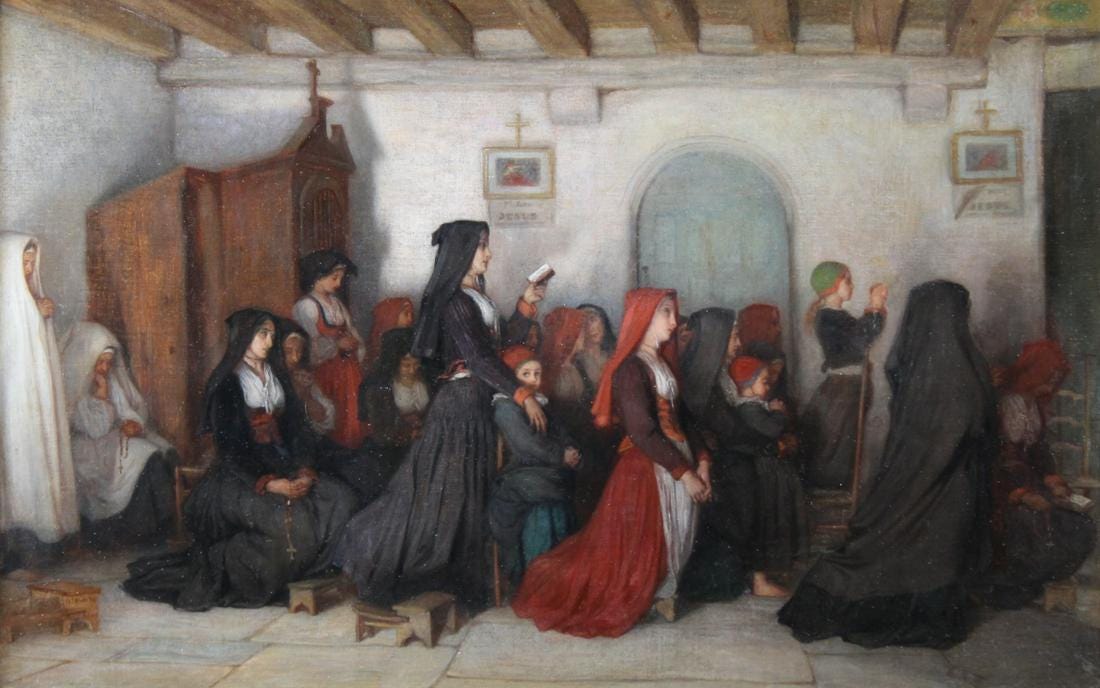
Henry Ossawa Tanner, American, (1859–1937)
Mary (La Sainte-Marie), c. 1898
Oil on canvas
34 1/8 x 42 5/8 in. (86.7 x 108.3 cm)
La Salle University Art Museum
In this rendering of the Virgin Mary with the Christ child, Mary appears melancholy and lost in thought. The infant is almost completely covered by a shroud-like cloth, suggesting a foreshadowing of Jesus’ death. Tanner paid careful attention to details studied first-hand in Jerusalem, where he first traveled in 1898. Tanner was painstaking when it came to detail and took back home with him sketches which he had made whilst in Jerusalem, where he first travelled in 1898.
Henry Ossawa Tanner (June 21, 1859 – May 25, 1937) was an American artist and the first African-American painter to gain international acclaim. Tanner moved to Paris, France, in 1891 to study, and continued to live there after being accepted in French artistic circles. His painting entitled Daniel in the Lions' Den (See below) was accepted into the 1896 Salon, the official art exhibition of the Académie des Beaux-Arts in Paris.
Henry Ossawa Tanner (1859-1937)
Daniel in the Lions' Den, c. 1907-1918
Oil on paper mounted on canvas
Height: 104.4 cm (41.1 in); Width: 126.8 cm (49.9 in)
Los Angeles County Museum of Art
At daybreak the king hurries to the place and cries out anxiously, asking if God had saved his friend. Daniel replies that his God had sent an angel to close the jaws of the lions, "because I was found blameless before him". The king commands that those who had conspired against Daniel should be thrown to the lions in his place with their wives and children, and that the whole world should tremble and fear before the God of Daniel. More on Daniel in the Lions' Den
Henry Ossawa Tanner
Moses in the Bullrushes, c. 1921
Oil on wood panel
22 3⁄8 x 15 1⁄8 in. (56.8 x 38.5 cm)
Smithsonian American Art Museum
After his own self-study in art as a young man, Tanner enrolled in 1879 at the Pennsylvania Academy of the Fine Arts in Philadelphia. The only black student, he became a favorite of the painter Thomas Eakins, who had recently begun teaching there. Tanner made other connections among artists, including Robert Henri. In the late 1890s he was sponsored for a trip to the Mutasarrifate of Jerusalem by Rodman Wanamaker, who was impressed by his paintings of biblical themes.
Henry Ossawa Tanner
Return from the Cross, circa 1934-1935
Tempera on board
39 7/8 x 29 7/8in
Private collection
“Return from the Cross is a triumph in execution that boldly exhibits Tanner's mastery of a unique painting technique that distinctly employed thick, textured applications of richly colored paint,” Bonhams American art specialist Aaron Anderson said in a statement. “The pure emotion that Tanner successfully imbued in his religious scenes resulted in paintings that remain universally captivating. His scarce number of works on the subject of the crucifixion of Jesus Christ are considered to be among Tanner’s best work.” Private collection
Tanner, Henry Ossawa
Return of the Holy Women
Oil on canvas
116.84 cm (46 in.) x 88.9 cm (35 in.)
Cedar Rapids Museum of Art
The holey women returning to the tomb of Christ were Mary Magdalene, Joanna, and Mary the mother of James; they and other women with them.
Henry Ossawa Tanner
The Three Marys, c. 1910
Oil on canvas
Fisk University, Nashville, TN
The Three Marys or Maries are women mentioned in the canonical gospel's narratives of the crucifixion and resurrection of Jesus, several of whom were, or have been considered by Christian tradition, to have been named Mary
Another woman who appears in the Crucifixion and Resurrection narratives is Salome, who, in some traditions, is identified as being one of the Marys, notwithstanding having a different name. In such cases, she is referred to as Mary Salome. More on The Three Marys
Henry Ossawa Tanner
The Two Disciples at the Tomb, c. 1906
Oil on canvas
129.5 × 105.7 cm (51 × 41 7/8 in.)
Art Institute of Chicago
The Two Disciples at the Tomb is one of the most concentrated and austere of these works. The somber spirituality of the moment when two of Jesus’s followers realize that he has risen from the dead is conveyed by Tanner’s use of dark tones and compressed space and his avoidance of superfluous detail. Although the artist painted in a relatively conservative representational manner throughout his life, the sinuous lines and simplified, harsh modeling here suggest his awareness of Art Nouveau and Expressionist currents in contemporary European painting. Likewise, his emphasis on psychological rather than physical experience has many parallels in advanced art of the same period, including Pablo Picasso’s early work, such as The Old Guitarist, painted two years earlier. More on this painting
Henry Ossawa Tanner was born in Pittsburgh, Pennsylvania. The family moved from Pittsburgh to Philadelphia when Tanner was young. When Tanner was about 13 years old, he saw a landscape painter working in Fairmount Park, where he was walking with his father. He decided that he wanted to be a painter.
Henry Ossawa Tanner
Flight into Egypt, circa 1910
Oil on linen canvas
23 1/4 x 37 in
Private collection
The flight into Egypt is a biblical event described in the Gospel of Matthew in which Joseph fled to Egypt with Mary and infant son Jesus after a visit by Magi because they learned that King Herod intended to kill the infants of that area. The episode is frequently shown in art, as the final episode of the Nativity of Jesus in art, and was a common component in cycles of the Life of the Virgin as well as the Life of Christ.
When the Magi came in search of Jesus, they go to Herod the Great in Jerusalem and ask where to find the newborn "King of the Jews". Herod becomes paranoid that the child will threaten his throne, and seeks to kill him. Herod initiates the Massacre of the Innocents in hopes of killing the child. But an angel appears to Joseph and warns him to take Jesus and his mother into Egypt.
Egypt was a logical place to find refuge, as it was outside the dominions of King Herod, but both Egypt and Israel were part of the Roman Empire, linked by a coastal road known as "the way of the sea", making travel between them easy and relatively safe. More on The flight into Egypt

Henry Ossawa Tanner (American, Pittsburgh, Pennsylvania 1859–1937 Paris)
Flight Into Egypt, c. 1923
Oil on canvas
29 x 26 in. (73.7 x 66 cm)
The Metropolitan Museum of Art
By the mid-1890s Tanner had shifted to more universal biblical themes familiar from his childhood; his father, Benjamin Tanner, was a bishop in the African Methodist Episcopal Church. To represent these stories, the artist developed an increasingly painterly, highly personal style based on direct observation and imagination. The subject of this work, which he depicted frequently, represents the Holy Family's escape from King Herod's assassins (Matthew 2:12–14). More on this painting
Although many artists refused to accept an African-American apprentice, in 1879 Tanner enrolled at the Pennsylvania Academy of the Fine Arts in Philadelphia, becoming the only black student. His decision to attend the school came at an exciting time in the history of artistic institutional training. Art academies had long relied on tired notions of study devoted almost entirely to plaster cast studies and anatomy lectures. This changed drastically with the addition of Thomas Eakins as "Professor of Drawing and Painting" to the Pennsylvania Academy. Eakins encouraged new methods, such as study from live models, direct discussion of anatomy in male and female classes, and dissections of cadavers to further familiarity with and understanding of the human body. Eakins's teaching and progressive approach to art education had a profound effect on Tanner. The young artist was one of Eakins' favorite students; two decades after Tanner left the Academy, Eakins painted his portrait.
Henry Ossawa Tanner (1859–1937)
Sodom and Gomorrha, circa 1920
Oil on canvas
Height: 41.1 in (104.4 cm); Width: 36.2 in (92 cm)
I have no further description, at this time
Lot was a patriarch in the biblical Book of Genesis. Notable episodes in his life include his travels with his uncle Abram (Abraham), his flight from the destruction of Sodom and Gomorrah, during which Lot's wife became a pillar of salt, and the seduction by his daughters so that they could bear children.
Lot, his wife, and two daughters are saved when God sends two angels to make sure they are out of Sodom before the city is punished for their wicked ways. Lot's request to have the family flee to the nearby small town of Zoar, instead of the mountains, is granted (Genesis 19:18 - 22). As they came into Zoar, God brought brimstone and fire upon the two sinful cities and totally cleansed the land of their existence. More on Lot
Henry Ossawa Tanner (1859–1937)
Sodom and Gomorrah, circa 1920-24
Oil on canvas
41 1/2 x 36 1/2 inches
Michael Rosenfeld Gallery LLC, New York, N.Y.
Henry Ossawa Tanner, American, 1859–1937
Destruction of Sodom and Gomorrah, c. 1929–1930
Tempera and varnish on cardboard
20 3/8 x 36 inches
High Museum of Art, Atlanta, Georgia
Tanner painted Destruction of Sodom and Gomorrah after two trips to Palestine. He used his favorite hue, the distinctive greenish-blue color dominating the sky, to portray the smoky conflagration engulfing the two cities. The painting’s abstraction and simplicity of form evoke a sense of interaction between the physical and spiritual worlds. Tanner downplays the presence of Lot and his daughters, barely visible at the lower right. His blend of tempera and oil unifies the composition and imparts an almost unearthly luminosity. More on this painting
In this version of the Old Testament story of Sodom and Gomorrah, Tanner used layers of varnish and greenish blue tempera, the color he considered the most pure and spiritual.
Henry Ossawa Tanner
Salome, ca. 1900
Oil on canvas
45 7⁄8 x 35 1⁄4 in. (116.5 x 89.4 cm.)
Smithsonian American Art Museum
Salome stands out from Henry Ossawa Tanner’s other religious images, which are more conservative than this provocative painting. Salome’s demand for the head of John the Baptist is one of the most lurid stories in the Bible. She dances for her stepfather, who rewards her beauty by giving her the prophet’s head on a platter. Here, Tanner presented Salome in a revealing gown, emphasizing her sensuality. The yellow shape in the lower left of the image, marked with red paint, suggests the corpse of John the Baptist. More on this painting
At the Academy Tanner befriended artists with whom he kept in contact throughout the rest of his life, most notably Robert Henri, one of the founders of the Ashcan School. During a relatively short time at the Academy, Tanner developed a thorough knowledge of anatomy and the skill to express his understanding of the weight and structure of the human figure on the canvas.
In the hope of earning enough money to travel to Europe, Tanner operated a photography studio in Atlanta during the late 1880s. The venture was unsuccessful. During this period Tanner met Bishop Joseph Crane Hartzell, a trustee of Clark College. Hartzell and his wife befriended Tanner, became his patrons, and recommended him for a teaching job at the college. Tanner taught drawing at Clark College for a short period.
Henry Ossawa Tanner
Crossing the Atlantic (Return Home), c. 1894
Location
Watercolor and pencil on paper mounted on paperboard
9 7⁄8 x 13 1⁄2 in. (25.2 x 34.2 cm)
Smithsonian American Art Museum
In 1891 he traveled to Paris, France, to study at the Académie Julian. He also joined the American Art Students Club. Paris was a welcome escape for Tanner; within French art circles, race mattered little. Tanner acclimated quickly to Parisian life. There he met Atherton Curtis who became a friend and a patron of his art.
Henry Ossawa Tanner
Portrait of Mr. and Mrs. Atherton Curtis with Still Life
Oil on plywood
26 5⁄8 x 28 7⁄8 in. (67.6 x 73.3cm.)
Smithsonian American Art Museum
Atherton Curtis was a wealthy American living in France who made his fortune in medicine patents. The couple, who supported many artists, met Henry Ossawa Tanner in 1897 and became ardent supporters of his art. Tanner later used the composition of this portrait in a painting of Christ sitting down to dinner with Lazarus and his sister. More on this painting
Henry Ossawa Tanner
Study for Portrait of Mrs. Atherton Curtis
18 3⁄4 x 20 in. (47.6 x 50.8 cm)
Smithsonian American Art Museum
Henry Ossawa Tanner (1859–1937)
The Young Sabot Maker, c. 1895
Oil on canvas
Height: 120.3 cm (47.3 in); Width: 89.8 cm (35.3 in)
The Nelson-Atkins Museum of Art
During his first summer in France, Tanner traveled to the village of Pont-Aven on Brittany's coast. Brittany was a popular destination for artists, and Tanner became fascinated with his rural French surroundings. Tanner returned to Philadelphia in 1892, and it was there in 1893 that he began work on The Young Sabot Maker, when he made a number of preliminary studies.
The figures in The Young Sabot Maker exist within a humble, timeless interior, seemingly apart from the modern world. Within the composition, Tanner emphasized the inherent dignity and ennobling effect of work, More on The Young Sabot Maker
Henry O. Tanner
The Banjo Lesson, c. 1893
Oil on canvas
Height: 49 in (124.4 cm); Width: 35.5 in (90.1 cm)
Hampton University, Hampton, VA
The Banjo Lesson shows the scene of a grandfather teaching his grandson how to play the banjo. Tanner painted this scene while visiting his home state of Pennsylvania. The Banjo Lesson focuses on a specific situation and place in time in an everyday scene. The grandfather and his grandson are meant to be specific people, avoiding a generalization of all blacks. The skill used to paint the characters and scene of the painting make it obvious that Tanner is attempting to show a specific pair of real people. Through its specificity, the painting intentionally avoids the long running stereotype that blacks who played instruments were only jokes included in minstrel shows. More on this painting
Henry Ossawa Tanner (1859–1937)
The Thankful Poor, c. 1894
Oil on canvas
Height: 90.1 cm (35.5 in); Width: 112.4 cm (44.2 in)
Private collection
The Thankful Poor is an 1894 genre painting by African-American painter Henry Ossawa Tanner. It depicts two African Americans praying at a table, and shares common themes with Tanner's other paintings from the 1890s including The Banjo Lesson (1893) (See above) and The Young Sabot Maker (1895) (See above). The work is based on photographs Tanner had taken, and is influenced by his views on education and race, which were in turn derived from those of his father, Benjamin Tucker Tanner, and the African Methodist Episcopal Church. The painting is considered a milestone in African-American art, notably for its countering of racial stereotypes. More on this painting
Tanner continued his studies under renowned artists such as Jean Joseph Benjamin Constant and Jean-Paul Laurens. With their guidance, Tanner began to establish a reputation in France. He settled at the Étaples art colony in Normandy.
Henry Ossawa Tanner
Mary, ca. 1914
Oil on canvas
45 1⁄2 x 34 3⁄4 in. (115.5 x 88.2 cm.)
Smithsonian American Art Museum
Henry Ossawa Tanner saw Mary, mother of Jesus, as a symbol of faith and fortitude. He painted many images of her and created this particular work during a difficult and trying time in his life. In 1914, the year his mother died, the outbreak of World War I forced his family to flee France for England. In this scene, Mary awaits the arrival of the angel who will tell her that she bears the Son of God. The glowing lamp, a symbol of God’s presence, adds mystery and suspense to the painting. More on this painting
Henry Ossawa Tanner, American (active France), 1859 - 1937
The Annunciation, c. 1898
Oil on canvas
57 × 71 1/4 inches (144.8 × 181 cm)
Philadelphia Museum of Art
The Annunciation referred to as the Annunciation to the Blessed Virgin Mary, the Annunciation of Our Lady, or the Annunciation of the Lord, is the Christian celebration of the announcement by the angel Gabriel to the Virgin Mary that she would conceive and become the mother of Jesus, the Son of God, marking his Incarnation. Gabriel told Mary to name her son Yehoshua , meaning "YHWH is salvation".
According to Luke 1:26, the Annunciation occurred "in the sixth month" of Elizabeth's pregnancy. Many Christians observe this event with the Feast of the Annunciation on 25 March, an approximation of the northern vernal equinox nine full months before Christmas, the ceremonial birthday of Jesus. In England, this came to be known as Lady Day. It marked the new year until 1752. The 2nd-century writer Irenaeus of Lyon regarded the conception of Jesus as 25 March coinciding with the Passion.
More The Annunciation
Tanner painted The Annunciation soon after returning to Paris from a trip to Egypt and Palestine in 1897.
Henry Ossawa Tanner (1859–1937)
The Annunciation to the Shepherds, circa 1895
Oil on canvas
Height: 32.5 cm (12.7 in); Width: 40 cm (15.7 in) . (12.8 x 15.7 in.)
Private collection
Shepherds were tending their flocks out in the countryside near Bethlehem, when they were terrified by the appearance of an angel. The angel explains that he has a message of good news for all people, namely that "Today in the town of David a Savior has been born to you; he is the Messiah, the Lord. This will be a sign to you: You will find a baby wrapped in cloths and lying in a manger. More on the Annunciation to the Shepherds
Earlier, Tanner had painted marine scenes of man's struggle with the sea, but by 1895 he was creating mostly religious works. His shift to painting biblical scenes occurred as he was undergoing a spiritual struggle. In a letter he wrote to his parents on Christmas 1896, he stated, "I have made up my mind to serve Him [God] more faithfully." A transitional work from this period is the recently rediscovered painting of a fishing boat tossed on the waves, which is held by the Smithsonian American Art Museum.
Henry Ossawa Tanner
Fishermen at Sea, ca. 1913
Oil on canvas
46 x 35 1⁄4 in. (116.9 x 89.5 cm.)
Smithsonian American Art Museum
In this painting, Tanner depicted a passage described in the book of Matthew: “But the boat was now in the middle of the sea, tossed by the waves, for the wind was contrary.” The surging sea pushes the boat to an almost vertical position, revealing the fishermen that Tanner rendered as dabs of paint. More on this painting
Henry Ossawa Tanner (1859–1937)
The Disciples See Christ Walking on the Water, circa 1907
Oil on canvas
51.5 x 42 in
Des Moines Art Center
This is based on the description of a miracle in the Gospel of Matthew in which "the boat was now in the middle of the sea, tossed by the waves, for the wind was contrary" (14:24). The simple resources at Étaples were well adapted to his subject matter, which in several cases featured biblical figures in dark interiors.
Henry Ossawa Tanner (American, 1859 - 1937)
Christ Learning to Read, ca. 1911
Oil on canvas
50 × 38 5/8 in. (127 × 98.1 cm.)
Henry Ossawa Tanner (1859–1937)
Christ and His Mother Studying the Scriptures, circa 1909
Oil on canvas
Height: 123.8 cm (48.7 in); Width: 101.6 cm (40 in)
Dallas Museum of Art
The figures of Christ and Mary clasp each other tenderly as they each hold the scroll from which they read, their physical bond an outward acknowledgment of their spiritual unity. Henry Ossawa Tanner's lush, densely painted surface is restricted to shades of blue, purple, and gold, bathing the figures in a warm, golden light, a metaphor for the illumination gleaned from the scroll. Thanks to existing photographs, we know that Tanner used his wife and son as models for Mary and Jesus, giving the work a double resonance as both a meditative biblical scene and a tender family portrait. More on this painting
Jessie Macauley Olssen and son Photograph
I have no further description, at this time
Jessie Macauley Olssen and their seven-year-old son Jesse posed for a photograph which Tanner would use for his 1909 painting, Christ and His Mother Studying the Scriptures
Henry Ossawa Tanner
Portrait of the Artist’s Wife, c. 1897?
Oil on fiberboard
22 3⁄8 x 18 7⁄8 in. (56.8 x 47.9 cm.)
Smithsonian American Art Museum
Jessie Macauley Olssen first met Henry Ossawa Tanner in Barbizon, France. They married in Paris in 1899 and had one child together. In this portrait, Mrs. Tanner is shown in a highly studied pose meant to look informal and casual. Tanner painted Jessie’s face with greater detail than her dress, which he painted in a loose, unfinished manner. More on this painting
Tanner's painting Daniel in the Lions' Den (See above) was accepted into the 1896 Salon. Later that year he painted The Resurrection of Lazarus. The critical praise for this piece solidified Tanner's position in the artistic elite and heralded the future direction of his paintings, which treated mostly biblical themes. Upon seeing The Resurrection of Lazarus (See below), art critic Rodman Wanamaker offered to pay all the expenses for a journey by Tanner to the Middle East. Wanamaker felt that any serious painter of biblical scenes needed to see the environment firsthand and that a painter of Tanner's caliber was well worth the investment.
Tanner, Henry Ossawa, (United States) 1859 - Paris (France) 1937
The Resurrection of Lazarus, c. 1896
Oil on canvas
H. 94.7; L. 120.5 cm.
Orsay museum, Paris, France
The Raising of Lazarus or the Resurrection of Lazarus, mentioned only in the Gospel of John, is a miracle of Jesus in which Jesus brings Lazarus of Bethany back to life four days after his burial. According to American theologian J P Dabney, "the usual reason assigned for the omission of so remarkable a story, as that of the resurrection of Lazarus by the other three Evangelists, is that he might still be living, when they wrote, and that a circumstantial account of this event, would have exposed him to the resentment of the unbelieving Jews, but John's Gospel was later by many years: in which long interval Lazarus' death was not unlikely to have occurred" More on the Resurrection of Lazarus
Henry Ossawa Tanner
He Healed the Sick, ca. 1930
Oil on wood
16 1⁄4 x 21 1⁄2 in. (41.3 x 54.5 cm)
Smithsonian American Art Museum
Henry Ossawa Tanner
Disciples Healing the Sick, c.1930
Oil on cardboard
Clark Atlanta University Art Galleries
Tanner quickly accepted the offer. Before the next Salon opened, he set forth for the Palestine region of the Levant. Explorations of various mosques and biblical sites, as well as character studies of the local population, allowed him to further his artistic training. His paintings developed a powerful air of mystery and spirituality. Tanner was not the first artist to study the Middle East in person: since the 1830s, interest in Orientalism had been growing in Europe. Artists such as Eugène Delacroix, David Roberts and, later, Henri Matisse made such tours to capitalize on this curiosity.
Henry Ossawa Tanner
The Savior, ca. 1900-1905
Oil on canvas mounted to plywood
29 1⁄8 x 21 3⁄4 in. (73.9 x 55.3 cm)
Smithsonian American Art Museum
The Savior shows Jesus meditating as he waits for his crown of thorns and purple robe, in which he would be mocked as the “King of the Jews.” Tanner portrayed him as a real person in contemplation and prayer rather than as an idealized figure. But the yellow color in his face and outlining his profile is like a glowing light that suggests Christ’s uniqueness as a spiritual being, able to transcend flesh and blood. More on this painting
In his adopted home of France, in 1923 Tanner was appointed Chevalier of the Legion of Honor, the highest national order of merit. He considered this "citation by the French government to be the greatest honor of his illustrious career."
Henry O. Tanner, (1859-1937)
Christ and Nicodemus on a Rooftop of 1899
Oil on canvas
33 11/16 x 39 1/2 in. (85.6 x 100.3 cm.)
ennsylvania Academy of the Fine Arts
Henry Ossawa Tanner (1859-1937)
Nicodemus Coming to Christ, c. 1927
Oil on canvas laid down on board
61¼ x 71 in. (155.6 x 180.3 cm.)
Private collection
Completed in 1927, the year that Henry Ossawa Tanner was elected a full academician in the National Academy of Design, Nicodemus Before Christ is a powerful masterwork that is exemplary of the distinctive, personal style of the artist's finest paintings.
Nicodemus Before Christ is an outdoor scene, depicting the two seated men speaking, set against a distant, vast landscape. The only source of light in the composition comes from the building to the far right of the composition. Tanner masterfully combines rich blues and greens to capture the evening atmosphere and imbue the work with an air of hushed secrecy. The highly worked surface, with its thick paint application, is characteristic of the artist's mature work and further enhances the sense that the scene is cloaked by the night. The masterfully developed figures are monumentalized while the distant landscape gives the work a sense of depth. More on this painting
Tanner was not limited to one specific approach to painting and drawing. His works reflect at times meticulous attention to detail and loose, expressive brushstrokes in others. Often both methods are employed simultaneously. Tanner was also interested in the effects that color could have in a painting. Warmer compositions such as The Resurrection of Lazarus (1896) (See above), and The Annunciation (1898) (See above) express the intensity and fire of religious moments, and the elation of transcendence between the divine and humanity. Other paintings emphasize cool hues, which became dominant in his work after the mid-1890s. A palette of indigos and turquoise—referred to as the "Tanner blues"—characterizes works such as The Three Marys (1910) (See above), Gateway (1912) (See below) and The Arch (1919) (See below). Works such as The Good Shepherd (1903) (See below) and Return of the Holy Women (1904) (See above) evoke a feeling of somber religiosity and introspection.
Henry Ossawa Tanner (1859–1937)
Gateway, Tangier, circa 1912
Oil on canvas
Height: 46.8 cm (18.4 in); Width: 38.9 cm (15.3 in)
Saint Louis Art Museum
During a 1912 trip to Tangier, Morocco, Tanner became fascinated with this gateway—the entrance to the casbah, or the historic city area and fortress—and he proceeded to paint the gateway from many perspectives and vantage points. More on this painting
Tanner often experimented with light in a composition. The source and intensity of light and shadow in his paintings create a physical, almost tangible space and atmosphere while adding emotion and mood to the environment. Tanner also used light to add symbolic meaning to his paintings. In The Annunciation (1898) (See above) the archangel Gabriel is represented as a column of light that forms, together with the shelf in the upper left corner, a cross. This view of the representation of Gabriel is consistent with James Romaine's comment that "Through the visual language of her pose and expression Tanner draws the viewer into Mary's inner life of virtue, trepidation, acceptance, and wonderment." Mary's acceptance includes her acceptance of the cross that she will have to bear by consenting to be the Lord's handmaid (Luke 1:38).
Henry Ossawa Tanner, American, 1859-1937
The Arch, c. 1919
Oil on canvas
39 1/4 x 38 3/16 in. (99.7 x 97 cm)
Brooklyn Museum
Tanner painted this scene of the Arc de Triomphe in Paris during a memorial celebration on July 13th 1919 for those who died fighting for France in the First World War. A cenotaph erected for the observation can be seen through the Parisian arch.
During World War I, Tanner worked for the Red Cross Public Information Department, during which time he also painted images from the front lines of the war. His works featuring African-American troops were rare during the war.
Henry Ossawa Tanner
The Good Shepherd (Atlas Mountains, Morocco), ca. 1930
Oil on fiberboard
29 7⁄8 x 36 in. (75.8 x 91.3 cm)
Smithsonian American Art Museum
In 1912, Henry Ossawa Tanner traveled to Morocco to see the Atlas Mountains. In this painting he downplayed the story in favor of the impressive landscape itself. Tanner’s son Jesse remembered that The Good Shepherd was his father’s favorite subject. The artist believed that “God needs us to help fight with him against evil and we need God to guide us” (Jesse Tanner in Mathews, Henry Ossawa Tanner, American Artist, 1969). More on this painting
Several of Tanner's paintings were purchased by Atlanta art collector J. J. Haverty, who founded Haverty Furniture Co. and was instrumental in establishing the High Museum of Art. Tanner's Étaples Fisher Folk is among several paintings from the Haverty collection now in the High Museum's permanent collection.
Tanner died peacefully at his home in Paris, France, on May 25, 1937.[33] He is buried at Sceaux Cemetery in Sceaux, Hauts-de-Seine, which is a suburb of Paris. More on Henry Ossawa Tanner
Please visit my other blogs: Art Collector, Mythology, Marine Art, Portrait of a Lady, The Orientalist, Art of the Nude and The Canals of Venice, Middle East Artists, 365 Saints, 365 Days,
and Biblical Icons,
also visit my Boards on Pinterest and deviantart
Images are copyright of their respective owners, assignees or others.
Some Images may be subject to copyright
I don't own any of these images - credit is always given when due unless
it is unknown to me. if I post your images without your permission, please tell
me.
I do not sell art, art prints, framed posters or reproductions. Ads are
shown only to compensate the hosting expenses.
If you enjoyed this post, please share with friends and family.
Thank you for visiting my blog and also for liking its posts and pages.
Please note that the content of this post primarily consists of articles
available from Wikipedia or other free sources online.
.jpg)