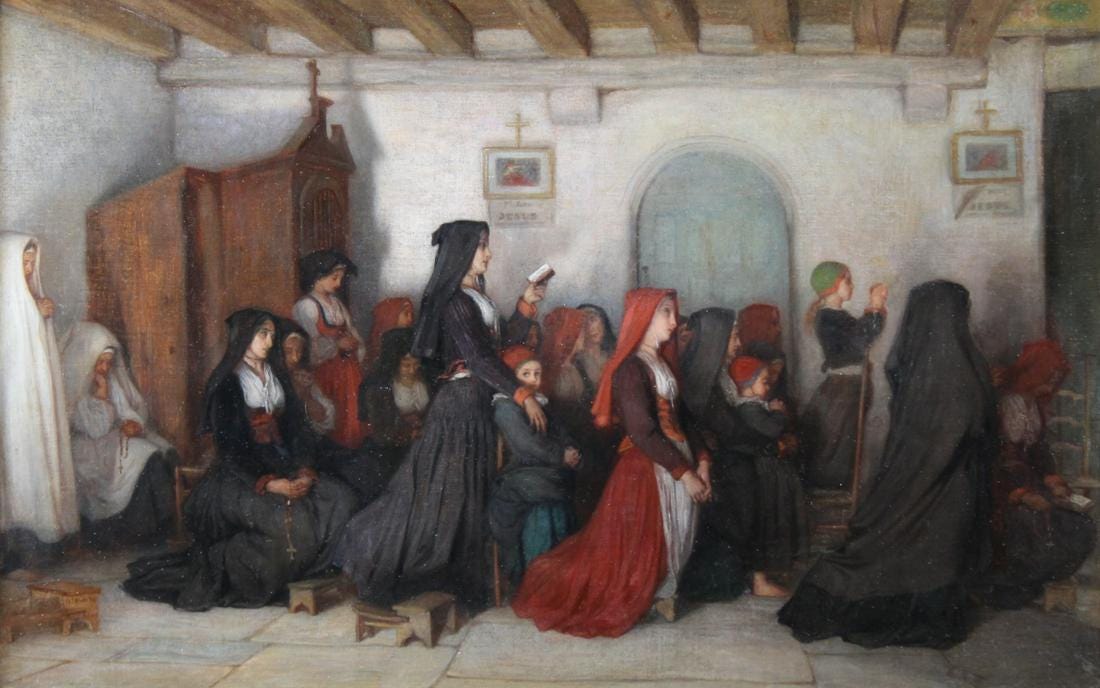
Reyer Jacobs van Blommendael
The Good Samaritan, c. 1665
104.1 x 147.3 cm
Oil on canvas
Agnes Etherington Art Centre, Queen's University, Kingston
The parable of the Good Samaritan is a didactic story told by Jesus in Luke 10:25–37. It is about a traveler who is stripped of clothing, beaten, and left half dead alongside the road. First a priest and then a Levite comes by, but both avoid the man. Finally, a Samaritan comes by. Samaritans and Jews generally despised each other, but the Samaritan helps the injured man. Jesus is telling the parable in response to the question from a lawyer, "And who is my neighbour?" whom that should be loved. Jesus answers his question in who is his neighbour, but also tells him to love his neighbour.
The parable has inspired painting, sculpture, satire, poetry, and film. The colloquial phrase "good Samaritan", meaning someone who helps a stranger, derives from this parable, and many hospitals and charitable organizations are named after the Good Samaritan. More on the Good Samaritan
Reyer van Blommendael (1628–1675)
St. Bavo saves Haarlem in 1274, c. 1673
Height: 144 cm (56.6 in); Width: 213 cm (83.8 in)
Frans Hals Museum
This painting depicts a Haarlem legend dating from that time. It was painted in 1673 when stories about knights were very popular and Haarlem was eager to show its patron Saint as a courageous knight. This painting shows many similarities with the Santiago Matamoros legend, that gained popularity at about the same time. The painting was commissioned exactly 100 years after the siege of Haarlem. The painting is not historically accurate, since Haarlem was not a walled city until the late middle ages. The view shown of Haarlem from the west is accurate for 1673 however. More on this painting
St. Bavo, also called Allowin, was a nobleman, and native of Hesbaye. After having led a very irregular life he was left a widower, and was moved to conversion to God by a sermon. Going home he distributed all his money among the poor, and went to the monastery at Ghent. St. Bavo seemed to have accompanied St. Amand on his missionary journeys in France and Flanders.
St. Amand after some time gave him leave to lead an eremitical life, and he is said first to have chosen for his abode a hollow trunk of a large tree, but afterward, built himself a cell at Mendonck, where vegetables and water were his chief subsistance. Bavo at length returned to the monastery at Ghent, where he built himself a new cell in a neighboring wood, where he lived a recluse until the end of his life. More on St. Bavo
Little is known about the life of Reyer Jacobsz van Blommendael except for a few details gleaned from documents concerning a certain Risje van Blommendael, who was a wealthy resident of Haarlem. For instance, a notarial deed drawn up in Haarlem in 1676 reveals that she had a brother called Reyer who was a painter. On 27 June 1628, a Reyer was baptised in the Nieuwe Kerk in Amsterdam: he was the son of Jacob Reijersz and Grietje Jans. This may well have been the child who grew up to be our painter, as two years earlier a girl by the name of Risje, the daughter of Jacob Reijersz and Grietje Reijners, had been baptised in the same church.
Reyer Jacobsz. van Blommendael (Dutch, b. ca. 1628–1675)
Diana with her Nymphs returning from the hunt
Oil on Canvas
122.5 x 162.4 cm. (48.2 x 63.9 in.)
Private collection
It is not known who taught Van Blommendael. Goudstikker thought his style was probably influenced by a trip to Italy. We do know that he joined the Haarlem Guild of St Luke on 14 March 1662, for which he paid a fee of four guilders and ten stuivers. There is also an entry in the guild ledger from September 1663 concerning the payment of two guilders and twenty stuivers 'to the children's home for Reijer van Blommendael'. He was still recorded as a member of the guild in 1668.
Reyer van Blommendael (1628–1675)
Xantippe Dousing Socrates, c. 1655
Oil on canvas
210 x 198 cm
Musée des Beaux-Arts, Strasbourg
This painting was formerly ascribed to Jan Victors, the Caesar van Everdingen. Its attribution changed very recently to Reyer van Blommendael.
The theme of this picture is unique in painting. The philosopher Socrates sits on the right on two steps that form a horizontal stone 'entrance' to the scene. This is a common device in work by the Haarlem classicists from after 1625. The shabbily dressed Socrates wears rags wrapped around his legs and secured with pieces of string. Socrates can be identified by his irregular features and his motto which is carved in Greek letters on the stone slab on which he leans. He pays no heed whatsoever as his wife Xantippe scolds him and proceeds to empty the contents of a vessel over his head.
Van Blommendael was probably influenced by a print depicting the same subject by Otto van Veen in 1606. An earlier illustration of a woman humiliating her husband by dousing him with the content of a vessel can be found in Dürer's painting of Job and His Wife from c. 1504. More on this painting
Attributed to Reyer Jacobsz van Blommendael (Dutch, 1628 - 1675)
Shepherd and Sleeping Shepherdess, c. about 1650–1660
Oil on canvas
121 × 156.8 cm (47 5/8 × 61 3/4 in.)
Getty Center
When the Persian princess Granida met the shepherd Daifilo and the shepherdess Dorilea resting in the woods, Daifilo fell in love with Granida at first sight. Oddly enough, Granida does not appear in this painting; she may have appeared at the left and was cut from the painting subsequently, or she may have appeared in a pendant painting.
All of Utrecht's leading artists painted scenes from the popular Dutch pastoral play Granida, written in about 1605. Hendrick Ter Brugghen here employed his characteristic low viewpoint, monumental figures, pale pastel color scheme, pinkish-red noses, and smooth surfaces. Responding to Caravaggio's influence, the artist presented the scene up close, dramatically illuminated by a broad beam of light from the left. But instead of Caravaggio's dark tones, he used delicate colors typical of his teacher Abraham Bloemaert's palette. More on this painting
Reyer van Blommendael (1628–1675) Paris and Oenone, c. 1655
Oil on canvas
123 x 110 cm
Palais des Beaux-Arts, Lille
Paris was the son of Priam, king of Troy. At his birth it was prophesied that he would bring ruin upon Troy. He was therefore left exposed to die on the slopes of Mt Ida, but was rescued and brought up by shepherds. He was loved by Oenone, a Naiad, or nymph of fountains and streams. But he deserted her for Helen, the Spartan queen, whom he forcibly carried off to Troy, thus bringing about the Troyan war and fulfilling the prophecy made at his birth.
Paris in this painting points at the inscription he has carved in the bark of a tree. He holds Oenone's hand while she reads the words with him.
The Paris and Oenone is one of three painting that bear Van Blommendael's mark. They show women of very similar features. More on this painting Reyer Jacobsz. van Blommendael
Vertumnus and Pomona
Oil on canvas
113,5 x 102,1 cm
Private collection
Pomona was a goddess of fruitful abundance in ancient Roman religion and myth. Her name comes from the Latin word pomum, "fruit," specifically orchard fruit. She was said to be a wood nymph.
Pomona scorned the love of the woodland gods, but married Vertumnus after he tricked her, disguised as an old woman. She and Vertumnus shared a festival held on August 13. The pruning knife was her attribute. There is a grove that is sacred to her called the Pomonal, located not far from Ostia, the ancient port of Rome.
Unlike many other Roman goddesses and gods, she does not have a Greek counterpart. She watches over and protects fruit trees and cares for their cultivation. She was not actually associated with the harvest of fruits itself, but with the flourishing of the fruit trees. In artistic depictions she is generally shown with a platter of fruit or a cornucopia. More on Pomona
On 20 February 1663, Van Blommendael was consulted to value the contents of a household in Haarlem. A few more facts emerge from other notarial deeds drawn up by Risje van Blommendael, for instance that he was living in Amsterdam in 1669. On 10 March 1675, Risje appointed him as the executor other will, describing him as a 'master painter residing in The Hague'. In 1676, she sold a house in Aelbersberg (known today as Bloemendaal) to a cousin of hers. The deed mentions that Reyer had lived in the house and that their father, Jacob Reyersz, was a bleacher by profession.
Reyer Jacobsz. van Blommendael (Dutch, b. ca. 1628–1675)
Saul's crown and bracelet are presented to David
Oil on Canvas
215 x 265 cm. (84.6 x 104.3 in.)
Private collection
A man came from Saul’s camp with his clothes torn and dust on his head. So David said to the young man who told him, “How do you know that Saul and Jonathan his son are dead?” Then the young man who told him said, “As I happened by chance to be on Mount Gilboa, there was Saul, leaning on his spear; and indeed the chariots and horsemen followed hard after him. Now when he looked behind him, he saw me and called to me. And I answered, ‘Here I am.’ And he said to me, ‘Who are you?’ So I answered him, ‘I am an Amalekite.’ He said to me again, ‘Please stand over me and kill me, for anguish has come upon me, but my life still remains in me.’ So I stood over him and killed him, because I was sure that he could not live after he had fallen. And I took the crown that was on his head and the bracelet that was on his arm, and have brought them here to my lord.” More on Saul's crown and bracelet

Attributed to Reyer Jacobsz Van Blommendael
Judith preparing herself to meet Holofernes
Oil on canvas
48¼ x 54 7/8 in. (122.5 x 139.3 cm.)
Private collection
The Book of Judith is the Old Testament of the Bible. The story revolves around Judith, a daring and beautiful widow, who is upset with her Jewish countrymen for not trusting God to deliver them from their foreign conquerors. She goes with her loyal maid to the camp of the enemy general, Holofernes, with whom she slowly ingratiates herself, promising him information on the Israelites. Gaining his trust, she is allowed access to his tent one night as he lies in a drunken stupor. She decapitates him, then takes his head back to her fearful countrymen. The Assyrians, having lost their leader, disperse, and Israel is saved. Though she is courted by many, Judith remains unmarried for the rest of her life. More on The Book of Judith
Reyer Jacobsz Van Blommendael
Lot and his Daughters
Oil on canvas
Musee des Beaux-Arts, Dunkirk, France
Lot and his two daughters, Genesis 19:30-38, left Zoar and settled in the mountains, for he was afraid to stay in Zoar. He and his two daughters lived in a cave. One day the older daughter said to the younger, “Our father is old, and there is no man around here to give us children—as is the custom all over the earth. 32 Let’s get our father to drink wine and then sleep with him and preserve our family line through our father.”
That night they got their father to drink wine, and the older daughter went in and slept with him. He was not aware of it when she lay down or when she got up.
The next day the older daughter said to the younger, “Last night I slept with my father. Let’s get him to drink wine again tonight, and you go in and sleep with him so we can preserve our family line through our father.” So they got their father to drink wine that night also, and the younger daughter went in and slept with him. Again he was not aware of it when she lay down or when she got up.
So both of Lot’s daughters became pregnant by their father. The older daughter had a son, and she named him Moab; he is the father of the Moabites of today. The younger daughter also had a son, and she named him Ben-Ammi; he is the father of the Ammonites of today. More Lot and his two daughters

Blommendael, Reyer Jacobsz. van. 1628-1675
Moses Striking Water from the Rock, c.1662
Oil on canvas
154х163 cm
The State Hermitage Museum
There is a water crisis, and God commands Moses to draw water from the rock. Moses fails to sanctify God name and strikes the rock instead. God punishes him by not allowing him to enter the Land of Israel.
The exact chain of events, what Moses' wrongdoing was, and a host of other details are unclear, and the story of Moses hitting the rock has baffled many a student for thousands of years. More on Moses Striking Water from the Rock

Reyer Jacobsz Van Blommendael
The Holy Family with the Infant St. John the Baptist
Oil on canvas
125 x 107 cm
Private collection
Reyer Jacobsz. van Blommendael
The meal at Emmaus, ca. 1650
Oil on canvas
131 x 178 cm
Private collection
Emmaus is mentioned in the Gospel of Luke as the village where Jesus appeared to his disciples after his crucifixion and resurrection. Luke 24:13-35 indicates that Jesus appears after his resurrection to two disciples who are walking from Jerusalem to Emmaus, which is described as being 60 stadia (10.4 to 12 km depending on what definition of stadion is used) from Jerusalem. One of the disciples is named Cleopas. More on Emmaus
Reyer Jacobsz Van Blommendael
Paul preaches
Perhaps preaching of Paul and Silas to the women of Philippi
Oil on canvas
121,9 x 144,8 cm
Private collection
Lydia and Paul first met outside the gates of Philippi, a city in Macedonia. Lydia lived and worked in Philippi, dealing in textiles colored with the purple dye for which the region was famous. Her wealth allowed her to live independently in a spacious house.
She was also a religious seeker. Though she was a Gentile by birth, Lydia worshipped the God of the Jews. When Paul saw her, she was with a group of devout women who gathered to pray at a place by the river just outside the city. More on Lydia and Paul
Van Blommendael was buried in the St Bavokerk in Haarlem on 23 November 1675. The costs of the funeral, which amounted to 25 guilders, suggest he had been reasonably well off. Risje van Blommendael was buried in the same grave seven years later, on 3 January 1682.
Reyer Jacobsz. van Blommendael, Dutch, 1628–1675
A Young Woman in Arcadian Costume, ca. 1650
Oil on canvas
76.2 × 64.1 cm (30 × 25 1/4 in.)
The Yale University Art Gallery
Van Blommendael's extant oeuvre consists of a few pastoral scenes, history paintings and half-length figures making music. There is no evidence that he earned a living from his work. His individualistic style is easy to identify on the basis of three signed paintings. His work evokes associations with the Utrecht Caravaggists as well as the Haarlem classicists, particularly Caesar van Everdingen. A few of his paintings were previously misattributed to Abraham Bloemaert, Jan Gerritsz van Bronchorst, Caesar van Everdingen, Gerard van Honthorst and Johannes Vermeer. More on Reyer Jacobsz van Blommendael
Please visit my other blogs: Art
Collector, Mythology, Marine
Art, Portrait of a Lady, The
Orientalist, Art of the Nude and The
Canals of Venice, Middle
East Artists, 365
Saints and 365 Days, also visit my Boards on Pinterest
Images are copyright of their respective owners, assignees or others.
Some Images may be subject to copyright
I don't own any of these images - credit is always given when due unless
it is unknown to me. if I post your images without your permission, please tell
me.
I do not sell art, art prints, framed posters or reproductions. Ads are
shown only to compensate the hosting expenses.
If you enjoyed this post, please share with friends and family.
Thank you for visiting my blog and also for liking its posts and pages.
Please note that the content of this post primarily consists of articles
available from Wikipedia or other free sources online.