Benjamin West, American, 1738-1820
Death on the Pale Horse, c. 1796
Oil on canvas
23 3/8 × 50 5/8 inches (59.4 × 128.6 cm)
Detroit Institute of Arts
The title of this painting is taken from the final book of the Bible, the Revelation of Saint John the Divine, which has often been interpreted as a symbolic description of warfare: “And I looked, and behold a pale horse: and his name that sat on him was Death, and Hell followed with him. And Power was given unto them over the fourth part of the earth to kill with the sword, and with hunger, and with death, and with the beasts of the earth” (Rev. 6:8).
In this horrifying chronicle of the destruction of humankind, the rugged irregular forms, the dramatic contrasts of light and dark, and the dynamism of the turbulent movement combine with the distorted faces and pitiful gestures of the dead and dying to convey a sense of terror. The violent furor exhibits a destructive dynamism that makes this one of the most awesome depictions of the methods by which a world may be annihilated.
In 1796, the year this work was painted, England was at war with revolutionary France, and West’s picture may have been intended to comment on what was happening, or was expected to happen, in the contemporary world. More on this painting
Benjamin West, PRA (October 10, 1738 – March 11, 1820) was a British-American artist who painted famous historical scenes such as The Death of Nelson (See below), The Death of General Wolfe (See below), the Treaty of Paris (See below), and Benjamin Franklin Drawing Electricity from the Sky (See below).
Benjamin West (1738–1820)
The Death of Nelson, c. 1806
Oil on canvas and panel
Height: 182 mm (7.16 in); Width: 247.50 mm (9.74 in)
National Museums Liverpool
This painting shows the great British naval hero Lord Nelson on the deck of his ship 'Victory' at the Battle of Trafalgar in 1805. He lies dying after being shot by a French sniper.
The wounded Nelson is seen here supported by Captain Hardy with Dr. Beatty and other figures bending over him. The group form the centre of the composition. Nelson was carried below deck after he was shot and in reality died there several hours later. The present composition is more dramatic for the purposes of this painting though. Dr. Beatty and Hardy both spent time with Nelson in the hours leading to his death.
Crowds flocked to see this work when West exhibited it in his house a few months after the Battle of Trafalgar. Many of the portraits were said to be taken from life. The event, however, is presented in an idealistic and theatrical manner. More on this painting
Benjamin West (1738–1820)
The Death of General Wolfe, c. 1770
Oil on canvas
Height: 152.6 cm (60 in); Width: 214.5 cm (84.4 in)
National Gallery of Canada
The Death of General Wolfe depicts the Battle of Quebec, also known as the Battle of the Plains of Abraham, on September 13, 1759. This was a pivotal event in the Seven Years' War and decided the fate of France's colonies in North America.
The battle was fought between the British Army and the French Army; the pitched fighting lasted only fifteen minutes. The British Army was commanded by General Wolfe. Although successful in holding the British line against the French and winning the battle, General Wolfe was mortally wounded by several gunshots.
More on The Death of General Wolfe
Wolfe’s death till resonated when West painted this work, its defining image. The men around Wolfe include portraits of fellow officers and representative types – enlisted soldiers, a settler in green, an Indigenous warrior. Pose, gesture and expression – ranging from stoic reserve to tears – eloquently tell the story. Unusually, West added carefully observed details of contemporary clothing and weaponry to anchor the scene in reality, and so connect to his audience. His goal was not to persuade viewers of the literal truth of his painting, but to move them to emulate Wolfe’s self-sacrifice. The canvas made the artist’s reputation. More on this painting
Benjamin West (1738–1820)
American Commissioners of the Preliminary Peace Negotiations with Great Britain
(unfinished oil sketch), c. between 1783 and 1784
Oil on canvas
Height: 72.3 cm (28.4 in); Width: 92 cm (36.2 in)
Winterthur Museum, Winterthur, Delaware
This work, intended to be the first in a series on the American Revolution, commemorates the commission that negotiated the preliminary treaty between America and Britain, signed in Paris on November 30, 1782. West portrayed five Americans: John Jay, John Adams, Benjamin Franklin, Henry Laurens, and William Temple Franklin (Benjamin Franklin’s grandson). West wanted to paint the participants from life, and all but Benjamin Franklin sat for him. However, the British representative Richard Oswald and his secretary, Caleb Whitefoord, meant to be depicted on the right, never sat for the artist and tradition has it that Oswald was unwilling to do so. John Quincy Adams discussed this painting in his diary: "As I very strongly expressed my regret that this picture should be left unfinished, Mr. West said he thought he could finish it . . . I understood his intention to be to make a present of it to Congress." Instead it remained unfinished, a powerful symbol of the division between Great Britain and its former American colonies. More on this painting
Benjamin West (1738–1820)
Benjamin Franklin Drawing Electricity from the Sky, circa 1816
Oil on slate
Height: 340.11 mm (13.39 in); Width: 256.29 mm (10.09 in)
Philadelphia Museum of Art
This painting commemorates the 1752 experiment in Philadelphia in which Benjamin Franklin demonstrated that lightning is a form of electricity. While in London, West befriended Franklin, a fellow Pennsylvanian, but did not render this likeness of the celebrated scientist and American statesman until after his death, creating it as a study for a larger, unrealized portrait that he planned to give to Pennsylvania Hospital, an institution Franklin founded in Philadelphia. West intended to display the larger picture with another of his compositions and a self-portrait, perhaps as an homage to Americans who had achieved international acclaim in science and the arts. More on this painting
Entirely self-taught, West soon gained valuable patronage and toured Europe, eventually settling in London. He impressed King George III and was largely responsible for the launch of the Royal Academy, of which he became the second president. He was appointed historical painter to the court and Surveyor of the King's Pictures.
West also painted religious subjects, as in his huge work The Preservation of St Paul after a Shipwreck at Malta, at the Chapel of St Peter and St Paul in Greenwich, and Christ Healing the Sick, presented to the National Gallery.
Benjamin West (American, Swarthmore, Pennsylvania 1738–1820 London)
Hagar and Ishmael, c. 1776, reworked 1803
Oil on canvas
76 x 54 1/2 in. (193 x 138.4 cm)
The Metropolitan Museum of Art
This painting illustrates the plight of Ishmael after he and his mother have been turned out of Abraham’s household West exhibited the picture at the Royal Academy of Arts in London in 1776. In 1803 he changed both the figures and the background, repainted the angel, added draperies, and submitted the painting for a second exhibition. The Royal Academy ruled that no artist could show a work twice. West, who was the academy’s president from 1792 to 1820, was outraged. The controversy continued until 1806, when West was finally allowed to exhibit the picture. More on this painting
Benjamin West (American, Swarthmore, Pennsylvania 1738–1820 London)
Moses Shown the Promised Land, c. 1801
Oil on wood
19 3/4 x 28 3/4 in. (50.2 x 73 cm)
The Metropolitan Museum of Art
And Moses went up from the plains of Moab unto the mountain of Nebo, to the top of Pisgah, that is over against Jericho . And the Lord shewed him all the land of Gilead, unto Dan.
And all Napthali, and the land of Ephraim, and Manasseh, and all the land of Judah, unto the utmost sea,
And the south, and the plain of the valley of Jericho, the city of palm trees, unto Zoar.
And the Lord said unto him, This is the land which I sware unto Abraham, saying, I will give it unto thy seed: I have caused thee to see it with thine eyes, but thou shalt not go over thither. [Deuteronomy 34: 1-4; King James Bible]
West was engaged for three decades in the massive decorative scheme for a Chapel of Revealed Religion that his kingly patron, George III, wished to erect at Windsor Castle. Although West completed more than thirty-five pictures, the project was eventually abandoned. The Museum’s oil sketch is probably a study for a large painting destined for the cycle, in which Moses was to play an important role. The shaft of light cutting diagonally through the Baroque composition symbolizes God’s revelation to Moses of the promised land he was to see but never enter himself. More on this painting
Benjamin West, American, 1738-1820
The Wise Men's Offering, c. 1799
Oil on canvas
27 by 22 in.; 68.5 by 56 cm.
The Wise Men's Offering
The biblical Magi, also referred to as the (Three) Wise Men or (Three) Kings, also the Three Magi were distinguished foreigners in the Gospel of Matthew and Christian tradition. They are said to have visited Jesus after his birth, bearing gifts of gold, frankincense and myrrh. They are regular figures in traditional accounts of the nativity celebrations of Christmas and are an important part of Christian tradition. More on Three Wise Kings
Benjamin West, American, 1738-1820
The Last Supper, c. 1786
Oil on canvas
98 × 140 1/2 inches (248.9 cm × 3 m 56.9 cm)
Detroit Institute of Arts
The Last Supper is the final meal that, in the Gospel accounts, Jesus shared with his Apostles in Jerusalem before his crucifixion. The Last Supper provides the scriptural basis for the Eucharist, also known as "Holy Communion" or "The Lord's Supper".
The four canonical Gospels all state that the Last Supper took place towards the end of the week, after Jesus' triumphal entry into Jerusalem and that Jesus and his Apostles shared a meal shortly before Jesus was crucified at the end of that week. During the meal Jesus predicts his betrayal by one of the Apostles present, and foretells that before the next morning, Peter will deny knowing him.
The three Synoptic Gospels and the First Epistle to the Corinthians include the account of the institution of the Eucharist in which Jesus takes bread, breaks it and gives it to the Apostles, saying: "This is my body which is given for you". The Gospel of John does not include this episode, but tells of Jesus washing the feet of the Apostles, giving the new commandment "to love one another as I have loved you", and has a detailed farewell discourse by Jesus, calling the Apostles who follow his teachings "friends and not servants", as he prepares them for his departure.
Scholars have looked to the Last Supper as the source of early Christian Eucharist traditions. Others see the account of the Last Supper as derived from 1st-century eucharistic practice as described by Paul in the mid-50s. More on The Last Supper

Benjamin West
Christ rejected, c. 1814
Oil on canvas
508.0 x 660.4 cm
1814
Pennsylvania Academy of the Fine Arts
The monumental scale and complex composition of this painting have something in common with other forms of popular entertainments of the period—dioramas and panoramas. Such spectacular works used to travel from city to city in Europe and America, where they were displayed to receptive crowds in galleries and lecture halls. The English novelist Jane Austen was particularly impressed by West’s contribution to the genre: “I have seen West’s famous Painting, and prefer it to anything of the kind I ever saw before...[it] is the first representation of our Savior which ever at all contented me.” When the painting was featured in a special exhibition at the Museum in 1862, viewers received a three-page pamphlet explaining the scene. More on this painting
Benjamin West, English (born America), 1738 - 1820
The Resurrection, c. 1808
Oil on paper on panel
15 3/4 x 12 1/16 inches (40 x 30.6 cm)
Philadelphia Museum of Art
The resurrection of Jesus is the Christian religious belief that, after being put to death, Jesus rose again from the dead. It is the central tenet of Christian theology and part of the Nicene Creed: "On the third day he rose again in accordance with the Scriptures"
Just before sunrise on the day after the regular weekly Sabbath three women, Mary Magdalene, Mary the mother of James, and Salome, come to anoint Jesus' body, wondering how they would be able to roll the large rock away from the tomb; but they found the rock already rolled aside and a young man in white inside; he told them that Jesus had risen, and that they should tell Peter and the disciples that he will meet them in Galilee, "just as he told you". More on The resurrection of Jesus
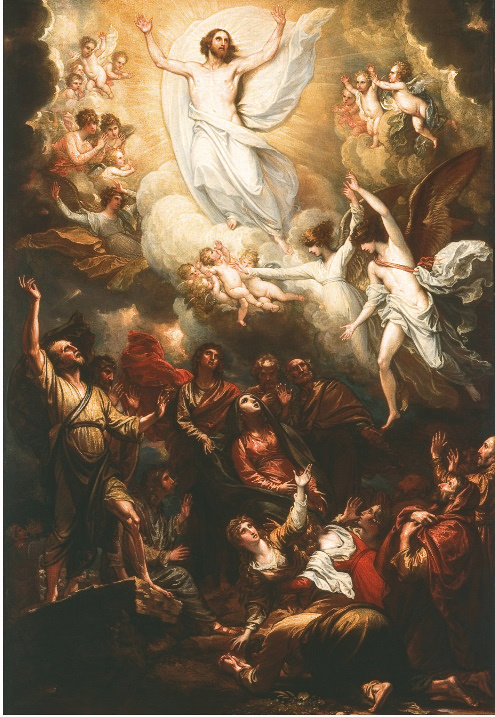
Benjamin West, American, 1738–1820
The Ascension, c. 1801
Oil paint on canvas
height: 49 1/2 in, 125.7300 cm; width: 34 in, 86.3600 cm
Denver Art Museum
Ascension, in Christian belief, the ascent of Jesus Christ into heaven on the 40th day after his Resurrection (Easter being reckoned as the first day). The Feast of the Ascension ranks with Christmas, Easter, and Pentecost in the universality of its observance among Christians. More on the Ascension
In 1779 West was commissioned by George III to decorate the walls of the Royal Chapel at Windsor Castle with scenes from the Old and New Testament, a project that would engage him for the next twenty years. He first painted The Ascension – in which Jesus ascends into heaven following his crucifixion and burial – in about 1781–82. The picture was never installed in the chapel, and West returned to the subject two decades later, producing the Berger picture. As was his practice, he created it as a finished study of the eventual painting. Soon after West completed it, King George appointed a new architect for the Royal Chapel project and the commission was cancelled. More on this painting

Benjamin West (1738–1820)
The Conversion of St. Paul, circa 1786
Oil on canvas
Dimensions
58 x 49 in. (147.32 x 124.46 cm)
Dallas Museum of Art
This altarpiece depicts the conversion of St. Paul, one of the fathers of the Christian church. Previously an avid persecutor of Christians, Saul—as he was originally known—was struck by temporary blindness while en route to the city of Damascus. Upon regaining his sight, he changed his name to Paul and became a Christian, going on to become one of the major authors of the New Testament.
This painting served as a model for a painted glass window in St. Paul's Church in Birmingham, England. It is the earliest and smallest of two versions of the subject by Benjamin West. He painted a later, sketchier treatment in response to the acclaim with which this altarpiece was greeted when it was exhibited in London at the Royal Academy. More on this painting
From 1746 to 1759, West worked in Pennsylvania, mostly painting portraits. While West was in Lancaster in 1756, his patron, a gunsmith named William Henry, encouraged him to paint a Death of Socrates based on an engraving in Charles Rollin's Ancient History. His resulting composition, which significantly differs from the source, has been called "the most ambitious and interesting painting produced in colonial America". Dr William Smith, then the provost of the College of Philadelphia, saw the painting in Henry's house and decided to become West's patron, offering him education and, more importantly, connections with wealthy and politically connected Pennsylvanians.
Benjamin West (1738–1820)
Musidora and Her Two Companions, Sacharissa and Amoret, at Their Bath Espied by Damon, c. 795 Retouched 1806
Oil on canvas
Height: 52.1 cm (20.5 in); Width: 72.4 cm (28.5 in)
Private collection
Benjamin West (American, Swarthmore, Pennsylvania 1738–1820 London)
The Damsel and Orlando, ca. 1793
Oil on canvas
36 x 28 in. (91.4 x 71.1 cm)
The Metropolitan Museum of Art
The dramatic interplay of glances and gestures depicts the climactic moment when Orlando, hero of the 1516 Italian epic poem, Orlando Furioso (Orlando Enraged), realizes that his love, Angelica, has married another. A shepherdess and her husband show Orlando a bracelet that Angelica gave to them as thanks for sheltering Angelica and her new husband. The astonished Orlando recognizes the bracelet as one he had given to Angelica as a token of his love. The children toying with Orlando’s discarded armor recall a Renaissance motif suggesting a warrior “disarmed” or “unmanned” by love. The frothing horse foreshadows Orlando’s eventual madness caused by the loss of Angelica. More on this painting
West was a close friend of Benjamin Franklin, whose portrait he painted. Franklin was the godfather of West's second son, Benjamin
Sponsored by Smith and William Allen, then reputed to be the wealthiest man in Philadelphia, West traveled to Italy in 1760 where he expanded his repertoire by copying works of Italian painters such as Titian and Raphael direct from the originals. In Rome he met a number of international neo-classical artists including German-born Anton Rafael Mengs, Scottish Gavin Hamilton, and Austrian Angelica Kauffman.
Benjamin West
Queen Elizabeth going in Procession to St. Paul's Cathedral after the Destruction of the Spanish Armada, c. 1792
Oil on canvas
44 x 65.5 cm. (17 1/4 x 25 3/4 in)
Private collection
The Queen and her people were jubilant. No more were they a second rate sea power, for they had conquered the fleet of the mighty Spanish Empire. A thanksgiving service was held at St. Paul's Cathedral for the delivery of the country, and a medal was struck with the words "God blew and they were scattered" inscribed on it. They believed that the storm that had besieged the Spanish ships was no ordinary storm, but the work of a Protestant God.
In August 1763, West arrived in England, on what he initially intended as a visit on his way back to America. In fact, he never returned to America. He moved into a house in Bedford Street, Covent Garden. The first picture he painted in England, Angelica and Medora, along with a portrait of General Monckton, and his Cymon and Iphigenia, painted in Rome, were shown at the exhibition in Spring Gardens in 1764. More on this painting
In 1765 he married Elizabeth Shewell, an American to whom he became engaged in Philadelphia, at St Martin-in-the-Fields.
Benjamin West (1738–1820)
Alexander III of Scotland Rescued from the Fury of a Stag by the Intrepidity of Colin Fitzgerald, c. 1786
Oil on canvas
Height: 3,660 mm (12 ft); Width: 5,210 mm (17.09 ft)
Scottish National Gallery
Benjamin West, American, 1738-1820
Queen Philippa Interceding for the Lives of the Burghers of Calais, c. 1788
Oil on canvas
39 1/2 x 52 1/4 inches (100.3 x 132.7 cm)
Detroit Institute of Arts
Philippa of Hainault was Queen of England as the wife and political adviser of King Edward III. She acted as regent in 1346, when her husband was away for the Hundred Years' War.
Philippa accompanied her husband on expeditions to Scotland and the rest of Europe in the early campaigns of the Hundred Years War, where she won acclaim for her gentle nature and compassion. In 1347, she is remembered as the kind woman who persuaded her husband to spare the lives of the Burghers of Calais, whom he had planned to execute as an example to the townspeople following his successful siege of that port. More on Philippa of Hainault
Dr Markham, then Headmaster of Westminster School, introduced West to Samuel Johnson, Edmund Burke, Thomas Newton, Bishop of Bristol, James Johnson, Bishop of Worcester, and Robert Hay Drummond, Archbishop of York. All three prelates commissioned work from him. In 1766 West proposed a scheme to decorate St Paul's Cathedral with paintings. It was rejected by the Bishop of London, but his idea of painting an altarpiece for St Stephen Walbrook was accepted. At around this time he also received acclaim for his classical subjects, such as Orestes and Pylades (See below) and The Continence of Scipio (See below).
Benjamin West (American, Swarthmore, Pennsylvania 1738–1820 London)
Omnia Vincit Amor, or The Power of Love in the Three Elements, c. 1809
Oil on canvas
70 3/8 x 80 1/2 in. (178.8 x 204.5 cm)
The Metropolitan Museum of Art
"Omnia vincit Amor," (Love triumphs over everything) is a quotation from Virgil’s Eclogues. Venus, the goddess of love, is shown at the left with her attributes the doves and with her small son, Amor, armed with bow and arrows, clinging to her draperies. A young deity, presumably Hymen, god of marriage, brandishes a flaming torch with his right hand and grasps in his left cords that leash an eagle. The eagle symbolizes all the creatures living in the element Air, a hippocampus stands for those of the Water, and a lion for those on Earth. The fourth element, Fire, is implicit in the goddess herself, in the winged Amores, or little Loves, and most particularly in Hymen’s flaming torch. More on this painting
Benjamin West
Venus At Her Birth Attired By The Three Graces
Oil on canvas
19 1/2 x 14 in
Private collection
According to Hesiod's Theogony, Aphrodite was born of the foam from the sea after Saturn (Greek Cronus) castrated his father Uranus (Ouranus) and his blood fell to the sea. This latter explanation appears to be more a popular theory due to the countless artworks depicting Venus rising from the sea in a clam.
The Birth of Venus was a theme launched by Lorenzo the Great, and it was he who had it set to verse by one of his favorite humanist poets, Angelo Poliziano. This filtered through to Botticelli and he scrupulously followed the text in order to design the artwork.
Angelo Poliziano's stanzas were based on an ode by Hesiod. In the story we see the aftermath of Venus's creation, pushed along by the Gods of the winds, on the first day of Creation, elevated this shell bearing Venus' triumphant nudity from the unknown depths of the sea. Approaching the earth over which she will assume her true role. More The Birth of Venus
The central figure of Venus appears here to be a combination of three sculptures which West would have studied during his visit to the Tribune of the Uffizi in the early 1760's. The pose of Venus, with her hand raised above her head is primarily taken from descriptions of a painting by Appelles. In addition to the present work, another now lost autograph version of this composition is recorded. More on this painting
Benjamin West 1738–1820
Pylades and Orestes Brought as Victims before Iphigenia, c. 1766
Oil paint on canvas
1003 × 1264 mm
Tate
Orestes had been sent to Phocis during his mother Clytemnestra's affair with Aegisthus. There he was raised with Pylades, and so considered him to be his closest friend. While Orestes was away, Clytemnestra killed her husband, Orestes' father Agamemnon.
As an adult, Orestes returns to Mycenae/Argos to avenge the murder of Agamemnon. With the assistance of his friend Pylades, Orestes kills his mother Clytemnestra and her lover Aegisthus.
West’s narrative is taken from the third act of a play by the classical author Euripides entitled Iphigenia in Tauris. In the passage Iphigenia, a priestess of Diana, stands in judgement before the semi-naked figures of her brother Orestes (in the red drapery) and his cousin and companion, Pylades. More on Pylades and Orestes
Benjamin West (1738–1820)
The Continence of Scipio, c.1766
Oil on panel
H 100.3 x W 133.3 cm
The Fitzwilliam Museum
The Continence of Scipio, or The Clemency of Scipio, is an episode recounted by Livy of the Roman general Scipio Africanus during his campaign in Spain during the Second Punic War. He refused a generous ransom for a young female prisoner, returning her to her fiancé Allucius, who in return became a supporter of Rome. In recognition of his magnanimous treatment of a prisoner, he was taken as one of the prime examples of mercy during warfare in classical times. Interest in the story revived in the Renaissance and the episode figured widely thereafter in both the literary and visual arts, as well as opera. More on The Continence of Scipio
After Benjamin West
The Appeal to Coriolanus
Oil on canvas
40 x 50 in
Private collection
Marcius Coriolanus was a Roman general who is said to have lived in the 5th century BC. He received his toponymic cognomen "Coriolanus" because of his exceptional valor in a Roman siege of the Volscian city of Corioli. He was subsequently exiled from Rome, and led troops of Rome's enemy the Volsci to besiege the city.
His military campaign against Rome is successful and his forces are approaching the walls of the city until the appeal of the Roman women, including his patrician mother and his wife. When he orders his troops to withdraw, he is killed by them. More on Marcius Coriolanus
Benjamin West 1738–1820
Cleombrotus Ordered into Banishment by Leonidas II, King of Sparta, c. 1768
Oil paint on canvas
1384 × 1854 mm
Tate
Benjamin West showed this painting at the second exhibition of the newly formed Royal Academy. After several years in Italy, West had established himself in London as the leading painter of subjects from classical history. His example, and the Academy’s teaching, encouraged numerous young British artists to study in Italy.
His subject is an incident from ancient Greek history. Leonidas, king of Sparta, was usurped by his son-in-law, Cleombrutus. When Leonidas returns looking for revenge, his daughter pleads for her husband’s life. Leonidas is moved by her tears, and commutes Cleombrutus’s death sentence to banishment. More on this painting
Benjamin West was known in England as the "American Raphael". His Raphaelesque painting of Archangel Michael Binding the Devil is in the collection of Trinity College, Cambridge (See below). He said that "Art is the representation of human beauty, ideally perfect in design, graceful and noble in attitude.
Benjamin West (1738–1820)
Archangel Michael Binding the Devil, c. 1777
Oil on canvas
H 453.5 x W 210.5 cm
Trinity College, University of Cambridge
Drummond tried to raise subscriptions to fund an annuity for West, so that he could give up portraiture and devote himself entirely to more ambitious compositions. Having failed in this, he tried—with greater success—to convince King George III to patronise West. West was soon on good terms with the king, and the two men conducted long discussions on the state of art in England, including the idea of the establishment of a Royal Academy. The academy came into being in 1768, with West one of the primary leaders of an opposition group formed out of the existing Society of Artists of Great Britain; Joshua Reynolds was its first president. In the same year, he was elected to membership in the American Philosophical Society.
Benjamin West (1738–1820)
Edward III Crossing The Somme Signed and dated 1788
Oil on canvas
140.0 x 153.1 cm
Royal Collection, Windsor
The Battle of Blanchetaque was fought on 24 August 1346 between an English army under King Edward III and a French force commanded by Godemar du Fay, which took place during the early stages of the Hundred Years' War.
The French king, Philip VI, had garrisoned all of the bridges and fords over the River Somme. The area had previously been stripped of food stocks by the French, and the English were essentially trapped.
Hearing of a ford at Blanchetaque, 10 miles (16 km) from the sea, Edward marched for it and encountered the blocking force under du Fay. Once the ebbing tide had lowered the water level, a force of English longbowmen marched partway across the ford and, standing in the water, engaged a force of mercenary crossbowmen, whose shooting they were able to suppress. A French cavalry force attempted to push back the longbowmen but were in turn attacked by English men-at-arms. After a mêlée in the river, the French were pushed back, more English troops were fed into the fight, and the French broke and fled. French casualties were reported as over half of their force, while English losses were light. Two days after Blanchetaque, the main French army under Philip was defeated at the Battle of Crécy with heavy loss of life. More on The Battle of Blanchetaque
According to West's earliest biographer, John Galt, it was George III who, 'recollecting that Windsor Castle had, in its present form, been created by Edward the Third, said, that he thought the achievements of his splendid reign were well calculated for pictures, and would prove very suitable ornaments to the halls and chambers of that venerable edifice.' In addition to his military prowess, Edward III had also been the founder of the Order of the Garter that is so closely associated with Windsor Castle. More on this painting
Benjamin West (1738–1820)
Edward, The Black Prince, receiving King John of France after the Battle of Poitiers, c. 1788
Oil on canvas
289.8 x 449.7 cm
The Royal Collection Trust
Edward of Woodstock, known to history as the Black Prince, was the eldest son of King Edward III of England, and the heir apparent to the English throne. He died before his father and so his son, Richard II, succeeded to the throne instead. Edward nevertheless earned distinction as one of the most successful English commanders during the Hundred Years' War, being regarded by his English contemporaries as a model of chivalry and one of the greatest knights of his age.
When he entered London in triumph on 24 May, King John II, his prisoner, rode a fine white charger, while he was mounted on a little black hackney. Judged by modern ideas the prince's show of humility appears affected, and the Florentine chronicler remarks that the honour done to King John II must have increased the misery of the captive and magnified the glory of King Edward. More on The Black Prince
In 1772, King George appointed him historical painter to the court at an annual fee of £1,000. He painted a series of eight large canvases showing episodes from the life of Edward III for St George's Hall at Windsor Castle, and proposed a cycle of 36 works on the theme of "the progress of revealed religion" for a chapel at the castle, of which 28 were eventually executed (See above). He also painted nine portraits of members of the royal family, including two of the king himself. He was Surveyor of the King's Pictures from 1791 until his death.
Benjamin West 1738–1820
Oil paint on canvas
54 × 765 mm
891 × 1022 × 100 mm
Tate
Although the young mother seems to be modelled on the artist's wife, this is not a West family portrait, but an allegorical scene. The Golden Age of the title, given in an engraving of the picture published in 1778, is the state of Infancy. The peacefully sleeping child knows nothing of the worries and poverty of its mother, indicated by the ragged hem of her dress and bare feet, or of the hard labour of the father, seen in the distance ploughing with a team of oxen. Neither is it aware of the cares and feebleness of old age, represented by the grandparents trying to catch the warmth of the sun in the doorway. More on this painting
West is also well known for his huge work in the Chapel of St Peter and St Paul which now forms part of the Old Royal Naval College in Greenwich, London. His work, The Preservation of St Paul after a Shipwreck at Malta, measures 25 ft by 14 ft and illustrates the Acts of the Apostles: 27 & 28. West also provided the designs for the other paintings executed by Biaggio Rebecca in the chapel.
Benjamin West, American, active Great Britain, 1738–1820
Agrippina Landing at Brundisium with the Ashes of Germanicus, c. 1768
Oil on canvas
64 1/2 × 94 1/2 in. (163.8 × 240 cm)
The Yale University Art Gallery
West here depicts a dramatic episode from Roman history. Agrippina, widow of the assassinated and much-admired general Germanicus, is seen arriving with the ashes of her slain husband. Crowds of mourning citizens greet her as she starts on her way to confront the Emperor Tiberius, widely believed to have arranged for Germanicus’s murder. To further his reference to antiquity, West modeled the central group on the Ara Pacis, the recently excavated Roman sacrificial altar, and painted the figures in cool whites, as if they too were carved in marble. Contemporary viewers would have recognized this classical allusion. More on this painting
Following a loss of royal patronage at the beginning of the 19th century, West began a series of large-scale religious works. The first, Christ Healing the Sick was originally intended as a gift to Pennsylvania Hospital in Philadelphia; instead he sold it to the British Institution for £3,000, which in turn presented it to the National Gallery. West then made a copy to send to Philadelphia. The success of the picture led him to paint a series of even larger works, including his Death on the Pale Horse, exhibited in 1817.
West died at his house in Newman Street, London, on March 11, 1820, and was buried in St Paul's Cathedral. He had been offered a knighthood by the British Crown, but declined it, believing that he should instead be made a peer. More on Benjamin West
Please visit my other blogs: Art
Collector, Mythology, Marine
Art, Portrait of a Lady, The
Orientalist, Art of the Nude and The
Canals of Venice, Middle
East Artists, 365
Saints and 365 Days, also visit my Boards on Pinterest
Images are copyright of their respective owners, assignees or others.
Some Images may be subject to copyright
I don't own any of these images - credit is always given when due unless
it is unknown to me. if I post your images without your permission, please tell
me.
I do not sell art, art prints, framed posters or reproductions. Ads are
shown only to compensate the hosting expenses.
If you enjoyed this post, please share with friends and family.
Thank you for visiting my blog and also for liking its posts and pages.
Please note that the content of this post primarily consists of articles
available from Wikipedia or other free sources online.