Showing posts with label Cleopatra. Show all posts

Saturday, December 18, 2021

23 Works, December 18th. is Frank O. Salisbury's day, his art, illustrated with footnotes #251

Frank O. Salisbury (British, 1874–1962)
Onward Christian Soldiers, c. 1911
Oil on canvas
63 x 90 cm. (24.8 x 35.4 in.)
Private collection

Painted in 1911 it is a figurative landscape of soldiers on the battlefield. The two central characters, the 'Christian Soldiers' from the early crusades have halos and ride through the chaos on white horses. Shafts on light with angels illuminate them and also a crucifix. A very powerful Edwardian religious oil painting and an excellent example of O'Salisbury's work. painted in oil and illuminated in gold leaf.

Frank Owen Salisbury
The passing of war
Watercolour heightened with metallic paints on buff paper
40 x 59cm; 15x 23in
Private collection

Francis ("Frank") Owen Salisbury (18 December 1874 – 31 August 1962) was an English artist who specialised in portraits, large canvases of historical and ceremonial events, stained glass and book illustration. In his heyday he made a fortune on both sides of the Atlantic and was known as "Britain’s Painter Laureate". His art was steadfastly conservative and he was a vitriolic critic of Modern Art – particularly of his contemporaries Picasso, Chagall and Mondrian. His father, Henry Salisbury, described himself as a "plumber, decorator and ironmonger" (his mother was Susan Hawes), yet his son Frank would become one of the greatest society artists of his generation.

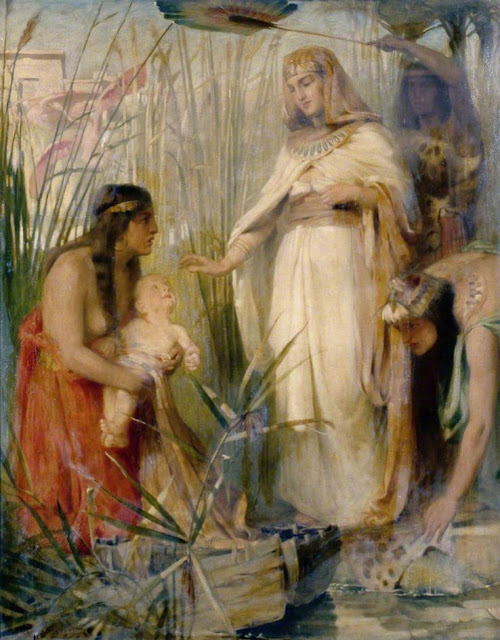
Frank O. Salisbury (1874–1962)
Finding of Moses, c. 1895
Oil on canvas
H 126 x W 100 cm
Royal Pavilion & Museums Trust, Brighton & Hove

The Finding of Moses is the story in chapter 2 of the Book of Exodus in the Hebrew Bible of the finding in the River Nile of Moses as a baby by the daughter of Pharaoh. The story became a common subject in art, especially from the Renaissance onwards. More on The Finding of Moses

Frank O. Salisbury (1874–1962)
The Quest of Saint George, c. early 20th C
Oil on canvas
H 152.4 x W 259 cm
National Museum Wales, National Museum Cardiff

Saint George (circa 275/281 – 23 April 303 AD) was a soldier in the Roman army who later became venerated as a Christian martyr. His parents were Christians of Greek background; his father Gerontius was a Roman army official from Cappadocia and his mother Polychronia was from Lydda, Syria Palaestina. Saint George became an officer in the Roman army in the Guard of Diocletian, who ordered his death for failing to recant his Christian faith.
 
In the fully developed Western version of the Saint George Legend, a dragon, or crocodile, makes its nest at the spring that provides water for the city of "Silene" (perhaps modern Cyrene in Libya or the city of Lydda in Palistine, depending on the source). Consequently, the citizens have to dislodge the dragon from its nest for a time, to collect water. To do so, each day they offer the dragon at first a sheep, and if no sheep can be found, then a maiden is the best substitute for one. The victim is chosen by drawing lots. One day, this happens to be the princess. The monarch begs for her life to be spared, but to no avail. She is offered to the dragon, but then Saint George appears on his travels. He faces the dragon, protects himself with the sign of the Cross, slays the dragon, and rescues the princess. The citizens abandon their ancestral paganism and convert to Christianity. More on Saint George

Francis Owen Salisbury, R.I., R.O.I., R.P. (1874-1962)
King Peter of Serbia retreating across the Albanian Mountains, c. 1915
Oil on canvas
83 x 144 in. (210.8 x 365.8 cm.)
Private collection

King Peter I of Serbia is regarded as one of the great Balkan leaders, both for his personal qualities as a leader, and his role in introducing democracy and reform to Serbia. Born in Belgrade in 1844, he was just 14 when he followed his father Prince Alexander into exile and he would not return to his homeland for over 50 years. In 1903, he returned to Serbia to ascend to the throne in the wake of the coup d'etat and assassination of King Alexander, in which he played no part.

In 1914 Arch-Duke Ferdinand, heir to the Austro-Hungarian throne was assassinated in Sarajevo by the terrorist group, the Black Hand. The assassination provided the Austro-Hungarian with an excuse to check growing Serbian nationalism and they accused Serbia of culpability for the assassination, demanding that Austrian officials be allowed to come to Serbia and lead the investigation into the assassination. Serbia refused, and as a consequence a state of war was established.

Despite repelling two Austro-Hungarian invasions, by autumn 1915, when Bulgaria mobilized its forces against Serbia, the country and army had been weakened by a typhus pandemic and could not withstand a third invasion by Germany and Austro-Hungary in October. With the Serbian army outnumbered two to one, the outcome was inevitable and Belgrade fell. The remainder of the Serbian army, with the aged King Peter and Crown Prince Alexander, retreated through Montenegro and the mountains of northern Albania in freezing conditions. More on this painting

Frank Owen Salisbury
King George V With The Prince Of Wales Visiting The Battlefields Of France, c.  1916
Oil on canvas, arched top
91.5cm x 61cm (36in x 24in)
Private collection

August 10 1916, Fricourt–King George had crossed over to France, visiting troops near Ypres before proceeding down to the Somme. While on the Somme, he met with his son, the Prince of Wales (later Edward VIII), who was serving as a staff officer with XIV Corps.  He also met with General Rawlinson, commander of the Fourth Army.

The high casualties and few gains of the Somme Offensive meant that Haig had quickly gained detractors in Britain. More on King George V visit

One of 11 children, Salisbury was such a delicate child that he was educated at home, in the main by his student teacher sister, Emilie. He had only a few weeks formal schooling and began work by repairing bicycles at his father’s Cycle Depot in Harpenden. Uncertain as to his ability to find and maintain a job, the family determined that he be apprenticed, at the age of 15, to Henry James Salisbury, his eldest brother, who managed a major stained glass company in Alma Road, St Albans. 

Frank O. Salisbury (British, 1874–1962)
Sweetening the Hay
Oil on canvas
108 x 194 cm. (42.5 x 76.4 in.)
Private collection

Frank O. Salisbury (1874–1962)
Escape: An Incident in the Destruction of Pompeii
Oil on canvas
H 106.5 x W 187.6 cm
Russell-Cotes Art Gallery & Museum

Frank O. Salisbury (1874–1962)
Cleopatra dancing in front of Commodus
Oil on canvas
101.5 x 127cm (39 15/16 x 50in)
Private collection

Commodus was a Roman emperor serving jointly with his father Marcus Aurelius from 176 until his father's death in 180, and solely until 192. His reign is commonly thought of as marking the end of a golden period of peace in the history of the Roman Empire, known as the Pax Romana.

Commodus accompanied his father during the Marcomannic Wars in 172, and on a tour of the Eastern provinces in 176. More on Commodus

Frank O. Salisbury (1874–1962)
Marchioness of Winchester (1902–1995), c. 1956
Oil on canvas
H 200 x W 107 cm
Guildhall Winchester

Bapsy Paulet, Marchioness of Winchester, was an Indian socialite and aristocrat. She was born Bapsy Pavry of Bombay, the daughter of the Parsi Zoroastrian "Head Priest", the Most Rev. Cursetji Erachji Pavry. Her brother, Dr. Jal Pavry, and she travelled extensively, visiting Germany, Italy, Belgium, Greece, and Egypt, where they were received by Adolf Hitler, Pope Pius XI, Benito Mussolini as well as the respective monarchs of Belgium, Greece, Iran, Afghanistan and Egypt. In England she was received by King George and Queen Mary. She received an MA from Columbia University after initial schooling at St. Xavier's College in Bombay.

She lived in England from a young age, where she pursued a "campaign to become one of the great figures of the age".

Pavry and her brother Jal, also attended the Paris Peace Conference of the victorious Allies after the end of World War I. H. A. J Hulugalle, described her as the 'glamour girl' of the conference and mentions she was sitting in the gallery near to Ho Chi Minh.

In 1952, she married Henry Paulet, 16th Marquess of Winchester and became the Marchioness of Winchester, thought to be the only Indian Marchioness in history. Her husband, the childless widower Marquess, was ninety years old at the time. 

After the death of her brother Jal in 1985, the Marchioness returned to India and lived out the rest of her life there, dying in 1995.

She was active in global Zoroastrian affairs, using her status to petition the Iranian government to improve the status of the persecuted Iranian Zoroastrians. More on the Marchioness of Winchester

Frank O. Salisbury
Golden Threads
Oil on canvas
183 x 127 cm (6' x 4' 2")
Public collection

Frank Owen Salisbury (1874-1962)
The Sen Sisters, c. 1928
Oil on canvas
60 in. (152.5 cm.) diameter
Private collection

The sitters portrayed are Srilata, Arathi and Anjali Sen, the daughters of Mr. and Mrs. Nirmal Sen. Their grandfather was Keshub Chandra Sen, a distinguished Hindu preacher and one of the founders of the Brahmo religious movement. Their aunt was Suniti Devi who, at the age of 14, was married off to the Maharaja of Cooch Behar in 1878. She became a favourite of the British aristocracy and made Queen Victoria godmother to her son Victor. Suniti's son Jit, first cousin to the Sen sisters married Indira, a daughter of the Maharaja of Baroda and a renowned beauty of her age. More on this painting

He rapidly acquired all the practical skills of a stained glass artist and exhibited exceptional skills in the painterly detail that was applied to glass before its final firing. This led to his brother sponsoring him to attend Heatherley’s School of Art three days a week to further a career in painting. He then won a scholarship to the Royal Academy Schools which he attended for five years and where he won two silver medals and two scholarships, including the Landseer scholarship which funded his to travel to Italy in 1896. In due course he would have seventy exhibits accepted for the annual Royal Academy Summer Exhibitions, from 1899 until 1943, though he was never offered membership, which reportedly disappointed him very much.

Frank O. Salisbury (1874–1962)
Henry VIII and Catherine of Aragon before Papal Legates at Blackfriars, 1529, c. 1910
Oil on canvas
H 205.7 x W 210.8 cm
Parliamentary Art Collection

The divorce of Henry VIII from Katherine of Aragon, instigated by the Kings desire for a male heir to the throne, was a major catalyst in the break from Rome and the introduction of Protestantism to England. This illustration shows the dramatic moment where, during the Kings petition for divorce before the Papal Legate and Cardinal Wolsey, the Queen enters the courtroom and kneeling down in sight of the whole court and assembly at the King's feet and in broken English makes her protest against the divorce, 'I take god and all the world to witness that I have been a true, humble and obedient wife'. The illustration depicts both the King and Queen with dark and pensive faces telling a quite personal story. More on this painting

Frank O. Salisbury (1874–1962)
Battle of Jutland: Boy Cornwell VC.
Oil on canvas
Royal Navy

One of the defining images depicting an event in the Royal Navy’s long history, Boy John Travers Cornwell mortally wounded but standing by his post during the Battle of Jutland in 1916. More on Boy John Travers Cornwell

In 1901 he married Alice Maude (d. 1951), daughter of C. Colmer Greenwood, with whom he had several children, including twin daughters Monica and Sylvia. His first Royal Academy exhibit was a portrait of Alice and he often painted pictures of their children.

Frank O. Salisbury (1874–1962)
Moses: The Friend of God, c. before 1954
Oil on canvas
H 75 x W 63 cm
John Wesley’s House & The Museum of Methodism

Moses' friendship with God is described as a relationship in which God speaks to Moses face to face. In some mysterious way Moses has access to God where Moses may speak his mind freely with God and engage in some persuasive debate. We see this in Exodus 32-33 where Moses tries to persuade God not to destroy Israel after the debacle of the golden calf. More on Moses, The Friend of God

Frank O. Salisbury (1874–1962)
Elijah: The Warrior of God, c. before 1954
Oil on canvas
H 73 x W 63 cm
John Wesley’s House & The Museum of Methodism

Elijah, was, according to the Books of Kings in the Hebrew Bible, a prophet and a miracle worker who lived in the northern kingdom of Israel during the reign of King Ahab. Elijah defended the worship of the Hebrew God over that of the Canaanite deity Baal. God also performed many miracles through Elijah, including resurrection, bringing fire down from the sky, and entering heaven alive "by fire". He is also portrayed as leading a school of prophets known as "the sons of the prophets". Following his ascension, Elisha, his disciple and most devoted assistant, took over his role as leader of this school. The Book of Malachi prophesies Elijah's return "before the coming of the great and terrible day of the LORD", making him a harbinger of the Messiah and of the eschaton in various faiths that revere the Hebrew Bible. References to Elijah appear in Sirach, the New Testament, the Mishnah and Talmud, the Quran, the Book of Mormon, the Doctrine and Covenants, and Baháʼí writings. More on Elijah

Frank O. Salisbury (1874–1962)
Jeremiah: The Mediator of God, c. before 1954
Oil on canvas
H 75 x W 63 cm
John Wesley’s House & The Museum of Methodism

Jeremiah was active as a prophet from the thirteenth year of Josiah, king of Judah, until after the fall of Jerusalem and the destruction of Solomon's Temple in 587 BC. This period spanned the reigns of five kings of Judah: Josiah, Jehoahaz, Jehoiakim, Jehoiachin, and Zedekiah. The prophetess Huldah was a relative and contemporary of Jeremiah while the prophet Zephaniah was his mentor.

In addition to proclaiming many prophecies of Yahweh, the God of Israel, the Book of Jeremiah goes into detail regarding the prophet's private life, his experiences, and his imprisonment. More on Jeremiah

One of a series of dramatic oil on canvas studies of the biblical prophets by Frank O. Salisbury. Salisbury's work was illustrated in 'The Prophets of Israel', in 1933. More on this painting

Frank O. Salisbury (1874–1962)
Daniel: The Statesman of God, c. before 1954
Oil on canvas
H 75 x W 62 cm
John Wesley’s House & The Museum of Methodism

Daniel, meaning "God is my Judge", the hero of the biblical Book of Daniel, is a Jewish youth of Jerusalem taken into captivity by Nebuchadnezzar of Babylon, serving the king and his successors with loyalty and ability until the time of the Persian conqueror Cyrus, all the while remaining true to the God of Israel. The consensus of most modern scholars is that Daniel is not an historical figure and that the book is a cryptic allusion to the reign of the 2nd century BCE Hellenistic king Antiochus IV Epiphanes. More on Daniel

Frank O. Salisbury (1874–1962)
Jonah: The Messenger of God, c. before 1954
Oil on canvas
H 75 x W 62 cm
John Wesley’s House & The Museum of Methodism

Jonah is a prophet in the Hebrew Bible and the Quran, from Gath-hepher of the northern kingdom of Israel in about the 8th century BCE. Jonah is the central figure of the Book of Jonah, which details his reluctance in delivering God's judgement on the city of Nineveh, and then his subsequent, albeit begrudged, return to the divine mission after he is swallowed by a large sea creature. More on Jonah

Frank O. Salisbury (1874–1962)
Ezekiel: The Priest-Prophet of God, c. before 1954
Oil on canvas
H 75 x W 63 cm
John Wesley’s House & The Museum of Methodism

Ezekiel, prophet-priest of ancient Israel and the subject and in part the author of an Old Testament book that bears his name. Ezekiel’s early oracles (from c. 592) in Jerusalem were pronouncements of violence and destruction; his later statements addressed the hopes of the Israelites exiled in Babylon. The faith of Ezekiel in the ultimate establishment of a new covenant between God and the people of Israel has had profound influence on the postexilic reconstruction and reorganization of Judaism. More on Ezekiel

Frank O. Salisbury (1874–1962)
Amos: The Spokesman of God, c. before 1954
Oil on canvas
H 75 x W 63 cm
John Wesley’s House & The Museum of Methodism

Amos, an older contemporary of Hosea and Isaiah, was active c. 750 BC during the reign of Jeroboam II (788–747 BC) of Samaria, making Amos the first prophetic book of the Bible to be written. Amos lived in the kingdom of Judah but preached in the northern kingdom of Israel. His major themes of social justice, God's omnipotence, and divine judgment became staples of prophecy. More on Amos

Frank O. Salisbury (1874–1962)
Isaiah: The Appointed of God, c. before 1954
Oil on canvas
H 62 x W 72 cm
John Wesley’s House & The Museum of Methodism

Isaiah 49:5 GNT; Before I was born, the LORD appointed me; he made me his servant to bring back his people, to bring back the scattered people of Israel. The LORD gives me honor; he is the source of my strength. 

Frank O. Salisbury (1874–1962)
Second Isaiah: The Forerunner of God's Great Day, c. before 1954
Oil on canvas
H 62 x W 72 cm
John Wesley’s House & The Museum of Methodism

Chapters 40–55 in the Book of Isaiah are believed to be the work of a prophet who lived with the Hebrew exiles during the Babylonian captivity. Because this prophet's real name is unknown and his work has been preserved in the collection of writings that include the prophecies of the earlier Isaiah, he is usually designated as Deutero-Isaiah — the second Isaiah. More on the Second Isaiah

Following his studies at the Royal Academy, London and a scholarship to visit Italy in 1896, he developed a taste for large scenes of pageantry and portraiture, painted in traditional style. He worked particularly in Britain and the United States of America, where he was known as Britain's 'Painter Laureate'.

Salisbury died on 31 August 1962 at Sarum Chase, the neo-Tudor mansion he built, in 1932, in Hampstead, London. He is buried in a rather unassuming grave, with his baby daughter Elaine Maude and his wife, in St Nicholas Churchyard, Harpenden. More on Frank O. Salisbury


Please visit my other blogs: Art Collector, Mythology, Marine Art, Portrait of a Lady, The Orientalist, Art of the Nude and The Canals of Venice, Middle East Artists, 365 Saints and 365 Days, also visit my Boards on Pinterest

Images are copyright of their respective owners, assignees or others. Some Images may be subject to copyright

I don't own any of these images - credit is always given when due unless it is unknown to me. if I post your images without your permission, please tell me.

I do not sell art, art prints, framed posters or reproductions. Ads are shown only to compensate the hosting expenses.

If you enjoyed this post, please share with friends and family.

Thank you for visiting my blog and also for liking its posts and pages.

Please note that the content of this post primarily consists of articles available from Wikipedia or other free sources online.


Friday, November 26, 2021

14 Works, November 26th. is Antonio Carneo's day, his art, illustrated with footnotes #241

Carneo Antonio
Proof of poison, c. 1670-1680
Oil on canvas
175 x 178 cm
Ado Furlan Foundation

Depicting a young man who compresses his bowels in the presence of a group of bystanders who follow his spasms with apprehension or try to help him, it is described ab antiquo with the title with which it is still remembered today. However, since it is difficult to represent a generic poisoning scene (provoked or self-induced), one wonders whether the artist did not want to illustrate a specific character in the episode in question. Among the proposals advanced by scholars, that of the young Mithridates who undergoes the poison test in order to immunize himself remains one of the most plausible. More on this painting

Mithridates VI Eupator of Pontus (b. c. 134 BC) ruled a Black Sea Empire to rival the Roman Republic in a series of wars that lasted decades. As Rome’s most dangerous enemy until his death in 63 BC, Mithridates is recognized as the first experimental toxicologist for his extensive investigations into a vast number of poisons and antidotes. Fearing assassination by poison, he gathered a team of botanists, physicians, and shamans seeking to create a “universal antidote” that would protect him from all poisons. Influenced by traditional theriacs and previous investigators and with access to rich natural resources, Mithridates’ experiments resulted in a formulation of more than 50 ingredients combining animal, plant, and mineral toxins with antidotes. He made himself immune to normally fatal amounts of arsenic and enjoyed robust health until forced to commit suicide in his 70s. Efforts to replicate his famous Mithridatium made his antidote the most popular and long-lived prescription in history. More on Mithridates VI

Antonio Carneo (1637–1692) was an Italian painter, active in Friuli and Venice, and depicting both mythologic, allegoric, and religious canvases, as well as portraits.

Antonio Carneo (1637–1692) (attributed to)
Venus, Vulcan and Cupid
Oil on canvas
H 103.5 x W 139.4 cm
The Bowes Museum

The subject of this painting has not been securely identified. The elderly man could be Vulcan, Venus's husband, to whom she presents her baby son Cupid. The figures of the young woman and the child reveal the influence of Venetian painting. They are represented by means of soft, fluid brushstrokes and a warm, light palette. The naturalism and the contrasting light, which defines the figures of the man and the elderly woman in the background, can be associated with the Caravaggesque tradition, under whose influence Antonio Carneo worked during the years he spent in Udine between 1660 and 1689. More on this painting

He was born in Concordia Sagittaria, and trained under his father as a painter. He was active for many years in Portogruaro. Other sources cite him as a pupil of Giovanni Giuseppe Cosattini (1625-1699) in Udine, but his paintings appear best to model Tintoretto and Paolo Veronese.

Antonio Carneo  (1637–1692)
The Death of Lucretia, c. second half of 17th century
Oil on canvas
Height: 99 cm (38.9 in); Width: 82.5 cm (32.4 in)
National Museum in Warsaw

Lucretia, legendary heroine of ancient Rome. According to tradition, she was the beautiful and virtuous wife of the nobleman Lucius Tarquinius Collatinus. Her tragedy began when she was raped by Sextus Tarquinius, son of Lucius Tarquinius Superbus, the tyrannical Etruscan king of Rome. After exacting an oath of vengeance against the Tarquins from her father and her husband, she stabbed herself to death. Lucius Junius Brutus then led the enraged populace in a rebellion that drove the Tarquins from Rome. The event (traditionally dated 509 BCE) marks the foundation of the Roman Republic. The story is first found in the work of the earliest Roman historian, Fabius Pictor (late 3rd century BCE). Its classic form is Livy’s version (late 1st century BCE). Lucretia’s story is also recounted in Shakespeare’s narrative poem The Rape of Lucrece. More on Lucretia

Antonio Carneo, Concordia Sagittaria, Italy, 1637 - 1692, Portogruaro, Italy
The Death of Rachel
Oil on canvas
81.3 cm x 106.7 cm (32 in. x 42 in.)
Blanton Museum of Art

Genesis 35: The Death of Rachel: Despite God’s admonition to remain at Bethel, a few verses later, Jacob and his entourage are on the move. While still some distance from Ephrath, Rachel goes into labor. This is the first indication that she is pregnant. The text states that the labor is hard; the birth is difficult. The midwife comforts and encourages her by saying she is having a son. The child is born, and with her dying breath, Rachel names him Benoni, which means “son of my misfortune” or “son of my sorrow.” This is the woman who once had said she would die if she didn’t have sons. Now she is dying because she is giving birth to a son. The irony hurts. She lives only long enough to give him a name. More on The Death of Rachel

Antonio Carneo, Concordia Sagittaria, Italy, 1637 - 1692, Portogruaro, Italy
Cleopatra
Oil on canvas
112 × 92 cm
Szépművészeti Múzeum

Cleopatra VII Philopator (69 – August 12, 30 BC), was the last active pharaoh of Ptolemaic Egypt, briefly survived as pharaoh by her son Caesarion. After her reign, Egypt became a province of the recently established Roman Empire.

Cleopatra was a member of the Ptolemaic dynasty, a family of Macedonian Greek origin that ruled Egypt after Alexander the Great's death. The Ptolemies spoke Greek throughout their dynasty, and refused to speak Egyptian, which is the reason that Greek as well as Egyptian languages were used on official court documents such as the Rosetta Stone. By contrast, Cleopatra did learn to speak Egyptian and represented herself as the reincarnation of the Egyptian goddess Isis.

Cleopatra originally ruled jointly with her father Ptolemy XII Auletes, and later with her brothers Ptolemy XIII and Ptolemy XIV, whom she married as per Egyptian custom, but eventually she became sole ruler. As pharaoh, she consummated a liaison with Julius Caesar that solidified her grip on the throne.

After Caesar's assassination in 44 BC, she aligned with Mark Antony in opposition to Caesar's legal heir Gaius Julius Caesar Octavianus (later known as Augustus). With Antony, she bore the twins Cleopatra Selene II and Alexander Helio. Antony committed suicide after losing the Battle of Actium to Octavian's forces, and Cleopatra followed suit. According to tradition, she killed herself by means of an asp bite on August 12, 30 BC. More on Cleopatra

Circle of Antonio Carneo Concordia Sagittaria 1637-1692 Portogruaro
Rebecca at the Well
Oil on canvas
29¼ x 41¾ in. 74.3 x 108.6 cm.
Private collection

Abraham went about finding a wife for his son Isaac. He commanded his servant to journey to his birthplace of Aram Naharaim to select a bride from his own family, rather than engage Isaac to a local Canaanite girl. Abraham sent along expensive jewelry, clothing and dainties as gifts to the bride and her family. 

The servant devised a test in order to find the right wife for Isaac. As he stood at the central well in Abraham's birthplace with his men and ten camels laden with goods, he prayed to God: "And let it come to pass, that the damsel to whom I shall say, Let down thy pitcher, I pray thee, that I may drink; and she shall say, Drink, and I will give thy camels drink also" — Genesis 24:14

To his surprise, a young girl immediately came out and offered to draw water for him to drink, as well as water to fill the troughs for all his camels. Rebecca continued to draw water until all the camels were sated, proving her kind and generous nature and her suitability for entering Abraham's household. The servant immediately gave her a golden nose ring and two golden bracelets. After hosting the party overnight, however, the family tried to keep Rebecca with them longer. The servant insisted that they ask the girl herself, and she agreed to go immediately.

As Rebecca and her entourage approached Abraham's home, they spied Isaac from a distance in the fields praying. Seeing such a spiritually exalted man, Rebecca immediately dismounted from her camel and asked the accompanying servant who he was. When she heard that this was her future husband, she modestly covered herself with a veil. Isaac brought her into the tent of his mother Sarah, married her, and loved her. More on Rebecca

Attributed to Antonio Carneo (1637 Concordia Sagittaria - 1692 Portogruaro)
Rebecca and Eliezer at the Well
Oil on canvas
75 x 95 cm
Private collection

Circle of Antonio Carneo Concordia Sagittaria 1637-1692 Portogruaro
Samson and Delilah
Oil on canvas
120.5 by 93.5 cm.; 47 1/2 by 36 3/4 in.
Private collection

Samson  is one of the last of the judges of the ancient Israelites mentioned in the Hebrew Bible. According to the biblical account, Samson was given supernatural strength by God in order to combat his enemies and perform heroic feats. Samson had two vulnerabilities—his attraction to untrustworthy women and his hair, without which he was powerless. These vulnerabilities ultimately proved fatal for him.
 
Samson eventually fell in love with a woman named Delilah. The Philistines bribed Delilah with 1,100 silver pieces from each of the Philistine leaders, to get her to figure out the secret of Samson's strength and tell them. 
 
After asking him several times what the secret to his strength is: "Finally he disclosed to her all his heart and said to her: 'A razor has never come upon my head, because I am a Naz′i·rite of God from my mother’s belly. If I did get shaved, my power also would certainly depart from me, and I should indeed grow weak and become like all other men.'" 
 
She relayed this to the Philistine axis lords, got Samson to fall asleep, and while he was sleeping, had his head shaved. The Philistines then took him captive, put out both his eyes, and made him their slave. 
 
One day as they are having a great party to worship their false god Dagon, the Philistines bring Samson out so they can make fun of him. By that time, Samson's hair has grown out again. Samson has a young boy lead him to the pillars that hold the building up, prays to Jehovah for strength, takes hold of the pillars, and cries out: "Let my soul die with the Philistines."
 
There are 3,000 Philistines on the roof of the building alone, and many more inside (the axis lords are all there as well), and when Samson pushes against the pillars, the building falls down and kills all of them, including Samson. More Samson

Antonio Carneo, Concordia Sagittaria, Italy, 1637 - 1692, Portogruaro, Italy
The Holy Family
Oil on canvas
79 x 75 cm
Private collection

The Holy Family consists of the Child Jesus, the Virgin Mary, and Saint Joseph. Veneration of the Holy Family was formally begun in the 17th century by Saint François de Laval, the first bishop of New France, who founded a Confraternity.

Matthew and Luke narrate the episodes from this period of Christ's life, namely his Circumcision and later Presentation, the Flight to Egypt, the return to Nazareth, and the Finding in the Temple.[Joseph and Mary were apparently observant Jews, as Luke narrates that they brought Jesus with them on the annual pilgrimage to Jerusalem with other Jewish families. More on The Holy Family

Antonio Carneo, Concordia Sagittaria, Italy, 1637 - 1692, Portogruaro, Italy
Christ and the Adulteress
oil on canvas
115.5 x 147.5 cm
Private collection

In the passage, Jesus was teaching in the Second Temple after coming from the Mount of Olives. A group of scribes and Pharisees confronts Jesus, interrupting his teaching. They bring in a woman, accusing her of committing adultery, claiming she was caught in the very act. They tell Jesus that the punishment for someone like her should be stoning, as prescribed by Mosaic Law.[1] Jesus begins to write something on the ground using his finger. But when the woman's accusers continue their challenge, he states that the one who is without sin is the one who should cast the first stone at her. The accusers and congregants depart, realizing not one of them is without sin either, leaving Jesus alone with the woman. Jesus asks the woman if anyone has condemned her and she answers no. Jesus says that he, too, does not condemn her, and tells her to go and sin no more. More on Christ and the Adulteress

Antonio Carneo, Concordia Sagittaria, Italy, 1637 - 1692, Portogruaro, Italy
Dead Christ held by two angels
Oil on canvas
110 x 94 cm. (43¼ x 37 in.)
Private collection

Antonio Carneo, Concordia Sagittaria, Italy, 1637 - 1692, Portogruaro, Italy
The Martyrdom of Saint Sebastian
With Saint Roch and an Angel in the background,
Oil on canvas
171.5 x 114.5 cm, 
Private collection

Saint Sebastian (died c. 288 AD) was an early Christian saint and martyr. Sebastian had prudently concealed his faith, but in 286 was detected. Diocletian reproached him for his betrayal, and he commanded him to be led to a field and there to be bound to a stake so that archers from Mauritania would shoot arrows at him. "And the archers shot at him till he was as full of arrows as an urchin is full of pricks, and thus left him there for dead." Miraculously, the arrows did not kill him.

Sebastian later stood by a staircase where the emperor was to pass and harangued Diocletian for his cruelties against Christians. This freedom of speech, and from a person whom he supposed to have been dead, greatly astonished the emperor; but, recovering from his surprise, he gave orders for his being seized and beat to death with cudgels, and his body thrown into the common sewer. A pious lady, called Lucina, admonished by the martyr in a vision, got it privately removed, and buried it in the catacombs at the entrance of the cemetery of Calixtus, where now stands the Basilica of St. Sebastian. More St. Sebastian

The present painting relates to a panel of the Averoldi Altarpiece by Titian from the 1520s in the Collegiata dei Santi Nazaro e Celso in Brescia. The figure of Saint Sebastian is reproduced fairly accurately, but in the rendering of the landscape there are differences from Titian’s original. More on this painting

Antonio Carneo
Episode from the life of Sant Antonio Abate
Oil on canvas, unframed
202 x 221 cm.
Private collection

Antonio abate is one of the most illustrious hermits in the history of the Church. Born in Coma, in the heart of Egypt, around 250, at the age of twenty he abandoned everything to live first in a deserted land and then on the shores of the Red Sea, where he led an anacoretic life for more than 80 years: he died, in fact, over a hundred years old in 356. Already in his life, pilgrims and needy people from all over the East flocked to him, attracted by the fame of holiness. Constantine and his sons also sought his advice. His story is told by a disciple, Saint Athanasius, who helped to make his example known throughout the Church. More on Antonio abate

He worked in eastern Veneto and Friuli , especially in Udine , where he was hosted for more than twenty years by Count Leonardo and Giovanni Battista Caiselli and for which he created numerous paintings. According to Guarienti's testimony, though his father was his first teacher, he would  later perfected himself in the diligent study of Venetian masters in the sixteenth century. An admirer of Flemish models, their "darkness" and their naturalistic accents, and the works of Bernardo Strozzi and Luca Giordano , he was appreciated for the natural chromaticism of the paintings. Its for the mix of realistic figurative patterns and rustic tastes, for the swirling and imaginative butterfly penetration.

Antonio Carneo
The Temperance
Oil on canvas
cm 73x61
Private collection
Temperance (XIV) is the fourteenth trump or Major Arcana card in most traditional Tarot decks. It is used in game playing as well as in divination.

Temperance (Italian: La Temperanza) appears in the oldest Italian decks where it is numbered VI or VII. In the Tarot de Marseille and in most contemporary decks the card is numbered XIV. In the Thoth Tarot and decks influenced by it, this card is called Art rather than Temperance.

A woman mixing water into wine was a standard allegory of Temperance in European iconography. 

Temperance is almost invariably depicted as a person pouring liquid from one receptacle into another. Historically, this was a standard symbol of the virtue temperance, one of the cardinal virtues, representing the dilution of wine with water. In many decks, the person is a winged angel, usually female or androgynous, and stands with one foot on water and one foot on land. More on The Temperance 

In Portogruaro, he painted an altarpiece depicting the Charity of St Thomas of Villanova for the church of Santa Lucia. In the town castle chapel, he painted a Christ and saints. For the other rooms he painted the Redeemer with St Marck and donors and a St Peter Martyr. He painted a Last Supper for the town convent. For the church of San Rocco, he painted the main altarpiece depicting St Francis and companions. In 1604, he painted four altarpieces for the church of San Francesco.

There was another painter Giacomo Carneo subsequently active in Friuli. More on Antonio Carneo


Please visit my other blogs: Art Collector, Mythology, Marine Art, Portrait of a Lady, The Orientalist, Art of the Nude and The Canals of Venice, Middle East Artists, 365 Saints and 365 Days, also visit my Boards on Pinterest

Images are copyright of their respective owners, assignees or others. Some Images may be subject to copyright

I don't own any of these images - credit is always given when due unless it is unknown to me. if I post your images without your permission, please tell me.

I do not sell art, art prints, framed posters or reproductions. Ads are shown only to compensate the hosting expenses.

If you enjoyed this post, please share with friends and family.

Thank you for visiting my blog and also for liking its posts and pages.

Please note that the content of this post primarily consists of articles available from Wikipedia or other free sources online.


Wednesday, November 17, 2021

20 Works, November 17th. is Pierre Mignard's day, his art, illustrated with footnotes #236

Pierre Mignard I  (1612–1695)
Winter: Cybele Begs for the Sun's Return (detail)
Textile, Tapestry
6.16 × 0 × 4.79 m
Mobilier National, Paris

The sea occupies the background of a winter landscape. Time or Saturn, accompanied by the Winged Genii, throws rain and ice from the top of the clouds. 

Pierre Mignard or Pierre Mignard I (17 November 1612 – 30 May 1695), called "Mignard le Romain" to distinguish him from his brother Nicolas Mignard, was a French painter known for his religious and mythological scenes and portraits. He was a near-contemporary of the Premier Peintre du Roi Charles Le Brun with whom he engaged in a bitter, life-long rivalry.

Pierre Mignard I  (1612–1695)
Winter: Cybele Begs for the Sun's Return
Textile, Tapestry
6.16 × 0 × 4.79 m
Mobilier National, Paris

On the left, Cybele leaning on her lion, next to a man who is warming himself with a braising pan. On the far right, a River leaning over its urn. In the border, the signs of the zodiac of winter (Capricorn, Aquarius, Pisces); in the lower medallion, a lighted brazier. More on this Tapestry

Pierre Mignard was born at Troyes in 1612 as the son of Pierre and Marie Gallois. He came from a family of artisans. He was the younger brother of Nicolas, who became a painter and etcher who was mainly active in Avignon and was known as Mignard d'Avignon. Nicolas had two sons, Paul who became a painter and etcher and Pierre who became a painter and architect. To distinguish his nephew Pierre from his uncle, the nephew was called "Pierre II" or "Le Chevalier".

Mignard, Pierre (Troyes, 1612 - Paris, 1695)
Neptune offering its riches to France. Allegory to Louis XIV
Oil on canvas
Height: 3.42 m; Width: 7.2 m
Musée du Louvre, Paris

Mignard, Pierre (Troyes, 1612 - Paris, 1695)
The Deliverance of Andromeda
King Cepheus and Queen Cassiope thanking Perseus for having delivered their daughter Andromeda
Oil on canvas
Height: 1.88 m; Width: 2.47 m
Musée du Louvre, Paris

Ovid tells how Andromeda, daughter of an Ethiopian king, was chained to a rock by the sea-shore as a sacrifice to a sea-monster. Perseus (the son of Danaë whom Jupiter caused to conceive after turning himself into a shower of golden rain) flying overhead on Pegasus, the winged horse, fell in love at first sight. He swooped down just in time, slew the monster and released Andromeda.

The picture represents the moment following the freeing of Andromeda. More on this painting

Pierre Mignard, Troyes, 1612 - Paris, 1695
The Dance of a Nymph and a Satyr
Oil on canvas
Height: 3.8 m; Width: 2.58 m
Louvre Museum

Pierre Mignard I  (1612–1695)
Time clipping Cupid's wings, c. 1694
Oil on canvas
height: 26 in, 66.0400 cm; width: 21.25 in, 53.9750 cm
Denver Art Museum

In this painting Mignard depicts an allegorical concept of Time’s effect on Love,, symbolised by the young Cupid. Time here is personified in Chronos (Father time wielding a scythe). Pierre painted this picture one year prior to his death, at the peak of his career.

The narrative is that of time’s effect on the longevity of love, or even infatuation that is often confused for love. More on Time clipping Cupid's wings

Pierre Mignard, Troyes, 1612 - Paris, 1695
Pan and Syrinx
Oil on canvas
Height: 1.13 m; Width: 0.89 m
Louvre Museum

In classical Greek mythology, Syrinx was a nymph and a follower of Artemis, known for her chastity. Pursued by the amorous god Pan, she ran to a river's edge and asked for assistance from the river nymphs. In answer, she was transformed into hollow water reeds that made a haunting sound when the god's frustrated breath blew across them. Pan cut the reeds to fashion the first set of panpipes, which were thenceforth known as syrinx. The word syringe was derived from this word. More on Syrinx

Pierre Mignard, Troyes, 1612 - Paris, 1695
Clio, c.1689
Oil on canvas
143,5 × 115 cm
Szépmûvészeti Múzeum, Budapest

Klio, in Greek mythology, was one of the nine Muses, patron of history. Traditionally Klio, after reprimanding the goddess Aphrodite for her passionate love for Adonis, was punished by Aphrodite, who made her fall in love with Pierus, king of Macedonia. From that union, in some accounts, was born Hyacinthus, a young man of great beauty who was later killed by his lover, the god Apollo. More on Klio

Pierre Mignard, Troyes, 1612 - Paris, 1695
Clio and Calliope
Oil on canvas
Height: 1.8 m; Width: 1.45 m
Musée du Louvre, Paris

In Renaissance and Neoclassical art, the dissemination of emblem books helped standardize the depiction of the Muses in sculpture and painting, so they could be distinguished by certain props. These props, or emblems, became readily identifiable by the viewer, enabling one immediately to recognize the Muse and the art with which she had become associated. Calliope (epic poetry) carries a writing tablet; Clio (history) carries a scroll and books. More on Muses

Pierre Mignard, Troyes, 1612 - Paris, 1695
Thalie and Érato, Muses of Comedy and Lyric Poetry
Oil on canvas
Height: 0.88 m; Width: 1.2m
Musée du Louvre, Paris

Pierre Mignard trained in Bourges with the Mannerist painter Jean Boucher. He later spent time making copies of the Mannerist works in the château of Fontainebleau. He then studied for a period in the studio of Simon Vouet. Mignard left for Rome in 1635 where he would stay about 22 years. It is because of his long residence in Rome that he got the nickname 'Mignard le Romaine'.

Mignard, Pierre. 1612-1695
Mystic Marriage of St Catherine, c. 1669
Oil on canvas
134x105 cm
The Hermitage

"The Mystic Marriage of St Catherine" was one of the numerous works created by Mignard to decorate various Parisian residences and the salons of art lovers. The subject of the painting is borrowed from the “Golden Legend”, a collection of the lives of Western European saints which was compiled by Jacobus de Voragine in the 13th century. St Catherine, who came from a royal family, lived in Alexandria during the reign of the Roman emperor Maximinus. She was a Christian and attempted to convert the emperor to the Christian faith, but was subjected to cruel torture and executed. During the prayer she saw a vision that she was married in heaven to the infant Christ. In his painting, Mignard has depicted the moment when the Virgin took the hand of Catherine and the Saviour placed a precious ring on her finger. The palm branch, which she holds in her other hand, symbolizes victory over death. The sword lying at the feet of the saint is the instrument of her martyrdom. More on The Mystic Marriage of St Catherine

Mignard, Pierre. 1612-1695
Saint John the Baptist, c. 1688
Oil on canvas
Height: 147 cm; Width: 109 cm
Museo Nacional del Prado

Although Mignard is primarily known as a successful portraitist, he occasionally worked in other genres. This canvas, depicting the youthful John the Baptist, is one example. Its meticulous brushwork reveals the influence of Bolognese painting. The careful rendering of the textures and the especially elegant figures is linked to Mignard´s early training in France, when he worked with the French Baroque´s leading artists. This painting was commissioned by Phillip of Orleans in 1688 for his son-in-law, King Carlos II (1661-1700). More on this painting

Mignard, Pierre (Troyes, 1612 - Paris, 1695)
Ex voto for the convalescence of a French prince
Oil on canvas
Height: 2.6 m; Width: 5.12 m
Musée du Louvre, Paris

An ex-voto is a votive offering to a saint or to a divinity; the term is usually restricted to Christian examples. It is given in fulfillment of a vow (hence the Latin term, short for ex voto suscepto, "from the vow made") or in gratitude or devotion.

In the Latin world, there is a tradition of votive paintings, typically depicting a dangerous incident which the offeror survived. More on ex-voto

In Rome he painted religious commissions. He was particularly known for his many images of the Madonna and Child. They were so popular that they were referred to as "Mignardises." He also painted altarpieces. Compatriot Nicolas Poussin hired Mignard to make copies of his works. He was also active as a reproductive engraver making copies after Annibale Carracci. Mignard also developed his lifelong interest in portraiture at this time, and he painted portraits of subsequent popes, cardinals, and prominent members of the Italian nobility. He also travelled to Northern Italy where he visited Bologna, Parma, Mantua, Florence and Venice

His reputation was such that he was summoned to Paris in 1657, probably by Cardinal Mazarin. He travelled back via Avignon where his brother Nicolas worked. Here he met the dramatist Molière, who became a close friend and of whom he painted several portraits. In Paris he became a popular portrait painter. 

Mignard, Pierre. 1612-1695
The Magnanimity of Alexander the Great/ Tent of Darius, c. 1689
Oil on canvas
298x451 cm
The Hermitage 

The subjects and allegorical subtext of Mignard’s depiction of The Magnanimity of Alexander the Great is obvious: the Macedonian conqueror, dressed in armour with a red cloak and red-plumed helmet is extending his hand to the mother of King Darius who kneels before him. Standing alongside is Hephaestion, also in armour, with a blue cloak and blue-plumed helmet. Red and blue were the colours of the King and the Marshal of France respectively. In 1688–89, when France was ramping up its offensive policy in Europe, the new victories of the French army and the idea of extolling the might of Louis XIV found expression in this striking programmatic picture. More on this painting

Charles Le Brun's dictatorship at the field of arts lasted till 1683. The latter's successor, Louvois, had for many years been a supporter of Le Brun's rival, Pierre Mignard, by whom Le Brun found himself gradually displaced. In 1689 Louvois brought to a head the rivalry between his favourite and Le Brun by commissioning from Mignard a Tent of Darius in direct competition with Le Brun's acknowledged masterpiece. More on this painting

Mignard, Pierre. 1612-1695
The Death of Cleopatra, c. 1635-1640
Oil on canvas
134,5х102 cm
The Hermitag

Cleopatra VII Philopator (69 – August 12, 30 BC), was the last active pharaoh of Ptolemaic Egypt, briefly survived as pharaoh by her son Caesarion. After her reign, Egypt became a province of the recently established Roman Empire.

Cleopatra was a member of the Ptolemaic dynasty, a family of Macedonian Greek origin that ruled Egypt after Alexander the Great's death. The Ptolemies spoke Greek throughout their dynasty, and refused to speak Egyptian, which is the reason that Greek as well as Egyptian languages were used on official court documents such as the Rosetta Stone. By contrast, Cleopatra did learn to speak Egyptian and represented herself as the reincarnation of the Egyptian goddess Isis.

Cleopatra originally ruled jointly with her father Ptolemy XII Auletes, and later with her brothers Ptolemy XIII and Ptolemy XIV, whom she married as per Egyptian custom, but eventually she became sole ruler. As pharaoh, she consummated a liaison with Julius Caesar that solidified her grip on the throne.

After Caesar's assassination in 44 BC, she aligned with Mark Antony in opposition to Caesar's legal heir Gaius Julius Caesar Octavianus (later known as Augustus). With Antony, she bore the twins Cleopatra Selene II and Alexander Helio. Antony committed suicide after losing the Battle of Actium to Octavian's forces, and Cleopatra followed suit. According to tradition, she killed herself by means of an asp bite on August 12, 30 BC. More on Cleopatra

Soon after his return to Paris, Mignard was able to attract the patronage of important personalities who commissioned portraits of him. His sitters included Turenne, Molière, Bossuet, Maintenon (in the Louvre), La Vallière (See below), Sévigné, Montespan, Descartes (in Castle Howard). He was thus one of the most successful portrait painters of his time although according to some art historians also the most boring one.

Follower of Pierre Mignard
Portrait of Marie Mancini (1640-1715)
Oil on canvas
29¼ x 24¼ in. (74.3 x 61.6 cm.)
Private collection

As a frequent visitor to the Mazarin house, Louis XIV fell deeply in love with Marie Mancini. But her uncle Cardinal Jules Mazarin was determined that Louis choose a Spanish bride to ensure an alliance with Spain. (In 1660, Louis married Maria Teresa of Spain .) Mazarin sent Marie away and pushed his niece Olympia Mancini into the arms of Louis; he also made sure that Marie was apprised of this. Deeply hurt, the 21-year-old Marie married the prince of Colonna on the rebound in 1661, but she soon left him and returned to France where she was shut up in a convent by Louis XIV. She lived in Spain for most of her life, then returned to France where she died in obscurity in 1714 or 1715. More on Marie Mancini

Attributed to Pierre Mignard I  (1612–1695)
Portrait of Louise de La Vallière (1644-1710)
Oil on canvas
Height: 106.5 cm (41.9 in)
National Trust for Scotland
The Duchesse de la Vallière (1644-1710), renowned for her beauty, was chosen as a mistress for Louis XIV to distract him from an impending relationship with his sister-in-law. Pierre Mignard, one of the most fashionable portraitists at Louis XIV's court, had trained under the celebrated Simon Vouet. The sitter is depicted in a landscape, having just picked flowers which she has collected in her cloak, probably to make a wreath, and she holds up a single anemone in her left hand. The flowers allude to beauty and fecundity, fitting attributes for an official royal mistress. More on this painting

She later became the Duchess of La Vallière and Duchess of Vaujours in her own right. She has no known surviving descendants. Louise was also very religious and she led a religious penance for herself near the end of her life. More on Louise de La Vallière


After Pierre Mignard I  (1612–1695)
Portrait of Marie Rabutin-Chantal, Marquise de Sévigné, c.1820s
Miniature on porcelain
Height: 6.8 cm (2.6 in); Width: 5.5 cm (2.1 in)
Palace of Versailles

Marie de Rabutin-Chantal, marquise de Sévigné (5 February 1626 – 17 April 1696), also widely known as Madame de Sévigné or Mme de Sévigné, was a French aristocrat, remembered for her letter-writing. Most of her letters, celebrated for their wit and vividness, were addressed to her daughter, Françoise-Marguerite de Sévigné. She is revered in France as one of the great icons of French 17th-century literature. More on Marie de Rabutin-Chantal

Workshop of Pierre Mignard I  (1612–1695)
Portrait of Madame de Montespan
Oil on canvas
Height: 115 cm (45.2 in); Width: 89 cm (35 in)
Palace of Versailles

Lady of honor to Queen Marie-Thérèse, everything destined this haughty young beauty to become the king's mistress. Blond hair, blue eyes, ruddy mouth, she was perfection according to the canons of the time. Tired of the Duchess de La Vallière (See above), more restrained, as at fault for having yielded to the king, Louis was not long in setting his eyes on the brilliant Marchioness, and this from 1667. It was the time of the king's triumph,. The husband, Louis de Pardaillan de Gondrin, Marquis de Montespan, poured out invectives. It was his right, he was banished from the court. The king was still divided between his two mistresses. More on Madame de Montespan

Her immediate contemporary was Barbara Villiers, mistress of King Charles II of England (See below).

Pierre Mignard I  (1612–1695)
Louise de Kéroualle, Duchess of Portsmouth with an unknown female attendant, c. 1682
Oil on canvas
Height: 120.7 cm (47.5 in) ; Width: 95.3 cm (37.5 in)
National Portrait Gallery

Louise Renée de Penancoët de Kéroualle, Duchess of Portsmouth (5 September 1649 – 14 November 1734) was a mistress of Charles II of England.

Louise had been selected by the French court to fascinate Charles II, but for this there seems to be no evidence. Yet when there appeared a prospect that Charles would show her favour, the intrigue was vigorously pushed by the French ambassador, Colbert de Croissy, who was aided by the secretary of state Henry Bennet, 1st Earl of Arlington, and his wife.

Louise, who concealed great cleverness and a strong will under an appearance of languor and a rather childlike beauty (diarist John Evelyn speaks of her "baby face"), yielded only when she had already established a strong hold on Charles' affections and character. Her son Charles (1672–1723) was created Duke of Richmond in 1675. More on Louise Renée de Penancoët de Kéroualle

He found favor with king Louis XIV who sat for many portraits. Mignard became a rival of the leading French painter of that time and first painter to the King, Charles Le Brun. He declined to enter the Academy of which Le Brun was the head. Mignard also opposed the authority of the Academy. His brother Nicolas and his nephew Paul, who was his pupil, chose the side of Le Brun against Pierre, which led to a break in the relationship.

Pierre Mignard, 1612 - 1695
The Marquise de Seignelay and Two of her Sons, c. 1691
Oil on canvas
194.5 x 154.4 cm
 The National Gallery

In this portrait, the recently widowed Catherine-Thérèse, Marquise de Seignelay (1662–1699) and two of her five sons are shown as characters from Greek and Roman mythology. The Marquise is probably meant to be the sea goddess Thetis, but could also be interpreted as Venus, the goddess of love, with her attributes: a scallop shell and strings of pearls. Her sons are painted as Cupid, god of love, and Achilles, a Greek hero of the Trojan War. The children gaze towards a small portrait cameo, which could be of their father, alluding to his death.

For Catherine-Thérèse’s sumptuous robe, Mignard used an expensive, high-quality ultramarine blue pigment as a show of her wealth and power. The figures are surrounded by sea and different kinds of shells, references to her husband’s profession in the French royal navy. A volcano smokes in the background. More on this painting

With the death of Le Brun in 1690, the situation changed. Mignard succeeded to all the posts held by his opponent. He died in 1695 at Paris as he was about to begin work on the cupola of Les Invalides. More on Pierre Mignard


Please visit my other blogs: Art Collector, Mythology, Marine Art, Portrait of a Lady, The Orientalist, Art of the Nude and The Canals of Venice, Middle East Artists, 365 Saints, 365 Days, and Biblical Icons, also visit my Boards on Pinterest and my art stores at  deviantart and Aaroko

Images are copyright of their respective owners, assignees or others. Some Images may be subject to copyright

I don't own any of these images - credit is always given when due unless it is unknown to me. if I post your images without your permission, please tell me.

Ads are shown only to compensate the hosting expenses.

If you enjoyed this post, please share with friends and family.

Thank you for visiting my blog and also for liking its posts and pages.

Please note that the content of this post primarily consists of articles available from Wikipedia or other free sources online.


A note to the readers of Zaidan Gallery

    A note to the readers of Zaidan Gallery It is with great sadness that we share the news that the author of this blog,  Henry Zaidan (194...