Showing posts with label Alexander. Show all posts

Wednesday, November 24, 2021

12 Works, November 22st. is Charles Meynier's day, his art, illustrated with footnotes #240

Charles Meynier  (–1832)
Detail; Wisdom Defending Youth from the Arrows of Love, c. 1810
Oil on canvas
242 x 206 cm
National Gallery of Canada

Charles Meynier (1763 or 1768, Paris – 1832, Paris) was a French painter of historical subjects in the late 18th and early 19th century. He was a contemporary of Antoine-Jean Gros und Jacques-Louis David.

Charles Meynier  (–1832)
Detail; Wisdom Defending Youth from the Arrows of Love, c. 1810
Oil on canvas
242 x 206 cm
National Gallery of Canada

Wisdom Defending Youth is a complex image, composed with great intelligence and care. A master when it came to painting the human form, Meynier has expressed his figures’ anatomy, poses and gestures with considerable skill, harnessing that same skill to tell the story concisely, clearly and convincingly. It is a work that is taut, poised and controlled, epitomizing many of the precepts of Neoclassical art. Commissioned by Sommariva, the work was exhibited by the collector at the 1810 Salon.

The inspiration for the painting comes from a classic, but now-forgotten text: François Fénelon’s 17th-century The Adventures of Telemachus, which tells story of Ulysses’ son. In a dream, young Telemachus is given a choice: Venus, goddess of love, presents him with the prospect of a life of pleasure and luxury, while Minerva, warrior-goddess of wisdom, offers a life of struggle, virtue and glory. More on this painting

Charles Meynier  (–1832)
Milo of Croton Attacked by a Lion, c. 1795
Oil on canvas
Height: 43.9 cm (17.2 in); Width: 35 cm (13.7 in)
Private collection

Milo of Croton was a 6th-century BC wrestler from the Magna Graecian city of Croton, who enjoyed a brilliant wrestling career and won many victories in the most important athletic festivals of ancient Greece.

The date of Milo's death is unknown. According to legend, he was attempting to tear a tree apart when his hands became trapped in a crevice in its trunk, and a pack of wolves (in later versions often changed to a lion) surprised and devoured him. More on Milo of Croton

Charles Meynier
Alexander ceding Campaspe to Apelles, circa 1822
Oil on canvas laid on cardboard
23.8×32.2 cm. 
Private collection

Campaspe was a supposed mistress of Alexander the Great and a prominent citizen of Larissa in Thessaly. 

According to tradition, she was painted by Apelles, who had the reputation in antiquity for being the greatest of painters. The episode occasioned an apocryphal exchange that was reported in Pliny's Natural History: "Seeing the beauty of the nude portrait, Alexander saw that the artist appreciated Campaspe (and loved her) more than he. And so Alexander kept the portrait, but presented Campaspe to Apelles." More on Campaspe

Meynier, Charles (1768-1832)
Alexander the Great (356-323 BC) Hands Over Campaspe to Apelles, 1822
Oil on canvas
Musee des Beaux-Arts, Rennes

Rennes places an order with Charles Meynier for a painting representing Alexandre cédant Campaspe in Apelles. The same year the original painting was released

Charles Meynier
The Departure of Telemachus
1789 Prize of Rome
Oil on canvas
154 cm x 203 cm
Private collection

Within Greek mythology, Telemachus is the son of Odysseus and Penelope. He is a character in Homer’s “Odyssey” whose story is told in the first four books named “The Telemachy”. Telemachus is very young when his father leaves for the Trojan War. Twenty years later, he goes in search of his father who is slow returning from the war. More on Telemachus

At a young age of fifteen, Charles Meynier was taking art lessons from Pierre-Philippe Choffard. Later, as a student of François-André Vincent, Meynier won the second prize in the 1789 Prix de Rome competition and went to Rome to study, he became a member of the Académie de France in Rome.

Charles Meynier  (–1832)
France triumphant encouraging the Sciences and the Arts during the war, c. 1794
Oil on canvas
Height: 65.3 cm (25.7 in); Width: 84.3 cm (33.1 in)
Bibliothèque Paul-Marmottan

Charles Meynier  (–1832)
La France protégeant les beaux-arts sous les auspices de paix
Français : La France sous les traits de Minerve/ France, under the guise of Minerva, Protecting the Arts, c. 1819
Oil on canvas
Height: 815 cm (26.7 ft); Width: 360 cm (11.8 ft)
Louvre Museum

Minerva is the Roman goddess of wisdom and strategic warfare, justice, law, victory, and the sponsor of arts, trade, and strategy. Minerva is not a patron of violence such as Mars, but of defensive war only. From the second century BC onward, the Romans equated her with the Greek goddess Athena. More on Minerva

Study made for the ceiling of the main staircase of the Louvre, which was built in 1809 and designed by Percier and Fontaine. It was commissioned from Meynier in 1818. All that remains of the staircase, which was destroyed in 1855, is the landing, today the Salle Percier et Fontaine, whose vaults and columns provide a glimpse of the fomer decor. More on this painting

Charles Meynier  (–1832)
Clio, Muse of History, c. 1800
Oil on canvas
Height: 273 cm (107.4 in); Width: 176 cm (69.2 in)
Cleveland Museum of Art

Like all the muses, Clio is a daughter of Zeus and the Titaness Mnemosyne, goddess of memory. Along with her sister Muses, she is considered to dwell at either Mount Helicon or Mount Parnassos.

Clio, sometimes referred to as "the Proclaimer", is often represented with an open parchment scroll, a book, or a set of tablets. More on Clio

Charles Meynier  (–1832)
Calliope, Muse of Epic Poetry, c. 1798
Oil on canvas
Height: 275 cm (108.2 in); Width: 177 cm (69.6 in)
Cleveland Museum of Art

In Greek mythology is the Muse who presides over eloquence and epic poetry; so called from the ecstatic harmony of her voice. Hesiod and Ovid called her the "Chief of all Muses".

Calliope is usually shown with a writing tablet in her hand. At times, she is depicted carrying a roll of paper or a book, or wearing a gold crown. She is also depicted with her children.

Charles Meynier, in his painting of Calliope, agreed with Ovid that a wreath headpiece should be included in the poet-Muse’s wardrobe. Yet, Meynier and Ovid diverged on the Muse’s choice of musical instrument. Whereas Ovid and other ancient sources often described Calliope having a lyre, Charles Meynier’s painting of Calliope features a horn. More on this painting

In 1793 he returned to Paris during the Reign of Terror and started to paint large Neo-Classical works. That same year he entered a competition set by the Committee of Public Safety for the best work on a theme from the French Revolution. Taking the competition itself as his subject, Charles Meynier painted France Triumphant Encouraging The Sciences And The Arts (See above). The painting won a prize, and thereafter Meynier rapidly established his reputation. He made his debut at the Paris Salon in 1795.

Charles Meynier  (–1832)
Marshal Ney hands over their flags to the soldiers of the 76th Line Regiment, November 7, 1805, c. 1808
Oil on canvas
Height: 3.6 m (11.8 ft); Width: 5.2 m (17.1 ft)
Palace of Versailles

Michel Ney, 1st Duke of Elchingen, popularly known as Marshal Ney, was a French military commander and Marshal of the Empire who fought in the French Revolutionary Wars and the Napoleonic Wars. He was one of the original 18 Marshals of the Empire created by Napoleon I. Napoleon characterized him as le Brave des Braves (the Bravest of the Brave), a real paladin in the field, a braggart without judgment and decision in the workroom and after all is said, a Don Quixote. More on Michel Ney

Under the First Empire, he received several public commissions for works celebrating Napoleon's triumphs. In 1806 he produced a series of drawings for bas-reliefs and sculptures to ornament the Arc de Triomphe du Carrousel, Paris, the monumental entrance to the Tuileries Palace that was built to celebrate Napoleon's victories of 1805. In 1808 Charles Meynier painted Marshal Ney and the Soldiers of the 76th Regiment Retrieving their Flags from the Arsenal of Inspruck (See above), one of 18 works commissioned in 1806 to illustrate Napoleon's German campaign. The work, which depicts the retrieval in 1805 of three flags that had been lost in the campaign of 1800, was highly praised at the Salon in Paris of 1808. In 1807 Charles Meynier was one of 26 artists who entered the competition to paint a scene from the recently fought Battle of Eylau. His Napoleon on the Battlefield of Eylau won one of the two honorable mentions (See below). 

Charles Meynier  (–1832)
Napoleon on the Battlefield of Eylau, 9 February 1807
Oil on canvas
93х146
Château de Versailles

The commanding figure of Napoleon Bonaparte (1769–1821) surveys the carnage after the battle between French troops and combined Russian and Prussian forces at Eylau (now in Russia). Fighting in snow and bitter cold on February 7 and 8, 1807, the armies were deadlocked until the Russians retreated during the night, leaving the French victors by default. The staggering number of dead and wounded on both sides—some 50,000—made this one of the most devastating battles of the Napoleonic Wars.

Downplaying French casualties, Gros showed mostly Russian dead and wounded being tended by French medical officers. Though it fulfilled its role as state propaganda, the painting also presented a horrifically realistic depiction of the bloody costs of war. More on this painting

Charles Meynier  (–1832)
Return of Napoleon to the Isle of Lobau after the Battle of Essling, 23 May 1809, c. 1812
Oil on canvas
473 × 529 cm (15.5 × 17.3 ft)
Palace of Versailles

Napolian's retreat to the Danube island Lobau , 23 May 1809, after a lost battle against the Austrians near Aspern a.Essling

In 1819 Meynier was appointed teacher at the École des Beaux-Arts. Like his wife he died of cholera.

New studies on Charles Meynier now dispute his birth date of 1768 and put it five years earlier at 1763. More on Charles Meynier


Please visit my other blogs: Art Collector, Mythology, Marine Art, Portrait of a Lady, The Orientalist, Art of the Nude and The Canals of Venice, Middle East Artists, 365 Saints and 365 Days, also visit my Boards on Pinterest

Images are copyright of their respective owners, assignees or others. Some Images may be subject to copyright

I don't own any of these images - credit is always given when due unless it is unknown to me. if I post your images without your permission, please tell me.

I do not sell art, art prints, framed posters or reproductions. Ads are shown only to compensate the hosting expenses.

If you enjoyed this post, please share with friends and family.

Thank you for visiting my blog and also for liking its posts and pages.

Please note that the content of this post primarily consists of articles available from Wikipedia or other free sources online.


Wednesday, November 17, 2021

20 Works, November 17th. is Pierre Mignard's day, his art, illustrated with footnotes #236

Pierre Mignard I  (1612–1695)
Winter: Cybele Begs for the Sun's Return (detail)
Textile, Tapestry
6.16 × 0 × 4.79 m
Mobilier National, Paris

The sea occupies the background of a winter landscape. Time or Saturn, accompanied by the Winged Genii, throws rain and ice from the top of the clouds. 

Pierre Mignard or Pierre Mignard I (17 November 1612 – 30 May 1695), called "Mignard le Romain" to distinguish him from his brother Nicolas Mignard, was a French painter known for his religious and mythological scenes and portraits. He was a near-contemporary of the Premier Peintre du Roi Charles Le Brun with whom he engaged in a bitter, life-long rivalry.

Pierre Mignard I  (1612–1695)
Winter: Cybele Begs for the Sun's Return
Textile, Tapestry
6.16 × 0 × 4.79 m
Mobilier National, Paris

On the left, Cybele leaning on her lion, next to a man who is warming himself with a braising pan. On the far right, a River leaning over its urn. In the border, the signs of the zodiac of winter (Capricorn, Aquarius, Pisces); in the lower medallion, a lighted brazier. More on this Tapestry

Pierre Mignard was born at Troyes in 1612 as the son of Pierre and Marie Gallois. He came from a family of artisans. He was the younger brother of Nicolas, who became a painter and etcher who was mainly active in Avignon and was known as Mignard d'Avignon. Nicolas had two sons, Paul who became a painter and etcher and Pierre who became a painter and architect. To distinguish his nephew Pierre from his uncle, the nephew was called "Pierre II" or "Le Chevalier".

Mignard, Pierre (Troyes, 1612 - Paris, 1695)
Neptune offering its riches to France. Allegory to Louis XIV
Oil on canvas
Height: 3.42 m; Width: 7.2 m
Musée du Louvre, Paris

Mignard, Pierre (Troyes, 1612 - Paris, 1695)
The Deliverance of Andromeda
King Cepheus and Queen Cassiope thanking Perseus for having delivered their daughter Andromeda
Oil on canvas
Height: 1.88 m; Width: 2.47 m
Musée du Louvre, Paris

Ovid tells how Andromeda, daughter of an Ethiopian king, was chained to a rock by the sea-shore as a sacrifice to a sea-monster. Perseus (the son of Danaë whom Jupiter caused to conceive after turning himself into a shower of golden rain) flying overhead on Pegasus, the winged horse, fell in love at first sight. He swooped down just in time, slew the monster and released Andromeda.

The picture represents the moment following the freeing of Andromeda. More on this painting

Pierre Mignard, Troyes, 1612 - Paris, 1695
The Dance of a Nymph and a Satyr
Oil on canvas
Height: 3.8 m; Width: 2.58 m
Louvre Museum

Pierre Mignard I  (1612–1695)
Time clipping Cupid's wings, c. 1694
Oil on canvas
height: 26 in, 66.0400 cm; width: 21.25 in, 53.9750 cm
Denver Art Museum

In this painting Mignard depicts an allegorical concept of Time’s effect on Love,, symbolised by the young Cupid. Time here is personified in Chronos (Father time wielding a scythe). Pierre painted this picture one year prior to his death, at the peak of his career.

The narrative is that of time’s effect on the longevity of love, or even infatuation that is often confused for love. More on Time clipping Cupid's wings

Pierre Mignard, Troyes, 1612 - Paris, 1695
Pan and Syrinx
Oil on canvas
Height: 1.13 m; Width: 0.89 m
Louvre Museum

In classical Greek mythology, Syrinx was a nymph and a follower of Artemis, known for her chastity. Pursued by the amorous god Pan, she ran to a river's edge and asked for assistance from the river nymphs. In answer, she was transformed into hollow water reeds that made a haunting sound when the god's frustrated breath blew across them. Pan cut the reeds to fashion the first set of panpipes, which were thenceforth known as syrinx. The word syringe was derived from this word. More on Syrinx

Pierre Mignard, Troyes, 1612 - Paris, 1695
Clio, c.1689
Oil on canvas
143,5 × 115 cm
Szépmûvészeti Múzeum, Budapest

Klio, in Greek mythology, was one of the nine Muses, patron of history. Traditionally Klio, after reprimanding the goddess Aphrodite for her passionate love for Adonis, was punished by Aphrodite, who made her fall in love with Pierus, king of Macedonia. From that union, in some accounts, was born Hyacinthus, a young man of great beauty who was later killed by his lover, the god Apollo. More on Klio

Pierre Mignard, Troyes, 1612 - Paris, 1695
Clio and Calliope
Oil on canvas
Height: 1.8 m; Width: 1.45 m
Musée du Louvre, Paris

In Renaissance and Neoclassical art, the dissemination of emblem books helped standardize the depiction of the Muses in sculpture and painting, so they could be distinguished by certain props. These props, or emblems, became readily identifiable by the viewer, enabling one immediately to recognize the Muse and the art with which she had become associated. Calliope (epic poetry) carries a writing tablet; Clio (history) carries a scroll and books. More on Muses

Pierre Mignard, Troyes, 1612 - Paris, 1695
Thalie and Érato, Muses of Comedy and Lyric Poetry
Oil on canvas
Height: 0.88 m; Width: 1.2m
Musée du Louvre, Paris

Pierre Mignard trained in Bourges with the Mannerist painter Jean Boucher. He later spent time making copies of the Mannerist works in the château of Fontainebleau. He then studied for a period in the studio of Simon Vouet. Mignard left for Rome in 1635 where he would stay about 22 years. It is because of his long residence in Rome that he got the nickname 'Mignard le Romaine'.

Mignard, Pierre. 1612-1695
Mystic Marriage of St Catherine, c. 1669
Oil on canvas
134x105 cm
The Hermitage

"The Mystic Marriage of St Catherine" was one of the numerous works created by Mignard to decorate various Parisian residences and the salons of art lovers. The subject of the painting is borrowed from the “Golden Legend”, a collection of the lives of Western European saints which was compiled by Jacobus de Voragine in the 13th century. St Catherine, who came from a royal family, lived in Alexandria during the reign of the Roman emperor Maximinus. She was a Christian and attempted to convert the emperor to the Christian faith, but was subjected to cruel torture and executed. During the prayer she saw a vision that she was married in heaven to the infant Christ. In his painting, Mignard has depicted the moment when the Virgin took the hand of Catherine and the Saviour placed a precious ring on her finger. The palm branch, which she holds in her other hand, symbolizes victory over death. The sword lying at the feet of the saint is the instrument of her martyrdom. More on The Mystic Marriage of St Catherine

Mignard, Pierre. 1612-1695
Saint John the Baptist, c. 1688
Oil on canvas
Height: 147 cm; Width: 109 cm
Museo Nacional del Prado

Although Mignard is primarily known as a successful portraitist, he occasionally worked in other genres. This canvas, depicting the youthful John the Baptist, is one example. Its meticulous brushwork reveals the influence of Bolognese painting. The careful rendering of the textures and the especially elegant figures is linked to Mignard´s early training in France, when he worked with the French Baroque´s leading artists. This painting was commissioned by Phillip of Orleans in 1688 for his son-in-law, King Carlos II (1661-1700). More on this painting

Mignard, Pierre (Troyes, 1612 - Paris, 1695)
Ex voto for the convalescence of a French prince
Oil on canvas
Height: 2.6 m; Width: 5.12 m
Musée du Louvre, Paris

An ex-voto is a votive offering to a saint or to a divinity; the term is usually restricted to Christian examples. It is given in fulfillment of a vow (hence the Latin term, short for ex voto suscepto, "from the vow made") or in gratitude or devotion.

In the Latin world, there is a tradition of votive paintings, typically depicting a dangerous incident which the offeror survived. More on ex-voto

In Rome he painted religious commissions. He was particularly known for his many images of the Madonna and Child. They were so popular that they were referred to as "Mignardises." He also painted altarpieces. Compatriot Nicolas Poussin hired Mignard to make copies of his works. He was also active as a reproductive engraver making copies after Annibale Carracci. Mignard also developed his lifelong interest in portraiture at this time, and he painted portraits of subsequent popes, cardinals, and prominent members of the Italian nobility. He also travelled to Northern Italy where he visited Bologna, Parma, Mantua, Florence and Venice

His reputation was such that he was summoned to Paris in 1657, probably by Cardinal Mazarin. He travelled back via Avignon where his brother Nicolas worked. Here he met the dramatist Molière, who became a close friend and of whom he painted several portraits. In Paris he became a popular portrait painter. 

Mignard, Pierre. 1612-1695
The Magnanimity of Alexander the Great/ Tent of Darius, c. 1689
Oil on canvas
298x451 cm
The Hermitage 

The subjects and allegorical subtext of Mignard’s depiction of The Magnanimity of Alexander the Great is obvious: the Macedonian conqueror, dressed in armour with a red cloak and red-plumed helmet is extending his hand to the mother of King Darius who kneels before him. Standing alongside is Hephaestion, also in armour, with a blue cloak and blue-plumed helmet. Red and blue were the colours of the King and the Marshal of France respectively. In 1688–89, when France was ramping up its offensive policy in Europe, the new victories of the French army and the idea of extolling the might of Louis XIV found expression in this striking programmatic picture. More on this painting

Charles Le Brun's dictatorship at the field of arts lasted till 1683. The latter's successor, Louvois, had for many years been a supporter of Le Brun's rival, Pierre Mignard, by whom Le Brun found himself gradually displaced. In 1689 Louvois brought to a head the rivalry between his favourite and Le Brun by commissioning from Mignard a Tent of Darius in direct competition with Le Brun's acknowledged masterpiece. More on this painting

Mignard, Pierre. 1612-1695
The Death of Cleopatra, c. 1635-1640
Oil on canvas
134,5х102 cm
The Hermitag

Cleopatra VII Philopator (69 – August 12, 30 BC), was the last active pharaoh of Ptolemaic Egypt, briefly survived as pharaoh by her son Caesarion. After her reign, Egypt became a province of the recently established Roman Empire.

Cleopatra was a member of the Ptolemaic dynasty, a family of Macedonian Greek origin that ruled Egypt after Alexander the Great's death. The Ptolemies spoke Greek throughout their dynasty, and refused to speak Egyptian, which is the reason that Greek as well as Egyptian languages were used on official court documents such as the Rosetta Stone. By contrast, Cleopatra did learn to speak Egyptian and represented herself as the reincarnation of the Egyptian goddess Isis.

Cleopatra originally ruled jointly with her father Ptolemy XII Auletes, and later with her brothers Ptolemy XIII and Ptolemy XIV, whom she married as per Egyptian custom, but eventually she became sole ruler. As pharaoh, she consummated a liaison with Julius Caesar that solidified her grip on the throne.

After Caesar's assassination in 44 BC, she aligned with Mark Antony in opposition to Caesar's legal heir Gaius Julius Caesar Octavianus (later known as Augustus). With Antony, she bore the twins Cleopatra Selene II and Alexander Helio. Antony committed suicide after losing the Battle of Actium to Octavian's forces, and Cleopatra followed suit. According to tradition, she killed herself by means of an asp bite on August 12, 30 BC. More on Cleopatra

Soon after his return to Paris, Mignard was able to attract the patronage of important personalities who commissioned portraits of him. His sitters included Turenne, Molière, Bossuet, Maintenon (in the Louvre), La Vallière (See below), Sévigné, Montespan, Descartes (in Castle Howard). He was thus one of the most successful portrait painters of his time although according to some art historians also the most boring one.

Follower of Pierre Mignard
Portrait of Marie Mancini (1640-1715)
Oil on canvas
29¼ x 24¼ in. (74.3 x 61.6 cm.)
Private collection

As a frequent visitor to the Mazarin house, Louis XIV fell deeply in love with Marie Mancini. But her uncle Cardinal Jules Mazarin was determined that Louis choose a Spanish bride to ensure an alliance with Spain. (In 1660, Louis married Maria Teresa of Spain .) Mazarin sent Marie away and pushed his niece Olympia Mancini into the arms of Louis; he also made sure that Marie was apprised of this. Deeply hurt, the 21-year-old Marie married the prince of Colonna on the rebound in 1661, but she soon left him and returned to France where she was shut up in a convent by Louis XIV. She lived in Spain for most of her life, then returned to France where she died in obscurity in 1714 or 1715. More on Marie Mancini

Attributed to Pierre Mignard I  (1612–1695)
Portrait of Louise de La Vallière (1644-1710)
Oil on canvas
Height: 106.5 cm (41.9 in)
National Trust for Scotland
The Duchesse de la Vallière (1644-1710), renowned for her beauty, was chosen as a mistress for Louis XIV to distract him from an impending relationship with his sister-in-law. Pierre Mignard, one of the most fashionable portraitists at Louis XIV's court, had trained under the celebrated Simon Vouet. The sitter is depicted in a landscape, having just picked flowers which she has collected in her cloak, probably to make a wreath, and she holds up a single anemone in her left hand. The flowers allude to beauty and fecundity, fitting attributes for an official royal mistress. More on this painting

She later became the Duchess of La Vallière and Duchess of Vaujours in her own right. She has no known surviving descendants. Louise was also very religious and she led a religious penance for herself near the end of her life. More on Louise de La Vallière


After Pierre Mignard I  (1612–1695)
Portrait of Marie Rabutin-Chantal, Marquise de Sévigné, c.1820s
Miniature on porcelain
Height: 6.8 cm (2.6 in); Width: 5.5 cm (2.1 in)
Palace of Versailles

Marie de Rabutin-Chantal, marquise de Sévigné (5 February 1626 – 17 April 1696), also widely known as Madame de Sévigné or Mme de Sévigné, was a French aristocrat, remembered for her letter-writing. Most of her letters, celebrated for their wit and vividness, were addressed to her daughter, Françoise-Marguerite de Sévigné. She is revered in France as one of the great icons of French 17th-century literature. More on Marie de Rabutin-Chantal

Workshop of Pierre Mignard I  (1612–1695)
Portrait of Madame de Montespan
Oil on canvas
Height: 115 cm (45.2 in); Width: 89 cm (35 in)
Palace of Versailles

Lady of honor to Queen Marie-Thérèse, everything destined this haughty young beauty to become the king's mistress. Blond hair, blue eyes, ruddy mouth, she was perfection according to the canons of the time. Tired of the Duchess de La Vallière (See above), more restrained, as at fault for having yielded to the king, Louis was not long in setting his eyes on the brilliant Marchioness, and this from 1667. It was the time of the king's triumph,. The husband, Louis de Pardaillan de Gondrin, Marquis de Montespan, poured out invectives. It was his right, he was banished from the court. The king was still divided between his two mistresses. More on Madame de Montespan

Her immediate contemporary was Barbara Villiers, mistress of King Charles II of England (See below).

Pierre Mignard I  (1612–1695)
Louise de Kéroualle, Duchess of Portsmouth with an unknown female attendant, c. 1682
Oil on canvas
Height: 120.7 cm (47.5 in) ; Width: 95.3 cm (37.5 in)
National Portrait Gallery

Louise Renée de Penancoët de Kéroualle, Duchess of Portsmouth (5 September 1649 – 14 November 1734) was a mistress of Charles II of England.

Louise had been selected by the French court to fascinate Charles II, but for this there seems to be no evidence. Yet when there appeared a prospect that Charles would show her favour, the intrigue was vigorously pushed by the French ambassador, Colbert de Croissy, who was aided by the secretary of state Henry Bennet, 1st Earl of Arlington, and his wife.

Louise, who concealed great cleverness and a strong will under an appearance of languor and a rather childlike beauty (diarist John Evelyn speaks of her "baby face"), yielded only when she had already established a strong hold on Charles' affections and character. Her son Charles (1672–1723) was created Duke of Richmond in 1675. More on Louise Renée de Penancoët de Kéroualle

He found favor with king Louis XIV who sat for many portraits. Mignard became a rival of the leading French painter of that time and first painter to the King, Charles Le Brun. He declined to enter the Academy of which Le Brun was the head. Mignard also opposed the authority of the Academy. His brother Nicolas and his nephew Paul, who was his pupil, chose the side of Le Brun against Pierre, which led to a break in the relationship.

Pierre Mignard, 1612 - 1695
The Marquise de Seignelay and Two of her Sons, c. 1691
Oil on canvas
194.5 x 154.4 cm
 The National Gallery

In this portrait, the recently widowed Catherine-Thérèse, Marquise de Seignelay (1662–1699) and two of her five sons are shown as characters from Greek and Roman mythology. The Marquise is probably meant to be the sea goddess Thetis, but could also be interpreted as Venus, the goddess of love, with her attributes: a scallop shell and strings of pearls. Her sons are painted as Cupid, god of love, and Achilles, a Greek hero of the Trojan War. The children gaze towards a small portrait cameo, which could be of their father, alluding to his death.

For Catherine-Thérèse’s sumptuous robe, Mignard used an expensive, high-quality ultramarine blue pigment as a show of her wealth and power. The figures are surrounded by sea and different kinds of shells, references to her husband’s profession in the French royal navy. A volcano smokes in the background. More on this painting

With the death of Le Brun in 1690, the situation changed. Mignard succeeded to all the posts held by his opponent. He died in 1695 at Paris as he was about to begin work on the cupola of Les Invalides. More on Pierre Mignard


Please visit my other blogs: Art Collector, Mythology, Marine Art, Portrait of a Lady, The Orientalist, Art of the Nude and The Canals of Venice, Middle East Artists, 365 Saints, 365 Days, and Biblical Icons, also visit my Boards on Pinterest and my art stores at  deviantart and Aaroko

Images are copyright of their respective owners, assignees or others. Some Images may be subject to copyright

I don't own any of these images - credit is always given when due unless it is unknown to me. if I post your images without your permission, please tell me.

Ads are shown only to compensate the hosting expenses.

If you enjoyed this post, please share with friends and family.

Thank you for visiting my blog and also for liking its posts and pages.

Please note that the content of this post primarily consists of articles available from Wikipedia or other free sources online.


Saturday, October 9, 2021

18 Works, October 9th. is Jean-Baptiste Regnault's day, his story, illustrated with footnotes #219

Regnault, Jean-Baptiste
The wedding between Jerome Bonaparte and Catherine of Wurtemberg
Oil on canvas
Height: 4 m (13.1 ft); Width: 6.4 m (21.1 ft)
Palace of Versailles

Signature of the marriage contract of Prince Jérôme Bonaparte and Frédérique-Catherine of Wurtemberg. In the presence of the imperial family at the Tuileries, August 22, 1807

Depicted people: Caroline Bonaparte, Elisa Bonaparte, Hortense de Beauharnais, Jerome Bonaparte, Joseph Bonaparte, Josephine de Beauharnais, Julie Clary, Letizia Bonaparte, Louis-Alexandre Berthier, Louis Bonaparte, Napoleon, Pauline Bonaparte

Jean-Baptiste Regnault (9 October 1754 – 12 November 1829)
was a French painter.

Regnault, Jean-Baptiste
Diogenes visited by Alexander
Oil / canvas
High. in cm: 119 . High. in cm: 145 .
 National Ecole des Beaux-Arts , France

"Thereupon many statesmen and philosophers came to Alexander with their congratulations, and he expected that Diogenes of Sinope also, who was tarrying in Corinth, would do likewise. But since that philosopher took not the slightest notice of Alexander, and continued to enjoy his leisure in the suburb Craneion, Alexander went in person to see him, and he found him lying in the sun. Diogenes raised himself up a little when he saw so many people coming towards him, and fixed his eyes upon Alexander. And when that monarch addressed him with greetings, and asked if he wanted anything, "Yes," said Diogenes, "stand a little out of my sun."[7] It is said that Alexander was so struck by this, and admired so much the haughtiness and grandeur of the man who had nothing but scorn for him, that he said to his followers, who were laughing and jesting about the philosopher as they went away, "But truly, if I were not Alexander, I wish I were Diogenes." Plutarch

Jean-Baptiste Regnault  (1754–1829)
The Education of Achilles by Chiron, c. 1782
Oil on canvas
Height: 261 cm (102.7 in); Width: 215 cm (84.6 in)
Louvre Museum

The legend of Achilles is one of the richest and oldest of Greek mythology. It was made famous by Homer in The Iliad, which helped to popularize the adventures of the young hero of the Trojan War. Son of Peleus, king of Phthia in Thessaly, and the sea nymph Thetis, Achilles is most remembered for his one weakness - his heel - which would eventually lead to his downfall. The composition captures the warrior as a youth with the centaur Chiron, the legendary tutor of gods and heroes who instructed him in the arts of medicine, music, riding and hunting. 

Beautifully composed, the two figures are depicted in perfect juxtaposition: young versus old, man versus centaur, light versus dark. Yet, the result is a lyrical harmony enhanced by both the narrative and aesthetic presence of the piece. More on the Education of Achilles by Chiron

Jean-Baptiste Regnault  (1754–1829)
The Three Graces, c. between 1793 and 1794
Oil on canvas
Height: 204 cm (80.3 in); Width: 153.5 cm (60.4 in)
Louvre Museum)

Attributed to Baron Jean Baptiste Regnault
The Three Graces
Oil on canvas
31 x 23.2 cm; 12 1/8 by 9 1/8 in
Private collection

In Greek mythology, a Charis or Grace is one of three or more minor goddesses of charm, beauty, nature, human creativity, and fertility, together known as the Charites or Graces. The usual list, from youngest to oldest is Aglaea ("Splendor"), Euphrosyne ("Mirth"), and Thalia ("Good Cheer"). In Roman mythology they were known as the Gratiae, the "Graces". In some variants, Charis was one of the Graces and was not the singular form of their name.

The Charites were usually considered the daughters of Zeus and Eurynome, though they were also said to be daughters of Dionysus and Aphrodite or of Helios and the naiad Aegle. Other possible names of their mother by Zeus are Eurydome, Eurymedousa, and Euanthe. Homer wrote that they were part of the retinue of Aphrodite. The Charites were also associated with the Greek underworld and the Eleusinian Mysteries.

The river Cephissus near Delphi was sacred to them. More Three Graces (aka the Charities)

Jean-Baptiste Regnault  (1754–1829)
The Flood, circa 1789
Oil on canvas
Height: 89 cm (35 in); Width: 71 cm (27.9 in)
Louvre Museum

A great flood is one of the most common elements in most mythologies. Floods appear in several variations across many quite different mythologies, and are a popular subject for depiction in European and non-European paintings.

The best-known story, at least in Europe, is that given in the Old Testament, in Genesis Chapters 6-9: the people of the world had become wicked and turned their backs on God, so God decided to send a flood to wipe them off the face of the earth. Only the faithful Noah and his family were to be spared, in recognition of their more godly ways. Noah was therefore told to build a large vessel, the Ark, into which he placed himself, his family, and a breeding pair of all the animals and birds on the earth. More on The Flood

Jean-Baptiste Regnault  (1754–1829)
The Descent from the Cross, c. 1789
Oil on canvas
Height: 4.2 m (13.9 ft); Width: 2.3 m (91.7 in)
Louvre Museum

Depicted people: John the Apostle, Mary Magdalene, Nicodemus

This altarpiece was commissioned for the chapel in the Château de Fontainiebleau.

The Descent from the Cross, or Deposition of Christ, is the scene, as depicted in art, from the Gospels' accounts of Joseph of Arimathea and Nicodemus taking Christ down from the cross after his crucifixion. In Byzantine art the topic became popular in the 9th century, and in the West from the 10th century. The Descent from the Cross is the 13th Station of the Cross.

Other figures not mentioned in the Gospels who are often included in depictions of this subject include St. John the Evangelist, who is sometimes depicted supporting a fainting Mary, and Mary Magdalene. More on the decent from the cross

Jean-Baptiste Regnault  (1754–1829)
Socrates Tears Alcibiades from the Embrace of Sensual Pleasure, c. 1791
Oil on canvas
H. 46 cm (18 in.), W. 68 cm (26 ¾ in.)
Louvre Museum

In this painting, the great philosopher Socrates forcibly tries to tear the young man out of the embrace of a personified Sensuality. This didactic image highlights Socrates as a model of rational thought, denouncing his student’s flight to earthly charms. The painting captures the moral dilemma of virtue versus pleasure for a celebrated Athenian youth, although this particular scene cannot be traced to any literary source. In a more general sense, according to Plato’s Symposium paraphrased by J. H. Lesher, Alcibiades “rejected Socrates’ attempt to recruit him into the philosophical life and fell back, with a palpable sense of shame and failure, into the pursuit of political power and popularity.” More on this painting

Regnault was born in Paris, and began life at sea in a merchant vessel. At the age of fifteen his talent attracted attention, and he was sent to Italy by M. de Monval under the care of Bardin. After his return to Paris in 1776, Regnault won the Grand Prix for his painting Alexandre and Diogène (See above), and in 1783 he was elected to the French Académie des Beaux-Arts. His diploma picture, The Education of Achilles by Chiron the Centaur (See above), is now in the Louvre, as also are his The Three Graces (See above), The Flood (See above), Descente de croix (Christ taken down from the Cross, originally executed for the royal chapel at Fontainebleau) (See above) and Socrate arrachant Alcibiade du sein de la Volupté (See above).

Jean-Baptiste Regnault  (1754–1829)
Dibutades Tracing the Portrait of a Shepherd, c. 1785
Oil on canvas
120 x 140 cm
Musée National du Château, Versailles

Long ago in the city of Corinth in Ancient Greece, a young maid traced the contour of her lover’s face on the wall. The man was leaving on a long trip. So, she figured out a way to preserve his image. With the help of a lamp, she cast the shadow of his profile and used it as a guide. And that is how the painting was born. 

In the last decades of the eighteenth century there was a widespread vogue for paintings that evoked the origins of art. Instead of the usual allegories or emblematic paintings of tools of the trade, two anecdotal subjects were often handled: "Dibutades Tracing the Portrait of a Shepherd" and "Pygmalion and Galatea" (sculpture). In both cases, love was at the heart of the work. The former subject, extraordinarily popular during the last third of the century, concerned the legend of a young woman from Corinth, who outlined the shadow cast on a wall by her beloved. It was held to be a valid illustration of the origins of art, combined with the amorous motivation required by that sentimental age. The anecdote was cited in art manuals as early as 1760, and was familiar to every studio. More on this painting

Jean-Baptiste Regnault  (1754–1829)
The Origin of Sculpture, c. 1786
Oil on canvas
Height: 120 cm (47.2 in); Width: 140 cm (55.1 in)
Palace of Versailles

The Propoetides denied the divinity of Venus. For that, the goddess first hardened their hearts by turning them into prostitutes, and finally into hard flint rocks.

Pygmalion had seen the Propoetides, and became celibate as a result of his revulsion. He still wanted married love, though, and carved himself the most perfect and lifelike statue of a woman in ivory. He kissed it lovingly, spoke to it, and dressed it in fine clothing.

When the festival of Venus arrived, Pygmalion prayed that he should have a bride who was the living likeness of his statue. Venus heard this, and the sacred flame rose to indicate her response. Pygmalion returned home, rejoicing that his prayer might be answered.

His marriage to the former statue was blessed by Venus, and nine months later they celebrated the birth of their daughter, whom they called Paphos, after whom the island was named. More on this painting

Regnault used to theme for an overdoor in the queen's Grand Cabinet at Versailles, at the same time painting a Pygmalion for her bedchamber. There are numerous examples of this subject up to about 1820, culminating with Fuseli and Girodet.

His L'origine de la peinture and L'origine de la sculpture (See above), or Pygmalion amoureux de sa statue (See above) are now at the Palace of Versailles.

Jean-Baptiste Regnault
Venus and Adonis
oil on canvas
89  3/8  by 67  3/8  in.; 227 by 171 cm.
Private collection

Venus and Adonis is a narrative poem by William Shakespeare published in 1593, the same year that Christopher Marlowe published Hero and Leander and Thomas Nashe published The Choice of Valentines, all three classic erotic poems. It is probably Shakespeare's first publication.

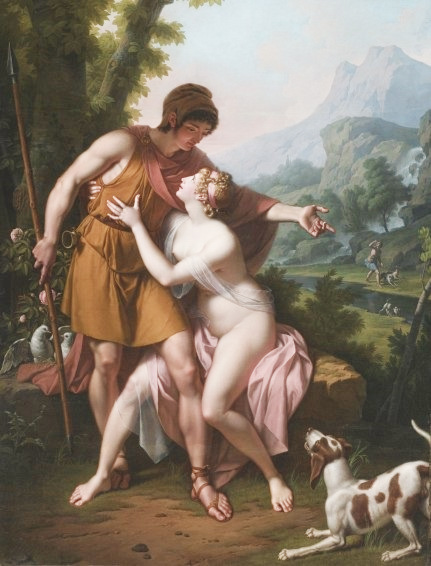
The poem tells the story of Venus, who is Goddess of Love, and her attempted seduction of Adonis, an extremely handsome young man, who would rather go hunting. The poem is dramatic, pastoral, and at times erotic, comic, tragic, pastoral-comical, historical-pastoral, tragical-historical, tragical-comical-historical-pastoral. It contains discourses on the nature of love, and many brilliantly described observations of nature. More Venus and Adonis

Almost always, the artist features softly rounded figures with pearly velvety flesh tones which play off against swaths of luxuriously rendered materials. These pictures were often executed for the artists own artistic satisfaction as no public commissions for works of this size are recorded, and many private homes of the time could rarely accommodate such large pictures. Through his preference for the mythological scene, Regnault was able to capitalize on the depiction of the female form in a variety of scenes, and his success in depicting the mythological female form as supremely sensual and elegant is apparent throughout his oeuvre. More on this painting

Jean-Baptiste Regnault  (1754–1829)
The death of Adonis, c. between 1800 and 1825 
Oil on panel
Height: 24 cm (9.4 in); Width: 19 cm (7.4 in)
Louvre museum

Adonis was the mortal lover of the goddess Aphrodite in Greek mythology. He was conceived after Aphrodite cursed his mother Myrrha to lust after her own father, King Cinyras of Cyprus. Myrrha had sex with her father in complete darkness for nine nights, but he discovered her identity and chased her with a sword. The gods transformed her into a myrrh tree and, in the form of a tree, she gave birth to Adonis. 

Aphrodite found the infant and gave him to be raised by Persephone, the queen of the Underworld. Adonis grew into an astonishingly handsome young man, causing Aphrodite and Persephone to feud over him, with Zeus eventually decreeing that Adonis would spend one third of the year in the Underworld with Persephone, one third of the year with Aphrodite, and the final third of the year with whomever he chose. Adonis chose to spend his final third of the year with Aphrodite.

One day, Adonis was gored by a wild boar during a hunting trip and died in Aphrodite's arms as she wept. His blood mingled with her tears and became the anemone flower. More on The death of Adonis

Jean Baptiste Regnault (Paris 1754-1829)
Danaë
Oil on canvas
19 7/8 x 24 1/8 in. (50.5 x 61.3 cm.)
Private collection

Disappointed by his lack of male heirs, King Acrisius asked the oracle of Delphi if this would change. The oracle announced to him that he would never have a son, but his daughter would, and that he would be killed by his daughter's son. At the time, Danae was childless and, meaning to keep her so, she was imprisoned in a tall brass tower with a single richly adorned chamber, but with no doors or windows, just a sky-light. However, Zeus, the king of the gods, desired her, and came to her in the form of golden rain which streamed in through the roof of the subterranean chamber and down into her womb. Soon after, their child Perseus was born.

Unwilling to provoke the wrath of the gods or the Furies by killing his offspring and grandchild, King Acrisius cast Danaë and Perseus into the sea in a wooden chest. The sea was calmed by Poseidon and, at the request of Zeus, the pair survived. They were washed ashore on the island of Seriphos, where they were taken in by Dictys – the brother of King Polydectes – who raised Perseus to manhood. The King was charmed by Danaë, but she had no interest in him. Consequently, he agreed not to marry her only if her son would bring him the head of the Gorgon Medusa. Using Athena's shield, Hermes's winged sandals and Hades' helmet of invisibility, Perseus was able to evade Medusa's gaze and decapitate her.

Later, after Perseus brought back Medusa's head and rescued Andromeda, the oracle's prophecy came true. He started for Argos, but learning of the prophecy, instead went to Larissa, where athletic games were being held. By chance, an aging Acrisius was there and Perseus accidentally struck him on the head with his javelin (or discus), fulfilling the prophecy. More on Danaë

Jean Baptiste Regnault (Paris 1754-1829)
Sapho
Oil on canvas
Height: 42 cm (16.5 in); Width: 53 cm (20.8 in)
Nationalmuseum, Stockholm

Sappho was an ancient Greek poet from the island of Lesbos, known amongst other things for her love poems dedicated to other women—hence the expression “lesbian love.” Naked figures are abundant in Neoclassical art, depicted with an emphasis on the contours of the body and the profile of the face that often has an erotic undertone. Sappho resembles pictures by Anne-Louis Girodet, and when Nationalmuseum bought the painting in 1919, experts believed Girodet was the artist. Now it is thought a lesser-known painter is the artist, possibly a foreigner educated in Paris around 1800. More on this painting

Besides various small pictures and allegorical subjects, Regnault was also the author of many large historical paintings; and his school, which reckoned amongst its chief attendants Guérin, Crepin, Lafitte, Blondel, Robert Lefèvre, Henriette Lorimier and Alexandre Menjaud, was for a long while the rival in influence of that of David.

Jean-Baptiste Regnault  (1754–1829) 
The Judgement of Paris, c. 1820
Oil on canvas
Staatsgalerie Stuttgart 

The judgment of Paris was a contest between the three most beautiful goddesses of Olympos--Aphrodite, Hera and Athena--for the prize of a golden apple addressed "To the Fairest."
 
The story began with the wedding of Peleus and Thetis which all the gods had been invited to attend except for Eris, goddess of discord. When Eris appeared at the festivities she was turned away and in her anger cast the golden apple amongst the assembled goddesses addressed "To the Fairest." Three goddesses laid claim to the apple--Aphrodite, Hera and Athena. Zeus was asked to mediate and he commanded Hermes to lead the three goddesses to Paris of Troy to decide the issue. The three goddesses appearing before the shepherd prince, each offering him gifts for favour. He chose Aphrodite, swayed by her promise to bestow upon him Helene, the most beautiful woman, for wife. The subsequent abduction of Helene led directly to the Trojan War and the fall of the city. More on The judgment of Paris

REGNAULT, Jean-Baptiste
The Toilet of Venus
Oil on panel
33 x 27 cm
Private collection

Baron Jean Baptiste Regnault
Io and Jupiter
Black chalk, stump (Black Stone, fades)
32 x 24cm
Private collection

Regnault Jean-Baptiste, Baron (1754-1829)
Jupiter and Io, c. 1827
Oil on canvas
Height: 2.14 m Width: 1.58 m
Museum of Fine Arts

The scene of Jupiter and Io is inspired by Ovid's classic Metamorphoses. Io, daughter of Inachus, the first king of Argos, is seduced by Jupiter (Zeus in Greek), who hides behind the dunes to avoid hurting the jealous Juno (Hera in Greek). Jupiter was often tempted by other women and took on various disguises in order to cover his various escapades, one time taking the form of a swan, another time of an eagle, and in this painting he is not becoming something else so much as enveloping himself in a dark cloud, even though it is bright daylight. He is embracing the nymph, his face barely visible above hers. She is pulling Jupiter's vague, smoky head towards herself with barely contained sensuality; this is a sensual painting, depicting one of the many loves of the god. More on this painting

Noteworthy is the contrast between the evanescent figure of the immaterial Jupiter, and the sensual substance of Io's body, shown lost in an erotic rapture which anticipates the works of Bernini and Rubens.

Besides Merry-Joseph Blondel, Pierre-Narcisse Guérin, Robert Lefèvre, and Henriette Lorimier, Jean-Baptiste Regnault's students include: Godefroy Engelmann, Louis Hersent, Charles Paul Landon, Hippolyte Lecomte, Jacques Réattu, Jean-Hilaire Belloc.

Jean-Baptiste Regnault was married first to Sophie Meyer, then Sophie Félicité Beaucourt.

He died in Paris. He is buried in Père-Lachaise Cemetery. More on Jean-Baptiste Regnault


Please visit my other blogs: Art Collector, Mythology, Marine Art, Portrait of a Lady, The Orientalist, Art of the Nude and The Canals of Venice, Middle East Artists, 365 Saints and 365 Days, also visit my Boards on Pinterest

Images are copyright of their respective owners, assignees or others. Some Images may be subject to copyright

I don't own any of these images - credit is always given when due unless it is unknown to me. if I post your images without your permission, please tell me.

I do not sell art, art prints, framed posters or reproductions. Ads are shown only to compensate the hosting expenses.

If you enjoyed this post, please share with friends and family.

Thank you for visiting my blog and also for liking its posts and pages.

Please note that the content of this post primarily consists of articles available from Wikipedia or other free sources online.


A note to the readers of Zaidan Gallery

    A note to the readers of Zaidan Gallery It is with great sadness that we share the news that the author of this blog,  Henry Zaidan (194...