Showing posts with label Achilles. Show all posts

Saturday, October 9, 2021

18 Works, October 9th. is Jean-Baptiste Regnault's day, his story, illustrated with footnotes #219

Regnault, Jean-Baptiste
The wedding between Jerome Bonaparte and Catherine of Wurtemberg
Oil on canvas
Height: 4 m (13.1 ft); Width: 6.4 m (21.1 ft)
Palace of Versailles

Signature of the marriage contract of Prince Jérôme Bonaparte and Frédérique-Catherine of Wurtemberg. In the presence of the imperial family at the Tuileries, August 22, 1807

Depicted people: Caroline Bonaparte, Elisa Bonaparte, Hortense de Beauharnais, Jerome Bonaparte, Joseph Bonaparte, Josephine de Beauharnais, Julie Clary, Letizia Bonaparte, Louis-Alexandre Berthier, Louis Bonaparte, Napoleon, Pauline Bonaparte

Jean-Baptiste Regnault (9 October 1754 – 12 November 1829)
was a French painter.

Regnault, Jean-Baptiste
Diogenes visited by Alexander
Oil / canvas
High. in cm: 119 . High. in cm: 145 .
 National Ecole des Beaux-Arts , France

"Thereupon many statesmen and philosophers came to Alexander with their congratulations, and he expected that Diogenes of Sinope also, who was tarrying in Corinth, would do likewise. But since that philosopher took not the slightest notice of Alexander, and continued to enjoy his leisure in the suburb Craneion, Alexander went in person to see him, and he found him lying in the sun. Diogenes raised himself up a little when he saw so many people coming towards him, and fixed his eyes upon Alexander. And when that monarch addressed him with greetings, and asked if he wanted anything, "Yes," said Diogenes, "stand a little out of my sun."[7] It is said that Alexander was so struck by this, and admired so much the haughtiness and grandeur of the man who had nothing but scorn for him, that he said to his followers, who were laughing and jesting about the philosopher as they went away, "But truly, if I were not Alexander, I wish I were Diogenes." Plutarch

Jean-Baptiste Regnault  (1754–1829)
The Education of Achilles by Chiron, c. 1782
Oil on canvas
Height: 261 cm (102.7 in); Width: 215 cm (84.6 in)
Louvre Museum

The legend of Achilles is one of the richest and oldest of Greek mythology. It was made famous by Homer in The Iliad, which helped to popularize the adventures of the young hero of the Trojan War. Son of Peleus, king of Phthia in Thessaly, and the sea nymph Thetis, Achilles is most remembered for his one weakness - his heel - which would eventually lead to his downfall. The composition captures the warrior as a youth with the centaur Chiron, the legendary tutor of gods and heroes who instructed him in the arts of medicine, music, riding and hunting. 

Beautifully composed, the two figures are depicted in perfect juxtaposition: young versus old, man versus centaur, light versus dark. Yet, the result is a lyrical harmony enhanced by both the narrative and aesthetic presence of the piece. More on the Education of Achilles by Chiron

Jean-Baptiste Regnault  (1754–1829)
The Three Graces, c. between 1793 and 1794
Oil on canvas
Height: 204 cm (80.3 in); Width: 153.5 cm (60.4 in)
Louvre Museum)

Attributed to Baron Jean Baptiste Regnault
The Three Graces
Oil on canvas
31 x 23.2 cm; 12 1/8 by 9 1/8 in
Private collection

In Greek mythology, a Charis or Grace is one of three or more minor goddesses of charm, beauty, nature, human creativity, and fertility, together known as the Charites or Graces. The usual list, from youngest to oldest is Aglaea ("Splendor"), Euphrosyne ("Mirth"), and Thalia ("Good Cheer"). In Roman mythology they were known as the Gratiae, the "Graces". In some variants, Charis was one of the Graces and was not the singular form of their name.

The Charites were usually considered the daughters of Zeus and Eurynome, though they were also said to be daughters of Dionysus and Aphrodite or of Helios and the naiad Aegle. Other possible names of their mother by Zeus are Eurydome, Eurymedousa, and Euanthe. Homer wrote that they were part of the retinue of Aphrodite. The Charites were also associated with the Greek underworld and the Eleusinian Mysteries.

The river Cephissus near Delphi was sacred to them. More Three Graces (aka the Charities)

Jean-Baptiste Regnault  (1754–1829)
The Flood, circa 1789
Oil on canvas
Height: 89 cm (35 in); Width: 71 cm (27.9 in)
Louvre Museum

A great flood is one of the most common elements in most mythologies. Floods appear in several variations across many quite different mythologies, and are a popular subject for depiction in European and non-European paintings.

The best-known story, at least in Europe, is that given in the Old Testament, in Genesis Chapters 6-9: the people of the world had become wicked and turned their backs on God, so God decided to send a flood to wipe them off the face of the earth. Only the faithful Noah and his family were to be spared, in recognition of their more godly ways. Noah was therefore told to build a large vessel, the Ark, into which he placed himself, his family, and a breeding pair of all the animals and birds on the earth. More on The Flood

Jean-Baptiste Regnault  (1754–1829)
The Descent from the Cross, c. 1789
Oil on canvas
Height: 4.2 m (13.9 ft); Width: 2.3 m (91.7 in)
Louvre Museum

Depicted people: John the Apostle, Mary Magdalene, Nicodemus

This altarpiece was commissioned for the chapel in the Château de Fontainiebleau.

The Descent from the Cross, or Deposition of Christ, is the scene, as depicted in art, from the Gospels' accounts of Joseph of Arimathea and Nicodemus taking Christ down from the cross after his crucifixion. In Byzantine art the topic became popular in the 9th century, and in the West from the 10th century. The Descent from the Cross is the 13th Station of the Cross.

Other figures not mentioned in the Gospels who are often included in depictions of this subject include St. John the Evangelist, who is sometimes depicted supporting a fainting Mary, and Mary Magdalene. More on the decent from the cross

Jean-Baptiste Regnault  (1754–1829)
Socrates Tears Alcibiades from the Embrace of Sensual Pleasure, c. 1791
Oil on canvas
H. 46 cm (18 in.), W. 68 cm (26 ¾ in.)
Louvre Museum

In this painting, the great philosopher Socrates forcibly tries to tear the young man out of the embrace of a personified Sensuality. This didactic image highlights Socrates as a model of rational thought, denouncing his student’s flight to earthly charms. The painting captures the moral dilemma of virtue versus pleasure for a celebrated Athenian youth, although this particular scene cannot be traced to any literary source. In a more general sense, according to Plato’s Symposium paraphrased by J. H. Lesher, Alcibiades “rejected Socrates’ attempt to recruit him into the philosophical life and fell back, with a palpable sense of shame and failure, into the pursuit of political power and popularity.” More on this painting

Regnault was born in Paris, and began life at sea in a merchant vessel. At the age of fifteen his talent attracted attention, and he was sent to Italy by M. de Monval under the care of Bardin. After his return to Paris in 1776, Regnault won the Grand Prix for his painting Alexandre and Diogène (See above), and in 1783 he was elected to the French Académie des Beaux-Arts. His diploma picture, The Education of Achilles by Chiron the Centaur (See above), is now in the Louvre, as also are his The Three Graces (See above), The Flood (See above), Descente de croix (Christ taken down from the Cross, originally executed for the royal chapel at Fontainebleau) (See above) and Socrate arrachant Alcibiade du sein de la Volupté (See above).

Jean-Baptiste Regnault  (1754–1829)
Dibutades Tracing the Portrait of a Shepherd, c. 1785
Oil on canvas
120 x 140 cm
Musée National du Château, Versailles

Long ago in the city of Corinth in Ancient Greece, a young maid traced the contour of her lover’s face on the wall. The man was leaving on a long trip. So, she figured out a way to preserve his image. With the help of a lamp, she cast the shadow of his profile and used it as a guide. And that is how the painting was born. 

In the last decades of the eighteenth century there was a widespread vogue for paintings that evoked the origins of art. Instead of the usual allegories or emblematic paintings of tools of the trade, two anecdotal subjects were often handled: "Dibutades Tracing the Portrait of a Shepherd" and "Pygmalion and Galatea" (sculpture). In both cases, love was at the heart of the work. The former subject, extraordinarily popular during the last third of the century, concerned the legend of a young woman from Corinth, who outlined the shadow cast on a wall by her beloved. It was held to be a valid illustration of the origins of art, combined with the amorous motivation required by that sentimental age. The anecdote was cited in art manuals as early as 1760, and was familiar to every studio. More on this painting

Jean-Baptiste Regnault  (1754–1829)
The Origin of Sculpture, c. 1786
Oil on canvas
Height: 120 cm (47.2 in); Width: 140 cm (55.1 in)
Palace of Versailles

The Propoetides denied the divinity of Venus. For that, the goddess first hardened their hearts by turning them into prostitutes, and finally into hard flint rocks.

Pygmalion had seen the Propoetides, and became celibate as a result of his revulsion. He still wanted married love, though, and carved himself the most perfect and lifelike statue of a woman in ivory. He kissed it lovingly, spoke to it, and dressed it in fine clothing.

When the festival of Venus arrived, Pygmalion prayed that he should have a bride who was the living likeness of his statue. Venus heard this, and the sacred flame rose to indicate her response. Pygmalion returned home, rejoicing that his prayer might be answered.

His marriage to the former statue was blessed by Venus, and nine months later they celebrated the birth of their daughter, whom they called Paphos, after whom the island was named. More on this painting

Regnault used to theme for an overdoor in the queen's Grand Cabinet at Versailles, at the same time painting a Pygmalion for her bedchamber. There are numerous examples of this subject up to about 1820, culminating with Fuseli and Girodet.

His L'origine de la peinture and L'origine de la sculpture (See above), or Pygmalion amoureux de sa statue (See above) are now at the Palace of Versailles.

Jean-Baptiste Regnault
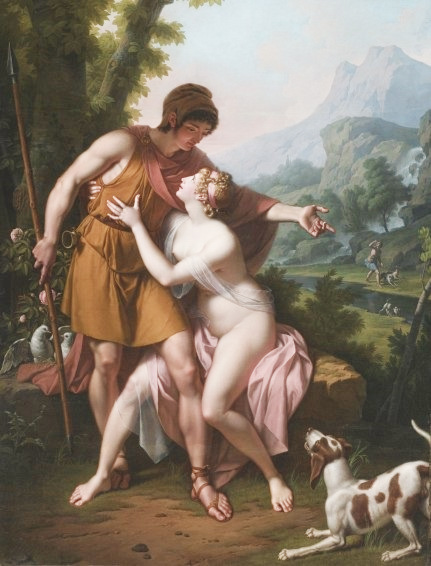
Venus and Adonis
oil on canvas
89  3/8  by 67  3/8  in.; 227 by 171 cm.
Private collection

Venus and Adonis is a narrative poem by William Shakespeare published in 1593, the same year that Christopher Marlowe published Hero and Leander and Thomas Nashe published The Choice of Valentines, all three classic erotic poems. It is probably Shakespeare's first publication.

The poem tells the story of Venus, who is Goddess of Love, and her attempted seduction of Adonis, an extremely handsome young man, who would rather go hunting. The poem is dramatic, pastoral, and at times erotic, comic, tragic, pastoral-comical, historical-pastoral, tragical-historical, tragical-comical-historical-pastoral. It contains discourses on the nature of love, and many brilliantly described observations of nature. More Venus and Adonis

Almost always, the artist features softly rounded figures with pearly velvety flesh tones which play off against swaths of luxuriously rendered materials. These pictures were often executed for the artists own artistic satisfaction as no public commissions for works of this size are recorded, and many private homes of the time could rarely accommodate such large pictures. Through his preference for the mythological scene, Regnault was able to capitalize on the depiction of the female form in a variety of scenes, and his success in depicting the mythological female form as supremely sensual and elegant is apparent throughout his oeuvre. More on this painting

Jean-Baptiste Regnault  (1754–1829)
The death of Adonis, c. between 1800 and 1825 
Oil on panel
Height: 24 cm (9.4 in); Width: 19 cm (7.4 in)
Louvre museum

Adonis was the mortal lover of the goddess Aphrodite in Greek mythology. He was conceived after Aphrodite cursed his mother Myrrha to lust after her own father, King Cinyras of Cyprus. Myrrha had sex with her father in complete darkness for nine nights, but he discovered her identity and chased her with a sword. The gods transformed her into a myrrh tree and, in the form of a tree, she gave birth to Adonis. 

Aphrodite found the infant and gave him to be raised by Persephone, the queen of the Underworld. Adonis grew into an astonishingly handsome young man, causing Aphrodite and Persephone to feud over him, with Zeus eventually decreeing that Adonis would spend one third of the year in the Underworld with Persephone, one third of the year with Aphrodite, and the final third of the year with whomever he chose. Adonis chose to spend his final third of the year with Aphrodite.

One day, Adonis was gored by a wild boar during a hunting trip and died in Aphrodite's arms as she wept. His blood mingled with her tears and became the anemone flower. More on The death of Adonis

Jean Baptiste Regnault (Paris 1754-1829)
Danaë
Oil on canvas
19 7/8 x 24 1/8 in. (50.5 x 61.3 cm.)
Private collection

Disappointed by his lack of male heirs, King Acrisius asked the oracle of Delphi if this would change. The oracle announced to him that he would never have a son, but his daughter would, and that he would be killed by his daughter's son. At the time, Danae was childless and, meaning to keep her so, she was imprisoned in a tall brass tower with a single richly adorned chamber, but with no doors or windows, just a sky-light. However, Zeus, the king of the gods, desired her, and came to her in the form of golden rain which streamed in through the roof of the subterranean chamber and down into her womb. Soon after, their child Perseus was born.

Unwilling to provoke the wrath of the gods or the Furies by killing his offspring and grandchild, King Acrisius cast Danaë and Perseus into the sea in a wooden chest. The sea was calmed by Poseidon and, at the request of Zeus, the pair survived. They were washed ashore on the island of Seriphos, where they were taken in by Dictys – the brother of King Polydectes – who raised Perseus to manhood. The King was charmed by Danaë, but she had no interest in him. Consequently, he agreed not to marry her only if her son would bring him the head of the Gorgon Medusa. Using Athena's shield, Hermes's winged sandals and Hades' helmet of invisibility, Perseus was able to evade Medusa's gaze and decapitate her.

Later, after Perseus brought back Medusa's head and rescued Andromeda, the oracle's prophecy came true. He started for Argos, but learning of the prophecy, instead went to Larissa, where athletic games were being held. By chance, an aging Acrisius was there and Perseus accidentally struck him on the head with his javelin (or discus), fulfilling the prophecy. More on Danaë

Jean Baptiste Regnault (Paris 1754-1829)
Sapho
Oil on canvas
Height: 42 cm (16.5 in); Width: 53 cm (20.8 in)
Nationalmuseum, Stockholm

Sappho was an ancient Greek poet from the island of Lesbos, known amongst other things for her love poems dedicated to other women—hence the expression “lesbian love.” Naked figures are abundant in Neoclassical art, depicted with an emphasis on the contours of the body and the profile of the face that often has an erotic undertone. Sappho resembles pictures by Anne-Louis Girodet, and when Nationalmuseum bought the painting in 1919, experts believed Girodet was the artist. Now it is thought a lesser-known painter is the artist, possibly a foreigner educated in Paris around 1800. More on this painting

Besides various small pictures and allegorical subjects, Regnault was also the author of many large historical paintings; and his school, which reckoned amongst its chief attendants Guérin, Crepin, Lafitte, Blondel, Robert Lefèvre, Henriette Lorimier and Alexandre Menjaud, was for a long while the rival in influence of that of David.

Jean-Baptiste Regnault  (1754–1829) 
The Judgement of Paris, c. 1820
Oil on canvas
Staatsgalerie Stuttgart 

The judgment of Paris was a contest between the three most beautiful goddesses of Olympos--Aphrodite, Hera and Athena--for the prize of a golden apple addressed "To the Fairest."
 
The story began with the wedding of Peleus and Thetis which all the gods had been invited to attend except for Eris, goddess of discord. When Eris appeared at the festivities she was turned away and in her anger cast the golden apple amongst the assembled goddesses addressed "To the Fairest." Three goddesses laid claim to the apple--Aphrodite, Hera and Athena. Zeus was asked to mediate and he commanded Hermes to lead the three goddesses to Paris of Troy to decide the issue. The three goddesses appearing before the shepherd prince, each offering him gifts for favour. He chose Aphrodite, swayed by her promise to bestow upon him Helene, the most beautiful woman, for wife. The subsequent abduction of Helene led directly to the Trojan War and the fall of the city. More on The judgment of Paris

REGNAULT, Jean-Baptiste
The Toilet of Venus
Oil on panel
33 x 27 cm
Private collection

Baron Jean Baptiste Regnault
Io and Jupiter
Black chalk, stump (Black Stone, fades)
32 x 24cm
Private collection

Regnault Jean-Baptiste, Baron (1754-1829)
Jupiter and Io, c. 1827
Oil on canvas
Height: 2.14 m Width: 1.58 m
Museum of Fine Arts

The scene of Jupiter and Io is inspired by Ovid's classic Metamorphoses. Io, daughter of Inachus, the first king of Argos, is seduced by Jupiter (Zeus in Greek), who hides behind the dunes to avoid hurting the jealous Juno (Hera in Greek). Jupiter was often tempted by other women and took on various disguises in order to cover his various escapades, one time taking the form of a swan, another time of an eagle, and in this painting he is not becoming something else so much as enveloping himself in a dark cloud, even though it is bright daylight. He is embracing the nymph, his face barely visible above hers. She is pulling Jupiter's vague, smoky head towards herself with barely contained sensuality; this is a sensual painting, depicting one of the many loves of the god. More on this painting

Noteworthy is the contrast between the evanescent figure of the immaterial Jupiter, and the sensual substance of Io's body, shown lost in an erotic rapture which anticipates the works of Bernini and Rubens.

Besides Merry-Joseph Blondel, Pierre-Narcisse Guérin, Robert Lefèvre, and Henriette Lorimier, Jean-Baptiste Regnault's students include: Godefroy Engelmann, Louis Hersent, Charles Paul Landon, Hippolyte Lecomte, Jacques Réattu, Jean-Hilaire Belloc.

Jean-Baptiste Regnault was married first to Sophie Meyer, then Sophie Félicité Beaucourt.

He died in Paris. He is buried in Père-Lachaise Cemetery. More on Jean-Baptiste Regnault


Please visit my other blogs: Art CollectorMythologyMarine ArtPortrait of a Lady, The OrientalistArt of the Nude and The Canals of VeniceMiddle East Artists365 Saints and 365 Days, also visit my Boards on Pinterest

Images are copyright of their respective owners, assignees or others. Some Images may be subject to copyright

I don't own any of these images - credit is always given when due unless it is unknown to me. if I post your images without your permission, please tell me.

I do not sell art, art prints, framed posters or reproductions. Ads are shown only to compensate the hosting expenses.

If you enjoyed this post, please share with friends and family.

Thank you for visiting my blog and also for liking its posts and pages.

Please note that the content of this post primarily consists of articles available from Wikipedia or other free sources online.


Sunday, September 12, 2021

19 Works, September 11th. is Artist Gerard de Lairesse's day, his story, illustrated with footnotes #201

Gerard de Lairesse (1640–1711)
Hercules between Vice and Virtue, c. 1685
Oil on canvas
Height: 112 cm (44 in); Width: 181 cm (71.2 in)
Louvre Museum

The theme comes from the famous apologue of Prodicas, transmitted by Xenophon, often represented by painters (Raphael, Carrache, Rubens, etc., cf. Panofsky). Vice is embodied by the provocative Voluptuousness, accompanied by an old woman in the role of matchmaker. The attribute of chaste Virtue is a horse bit, a symbol of restraint and moderation. Behind Hercules, already on the path to good, a Fame and, in the background, the temple of glory which rewards good deeds. More on this painting

Hercules at the crossroads, also known as the Choice of Hercules and the Judgement of Hercules, is an ancient Greek parable attributed to Prodicus and known from Xenophon. It concerns the young Heracles/Hercules who is offered a choice between Vice and Virtue—a life of pleasure or one of hardship and honour. In the early modern period it became a popular motif in Western art. More on Hercules at the crossroads

Gerard or Gérard (de) Lairesse (11 September 1641 – June 1711) was a Dutch Golden Age painter and art theorist. His broad range of skills included music, poetry, and theatre. His importance grew in the period following the death of Rembrandt. His treatises on painting and drawing, Grondlegginge Ter Teekenkonst (1701),based on geometry and Groot Schilderboek (1707), were highly influential on 18th-century painters.

Gerard de Lairesse (1640–1711)
An Allegory of the Senses, c. 1668
Oil on canvas
H 137.2 x W 182.9 cm
Kelvingrove Art Gallery and Museum

The senses are represented in this painting by the five main figures, each of whom holds or does something associated with a particular sense. But while the senses are short-lived, true love, symbolized by the statue of Cupid, is eternal. Such a grand and moralizing painting was probably commissioned by someone both learned and wealthy, presumably a member of the van Rijn family whose children are believed to be the models in the painting.

In 1730, Elizabeth van Rijn married Jacques-Philippe d'Orville, a celebrated Amsterdam professor, from whose descendant this painting was purchased in 2001. Lairesse was one of the greatest and most celebrated artists of his day, and a leading exponent of French-style Classicism. More on this painting

Gerard de Lairesse
Allegory of Abundance (? Allegory of the Blessings of the Peace of Breda), c. 1667
Oil on canvas
150 x 135 cm.
Haags Historisch Museum, The Hague

Central in this painting is a standing woman with a winged scepter topped by a hand and eye. She is Industria. She looks at the seated woman who, with her many breasts, represents fertile nature, and points to the statue that is crowned with flowers. The marble woman is an amalgam of several female statues. This painting must have been a commissioned chimneypiece—perhaps his first in Amsterdam—and he did his best to make a memorable work that would have dazzled Amsterdam connoisseurs. More on this painting

De Lairesse was born in Liège and was the second son of painter Renier de Lairesse (1597-1667). He studied art under his father and from 1655 under Bertholet Flemalle. He worked in Cologne and Aix-la-Chapelle for Maximilian Henry of Bavaria from 1660. In 1664 De Lairesse fled from Liège after an affair with two sisters, his models, led to difficulties. He travelled north with a girl named Marie Salme and married her in Visé. The couple settled in Utrecht, where a son was baptized in April 1665. When his talent as an artist was discovered by the art dealer Gerrit van Uylenburgh, he moved to Amsterdam. De Lairesse arrived with his violin, with which he impressed Jan van Pee and probably Anthonie Claesz de Grebber in Uylenburgh's studio. In 1670 a son, Abraham, was born; the engraver Abraham Blooteling, with whom he collaborated, was the witness at the baptism; another son was baptized in 1673.

Gerard de Lairesse (Dutch, Liège 1641–1711 Amsterdam)
Apollo and Aurora, c. 1671
Oil on canvas
80 1/2 x 76 1/8 in. (204.5 x 193.4 cm)
Metropolitan Museum of Art.

Apollo is one of the Olympian deities in classical Greek and Roman religion and Greek and Roman mythology. The national divinity of the Greeks, Apollo has been recognized as a god of archery, music and dance, truth and prophecy, healing and diseases, the Sun and light, poetry, and more. More on Apollo

Aurōra is the Latin word for dawn, and the goddess of dawn in Roman mythology and Latin poetry.  Aurōra renews herself every morning and flies across the sky, announcing the arrival of the Sun. More on Aurōra

De Lairesse was celebrated in his lifetime as a painter and advocate for an idealizing manner based on the study of classical antiquity. This work, likely destined to hang over the mantelpiece in a grand Amsterdam home, depicts the sun god consorting with the goddess of the dawn, a popular subject in French and Italian painting at the time. The attractively individualized young faces have led to speculation that they may be disguised portraits of a newly married couple. More on this painting

Gerard de Lairesse  1641-1711
Venus Presenting Weapons to Aeneas
Oil on canvas
Height: 161.8 cm (63.7 in); Width: 165.8 cm (65.2 in)
Museum Mayer van den Bergh 

de Lairesse has illustrated the passage from Virgil's Aeneid (Book VIII) in which Venus descends amid clouds to bring weapons made by Vulcan to her son Aeneas: "See the promised gifts, product of my husband's art. Now seek out the Laurentine enemy and defy proud Turnus".

Gerard de Lairesse  1641-1711
Selene and Endymion
Oil on canvas
177 cm × width 118.5 cm
Rijksmuseum, Amsterdam

The chaste goddess of the moon, Selene (or Diana), is in love with the shepherd Endymion. Only at night when he is asleep does she quietly creep down to him, accompanied by Cupid, whose torch symbolizes burning love. 

Cupid with a burning torch points Selene (or Diana) to the sleeping Endymion. Behind the moon goddess, the moon shines in the sky between the clouds. More on this painting

Gerard de Lairesse  1641-1711
Odysseus and Calypso
Oil on canvas
125 cm × width 94 cm
Rijksmuseum, Amsterdam

The Greek poet Homer recounts how the heroic warrior Odysseus found refuge on the island of the nymph Calypso. The Trojan War is over: Amor, the god of love, now teasingly places the battle helmet on Calypso’s head. Odysseus and Calypso instantly fall in love. This painting hung in the Soestdijk hunting lodge, in the apartment of Mary Stuart, the consort of William III.

The naked goddess puts an arm around Odysseus' shoulders. An Amor places a plumed helmet on her head. In the background a curtain stretched in front of a tree. More on this painting

Gerard de Lairesse, (Flemish, 1641-1711)
Hermes Ordering Calypso to Release Odysseus, c. 1670
Oil on canvas
91.4 x 113.7 cm (36 x 44 3/4 in.)
Cleveland Museum of Art

The Greek goddess Calypso held the hero Odysseus captive for seven years, preventing his return home from the Trojan War. Despite Calypso’s charms and the luxurious surroundings, Odysseus longed for his home and family, so the Olympian gods finally allowed his freedom. Here, the god Hermes swoops down to free Odysseus from Calypso’s embrace. De Lairesse, popularly known as the “Dutch Poussin,” introduced to the Netherlands a classicizing style influenced by artists of the French Academy. More on this painting

Gerard de Lairesse  1641-1711
Mercury Ordering Calypso to Release Odysseus, c. 1680
Oil on canvas
132 cm × width 96 cm
Rijksmuseum, Amsterdam

During his wanderings, Odysseus encounters the nymph Calypso, who falls in love with him and holds him captive on her island. Jupiter then sends Mercury to command her to let Odysseus return to his wife. 

Mercury orders Calypso to let Odysseus leave. In the foreground, an Amor poses with Odysseus' helmet and weapons. More on this painting

Lairesse, Gerard de. 1641-1711
The Landing of Helena led by Paris to the Priam Palace in Troy, c. 1685-1690
Other title: Cleopatra and Antoine disembark at Tarsus
Oil on canvas
Height: 0.6 m; Width: 0.67 m
Louvre Museum , Paris

Other title: Cleopatra and Antoine disembark at Tarsus (wrongly said, J. Foucart, p. 172)
Description / FeaturesIt is advisable to return to the previous title to Villot, that given by sales and documents of the 18th century.

Scene inspired by the Iliad and rarely represented. Old King Priam is in the far right, beyond the palace entrance arcade. More on this painting

Lairesse, Gerard de. 1641-1711
Achilles Discovered among the Daughters of Lycomedes, c. 1685
Oil on canvas
138 x 190 cm
Mauritshuis, The Hague

The subject is taken from Ovid's Metamorphoses. Knowing her son was destined to die if he went to fight in the Trojan war, Thethis, a sea nymph, disguised Achilles as a woman and entrusted him to King Lycomedes, in whose palace on the isle of Scyros he lived among the king's daughters. Odysseus and other Greek chieftains were sent to fetch Achilles. They cunningly laid a heap of gifts before the girls - jewellery, clothes and other finery, but among them a sword, spear and shield. When a trumpet was sounded, Achilles instinctively snatched up the weapons and thus betrayed his identity.

This subject is rare in seventeenth-century Northern Netherlandish art. However, it became extremely popular in Flanders after Rubens' version appeared in c. 1616. There are three known versions of the theme by Lairesse: in the Mauritshuis, The Hague, in the Nationalmuseum, Stockholm, and in the Herzog Anton Ulrich-Museum, Braunschweig. More on this painting

De Lairesse moved to Spinhuissteeg where he became a member of the literary society Nil volentibus arduum, which seems to have gathered in his house from 1676 until 1681. In 1682 he sold copies of sheet music composed by Lully. In May 1684 he rented the nearby house of Caspar Barlaeus. His pupils Philip Tideman and Louis Abry lived there too.

Lairesse, Gérard de (Liège, 1641 - Amsterdam, 1711)
Abraham receiving the three angels of the Lord who will announce to him the next birth of his son Isaac, c. 1680-1685
Oil on canvas
Height: 1.2 m; Width: 1.64 m
Louvre Museum, Paris

Abraham receiving the three angels of the Lord who will announce to him the imminent birth of his son Isaac with Sarah, Abraham's old wife, who will soon have a son despite his advanced age. The angels are represented here without wings, in a purely secular fashion, and the tent of the biblical story, omitted.

Gerard de Lairesse  1641-1711
The Expulsion of Heliodorus From The Temple, c. 1674
oil on canvas
Height: 204 cm (80.3 in); Width: 193 cm (75.9 in)
Private collection

The Expulsion of Heliodorus from the Temple illustrates the biblical episode from 2 Maccabees (3:21-28). Heliodorus is ordered by Seleucus IV Philopator, the king of Syria, to seize the treasure preserved in the Temple in Jerusalem. Answering the prayers of the high priest Onias III, God sends a horseman assisted by two youths to drive Heliodorus out.

Lairesse, Gerard de. 1641-1711
Sacrifice, c. 1675-1680
Oil on canvas
113,5х148 cm
Hermitage Museum, Saint Petersburg, Russia

Sacrifice is the offering of material possessions or the lives of animals or humans to a deity as an act of propitiation or worship. Evidence of ritual animal sacrifice has been seen at least since ancient Hebrew and Greeks, and possibly existed before that. Evidence of ritual human sacrifice can also be found back to at least pre-Columbian civilizations of Mesoamerica as well as in European civilizations. Varieties of ritual non-human sacrifices are practiced by numerous religions today. More on Sacrifice

Gerard de Lairesse
The Anointing of Salomon, probably 1668
Oil on canvas
130 x 200 cm.
Bradford, England, Cartwright Hall

Priest Zadok, the prophet Nathan, and Benaiah son of Jehoiada, and the Cherethites and the Pelethites, went down and had Solomon ride on King David’s mule, and led him to Gihon. There the priest Zadok took the horn of oil from the tent and anointed Solomon. Then they blew the trumpet, and all the people said, ‘Long live King Solomon!’ 40And all the people went up following him, playing on pipes and rejoicing with great joy, so that the earth quaked at their noise. More on the Anointing of Salomon

Lairesse, Gerard de. 1641-1711
Hagar in the Desert, c. 1675-1680
Oil on canvas
74x60 cm
Hermitage Museum, Saint Petersburg, Russia

Hagar is a biblical person in the Book of Genesis Chapter 16. She was an Egyptian handmaid of Sarah, who gave her to Abraham "to wife" to bear a child. The product of the union was Abraham's firstborn, Ishmael, the progenitor of the Ishmaelites.
After Sarah gave birth to Isaac, and the tension between the women returned. At a celebration after Isaac was weaned, Sarah found the teenage Ishmael mocking her son, and demanded that Abraham send Hagar and her son away. She declared that Ishmael would not share in Isaac's inheritance. Abraham was greatly distressed but God told Abraham to do as his wife commanded because God's promise would be carried out through both Isaac and Ishmael.
The name Hagar originates from the Book of Genesis, and is only alluded to in the Qur'an. She is considered Abraham's second wife in the Islamic faith and acknowledged in all Abrahamic faiths. In mainstream Christianity, she is considered a concubine to Abraham. More on Hagar

Lairesse, Gerard de. 1641-1711
Jesus Christ celebrating Passover with his disciples, c. 1664-1665
Oil on canvas
Height: 1.37 m; Width: 1.55 m
Louvre Museum, Paris

De Lairesse produced paintings as decorations for the Soestdijk Palace between 1676 and 1683. In 1684 he moved to the Hague and worked there for a year. In 1685 he painted works for the Loo Palace. In 1688-1689, he decorated the civil council chamber of the Hof van Holland at the Binnenhof, presently known as the Lairesse room, with seven paintings with subjects from the history of the Roman Republic, all displaying a remarkable legal iconography.

Gerard de Lairesse  1641-1711
Cleopatra’s Banquet
Oil on canvas
74 cm × width 95.5 cm
Rijksmuseum, Amsterdam

Cleopatra made a bet with Mark Antony on who could give the most lavish banquet. She won by dissolving a priceless pearl in vinegar and then drinking the mixture. De Lairesse painted this story like a scene from a play, situating the figures clad in antique costumes in a fitting décor of Classical architecture and furniture. His classicizing style breathed new life into Dutch painting.

On the right is Cleopatra with bare breasts at the table, on the left is Marcus Antonius. Several guests and members of the royal household are present around the table. Pictured is the moment when Lucius Plancus prevents Cleopatra from taking a second pearl from her earring to dissolve in her wine. Mark Antony loses the bet. On the floor in front of the table is a hunting dog. In the background the architecture of the palace interior with caryatids. More on this painting

De Lairesse suffered from congenital syphilis, which caused him to go blind around 1690. After losing his sight, De Lairesse was forced to give up painting and focused instead on lecturing twice a week. De Lairesse explicitly states that despite his blindness, he was still able to design a perfect composition. He drew on two chalk boards and was assisted by his audience and his son Johannes who collected their notes. After several years two books on art were published.

Lairesse, Gerard de, copy after. 1641-1711
Water Deities (copy)
Oil on canvas
113х93,5 cm
Hermitage

Water deities are common in mythology and were usually more important among civilizations in which the sea or ocean, or a great river was more important. Another important focus of worship of water deities has been springs or holy wells. More on Water deities 

De Lairesse expressed his disapproval of realism style used by Dutch Golden Age painters like Rembrandt, Adriaen Brouwer, Adriaen van Ostade and Frans Hals because they often portrayed everyday scenes and ordinary people such as soldiers, farmers, maids, and even beggars. In De Lairesse's view, paintings ought to show lofty biblical, mythological and historical scenes, and felt that a complex historical allegory was the highest of genres. "A good painting has a clue, indicating what holds the composition together.

De Lairesse attracted many pupils, including Jan van Mieris, Simon van der Does, and the brothers Teodor and Krzysztof Lubieniecki. According to Houbraken, Jan Hoogsaat was one of his best pupils. According to the Netherlands Institute for Art History (RKD), his pupils also included Jacob van der Does (the Younger), Gilliam van der Gouwen, Louis Fabritius Dubourg, Theodor Lubienitzki, Bonaventura van Overbeek, Jan Wandelaar. More on Gerard de Lairesse


Please visit my other blogs: Art CollectorMythologyMarine ArtPortrait of a Lady, The OrientalistArt of the Nude and The Canals of VeniceMiddle East Artists365 Saints365 Days, and Biblical Icons, also visit my Boards on Pinterest

Images are copyright of their respective owners, assignees or others. Some Images may be subject to copyright

I don't own any of these images - credit is always given when due unless it is unknown to me. if I post your images without your permission, please tell me.

I do not sell art, art prints, framed posters or reproductions. Ads are shown only to compensate the hosting expenses.

If you enjoyed this post, please share with friends and family.

Thank you for visiting my blog and also for liking its posts and pages.

Please note that the content of this post primarily consists of articles available from Wikipedia or other free sources online.


A note to the readers of Zaidan Gallery

    A note to the readers of Zaidan Gallery It is with great sadness that we share the news that the author of this blog,  Henry Zaidan (194...