Showing posts with label Odalisque. Show all posts

Monday, December 6, 2021

28 Works, December 5th. is Edward Henry Corbould's day, his art, illustrated with footnotes #245

Edward Henry Corbould (British, 1815–1905)
The Earl of Surrey beholding the Fayre Geraldine in the magic mirror,, c. 1853
Pencil and Watercolor
92.7 x 125.7 cm. (36.5 x 49.5 in.)
Private collection

The curious painting was inspired by an apocryphal episode in the life of the gallant and unfortunate Henry Howard, Earl of Surrey – courtier, soldier and poet at the court of Henry VIII, who was captivated by the childish beauty of Lady Elizabeth FitzGerald, known as ‘the fair Geraldine’, and to whose service he had devoted his pen. During his travels the lovesick Surrey pined for his beloved and turned for a cure to Cornelius Agrippa, the celebrated astrologer and student of the occult. Agrippa, who possessed the ability to summon up apparitions, obliged Surrey’s wish to see Geraldine and conjured in a magic mirror the object of his affections. More on The Earl of Surrey ‘beholding the Fayre Geraldine in the magic mirror’

Edward Henry Corbould, R.I. (5 December 1815, in London – 18 January 1905, in London) was a British artist, noted as a historical painter and watercolourist.

Edward Henry Corbould (British, 1815–1905)
Jehu son of Nimshi on his way to Jezreel
Watercolor
18.5 x 45 in. (47 x 114.3 cm.)
Private collection

Scene from 2 Kings 9:16. Entourage including mounted armed warriors and Jehu in his chariot approaching the town of Jezreel where he was seeking King Joram, who was lying there wounded and King Ahaziah of Judah both of whom he was to slay on God's orders. 

Edward Henry Corbould (British, 1815–1905)
Jehu Enters the City of Jezreel, c. 1866
Watercolor and ink on paper
47.75 x 33.75 in. (121.3 x 85.7 cm.)
Private collection

Corbould depicts the moments before the death of Jezebel, a popular subject in late 19th-century art history. In the present work, each figure is exactingly rendered with vivacity and realism, as Corbould captures the scene with a remarkable aptitude not only for narrative but also detail.

Jehu made his way to the royal palace in Jezreel, where Queen Jezebel was his last obstacle standing in the way of his kingship. Realizing that Jehu's arrival was imminent, Jezebel bedecked herself in makeup and finery, and stood at the palace window. Corbould captures Jehu as he gallops into the city, points to the Queen, and orders the court eunuchs to throw her out the window. The viewer is spared the macabre epilogue, in which the Queen's body is trampled by horses and then devoured by stray dogs, fulfilling the prophesy of Elijah. Corbould perfectly captures the drama of the moment, from the power and energy of Jehu's retinue to the theatricality of Jezebel confronting her fate. More on this painting

Edward Henry Corbould
Salome dancing before Herod, c. 1868
Pencil, watercolour, bodycolour and gum arabic
29½ x 41½ in. (74.9 x 105.3 cm.)
Private collection

Salome was the daughter of Herod II and Herodias. She is infamous for demanding and receiving the head of John the Baptist, according to the New Testament. According to Flavius Josephus's Jewish Antiquities, Salome was first married to Philip the Tetrarch of Ituraea and Trakonitis. After Philip's death in 34 AD she married Aristobulus of Chalcis and became queen of Chalcis and Armenia Minor. They had three children. Three coins with portraits of Aristobulus and Salome have been found. Her name in Hebrew meaning "peace". More on Salome

Edward Henry Corbould
The story of the young Christ
Watercolour
35 x 50cm (13 3/4 x 19 11/16in).
Private collection

Edward Henry Corbould (1815–1905)
The Woman taken in Adultery, dated Apr 1842
Watercolour and bodycolour
99.0 x 127.0 cm 
The Royal Collection Trust

Jesus and the woman taken in adultery is a passage found in the Gospel of John.
In the passage, Jesus was teaching in the temple after coming from the Mount of Olives. A group of scribes and Pharisees confronts Jesus, interrupting his teaching. They bring in a woman, accusing her of committing adultery, claiming she was caught in the very act. They tell Jesus that the punishment for someone like her should be stoning, as prescribed by Mosaic Law. Jesus begins to write something on the ground using his finger. But when the woman's accusers continue their challenge, he states that the one who is without sin is the one who should cast the first stone at her. The accusers and congregants depart realizing not one of them is without sin either, leaving Jesus alone with the woman. Jesus asks the woman if anyone has condemned her and she answers no. Jesus says that he, too, does not condemn her, and tells her to go and sin no more. Jesus and the woman taken in adultery

The royal purchase of this watercolour at an exhibition in 1842 was important in establishing Corbould’s reputation. The theatrical depiction of Christ’s defence of a woman accused of adultery is typical of the artist’s rich style, more comparable to oil painting than to the British watercolour tradition. More on this painting

Born in London, he was son of Henry Corbould and grandson of Richard Corbould, both painters. He was a pupil of Henry Sass, and a student at the Royal Academy. In 1842 his watercolour of The Woman taken in Adultery (See above) was purchased by Albert, Prince Consort, and nine years later he was appointed instructor of historical painting to the Royal Family. He continued for twenty-one years teaching its members.

Edward Henry Corbould (1815–1905)
Lord Eglintonc, c. 1840
Ooil on panel
H 53.3 x W 42.5 cm
Victoria and Albert Museum

The Victorians frequently made commemorative oil paintings of significant people and events. This splendid portrait was probably commissioned by the knight shown in the picture, Archibald William Montgomerie, 13th Earl of Eglinton and 1st Earl of Winton (1812-1861). He is dressed here as `Lord of the Tournament.'

By the 1830s tales of romance and chivalry inspired an interest in the costume and events of the Middle Ages. This painting shows Lord Eglinton dressed in gold armour at the `Eglinton Tournament', which he hosted on his Scottish estate in 1839. Eglinton and his guests dressed themselves in Medieval-style costumes, and took part in processions and competitions. The Earl had been fired with enthusiasm for the Gothic revival by reading Sir Walter Scott's novels of chivalry. Unfortunately it rained heavily and continuously on the Knights and Peers of the Realm in full armour with fully dressed horses. What the picture also illustrates is an early Victorian reconstruction of what antiquarians believed a Medieval knight should look like. More on this painting

Edward Henry Corbould
Hail! Here comes the conquering Hero, c. 1893
Oil on canvas  
Private collection

Edward Henry Corbould (British, 1815-1905)
The Procession, c. 1893
Oil on canvas
48 x 60 in. (121.9 x 152.4 cm.)
Private collection

Edward Henry Corbould (British, 1815-1905)
The Marquis of Waterford at the Eglinton Tournament
Watercolor
32 1/4in x 59cm; 23 1/4in
Private collection

The Eglinton Tournament was held at Eglinton Castle, Aryshire on 28th and 30th August 1839 and attracted around 100,000 people. It started with a procession accompanied by torrential rain which completely waterlogged the ground. The knights sheltered under a grand stand next to the lists which collapsed under the weight of water. However, the tournament continued with running at the quintain and tilting. The present picture records what was apparently the best tilt, that held between Lord Eglinton and Lord Waterford, after the second course when the former broke his lance. More on this painting

Edward Henry Corbould (British, 1815–1905)
Two equestrian figures in armour one being thrown from his horse, with a castle behind, c. 1891
Watercolor
16.5 x 17.5 in. (41.9 x 44.4 cm.)
Private collection

Corbould's two equestrian figures in armour, one being thrown from his horse, with a castle behind. The top two corners with the Royal coat of arms and a shield with Prince of Wales' feathers. More on this painting

In 1834, 1835, and 1836 Corbould won gold medals of the Society of Arts, in 1834 with a watercolour of the Fall of Phaethon, and in the last two years with models of St. George and the Dragon and a Chariot Race, from Homer. His first exhibits in the Royal Academy in 1835 included a model (Cyllarus and Hylonome); and he submitted designs for four pieces of sculpture for Blackfriars Bridge.

Edward Henry Corbould (British, 1815–1905)
Joan of Arc signed and dated 1844
Watercolour painting
61.8 x 87.8 cm
The Royal Collection Trust

Joan of Arc, a peasant girl living in medieval France. At the age of 13, Joan began to hear voices, which she determined had been sent by God to give her a mission of overwhelming importance: to save France by expelling its enemies, and to install Charles as its rightful king. 
With no military training, Joan convinced the embattled crown prince Charles of Valois to allow her to lead a French army to the besieged city of Orléans, where it achieved a momentous victory over the English and their French allies, the Burgundians. After seeing the prince crowned King Charles VII, Joan was captured by Anglo-Burgundian forces, tried for witchcraft and heresy and burned at the stake in 1431, at the age of 19. By the time she was officially canonized in 1920, the Maid of Orléans (as she was known) had long been considered one of history’s greatest saints, and an enduring symbol of French unity and nationalism. More on Joan of Arc

Edward Henry Corbould (British, 1815–1905)
Dinah Morris preaching on the common dated 1861
Watercolour and bodycolour
76.0 x 55.5 cm
The Royal Collection Trust

This watercolour illustrates George Eliot's popular novel Adam Bede, a favourite with both the Queen and Prince Albert. In this scene from the second chapter, Corbould has faithfully realised the author's detailed description of the young Methodist preacher and her audience, the villagers of Hayslope. More on this painting

Edward Henry Corbould (British, 1815–1905)
Héloïse
Watercolor w/gum arabic
47 x 37 cm. (18.5 x 14.6 in.)
Private collection

The painting depicted here, is the very best depiction of this tragic French Heroine; one of the most famous romantic stories of all time; the true story of Heloise and Abalard ~ the letters are famous... this is in our opinion the best depiction of Heloise of all time

What makes the painting so extraordinary, is the fact that the artist painted a pimple in the corner of her mouth. Our left, and her right. This apart from the fact that he did not paint her as a seductive lavishly dressed woman, but as a nun stripped off all worldly goods bar a pearl, the symbol of wisdom, the perfect harmony/marriage of love and knowledge.
But the question remains: why the pimple? It lifts the painting form the ordinary to the extraordinary. More on this painting

Héloïse was a French nun, philosopher, writer, scholar and abbess.

Héloïse was a renowned "woman of letters" and philosopher of love and friendship, as well as an eventual high ranking abbess in the Catholic Church. She achieved approximately the level and political power of a bishop in 1147 when she was granted the rank of prelate nullius.

She is famous in history and popular culture for her love affair and correspondence with the leading medieval logician and theologian Peter Abelard, who became her colleague, collaborator and husband. She is known for exerting critical intellectual influence upon his work and posing many challenging questions to him. More on Héloïse

Edward Henry Corbould
Ladie Godiva, c. 1871
Oil on panel
48 x 28 in. (121.9 x 71.1 cm.)
Private collection

The myth of Lady Godiva enabled Corbould to depict a female nude and a mystical inscription of her name, 'Godiva', written in runes, may be seen on the staircase.

Godiva lived in the 11th Century. She was the wife of Leofric, Earl of Mercia. As an avid patron of the arts, she hoped that if the local populace had increased wealth they would develop broader cultural interests. After interceding with her husband on behalf of the people of Coventry to lighten the burden of their taxes, he relented on the condition that she rode through the streets naked. Her husband held that the nude was considered by the ancient world to be one of the highest expressions of the perfection of nature, and contested that if she were true to her beliefs, Godiva would accept his challenge. She did, and earned a place in cultural history. Corbould depicts her descending the stair in trepidation; her waiting horse is visible below. Lady Godiva

Edward Henry Corbould.
Lady Godiva
Engraved by J J Chant
Size 29 x 21 inches (74 x 53 cms.)
Private collection

Edward Henry Corbould (British, 1815–1905)
ASTARTE , c. 1887
Watercolor
75 x 37.5 cm. (29.5 x 14.8 in.)
Private collection

The goddess Astarte, a deity closely related to Ishtar, was initially the protector not only of traditionally female “elements” but also of direct power - this was a very serious echo of more ancient matriarchal traditions. The Babylonian, Sumerian, and Akkadian kings managed to overcome these traditions for only two thousand years, gradually reducing the role of Astarte in their pantheons and, accordingly, oppressing the role of women in society. More on Astarte

Edward Henry Corbould
Helena and Iphigenia signed and dated 1859
Watercolour and bodycolour with gum arabic
77.0 x 61.5 cm
The Royal Collection Trust

A watercolour and bodycolour illustration of Tennyson's 'A Dream of Fair Women', published 1831-2, showing Helen of Troy and Iphigenia in classical dress standing in a forest. 

This illustration of an early poem by Tennyson, the Chaucer-inspired 'A Dream of Fair Women', reflects Prince Albert's taste for Tennyson's work. He received the watercolour for Christmas in 1859 from Queen Victoria. The Queen had admired a larger work by Corbould, portraying all the heroines of Tennyson's poem earlier that year and subsequently commissioned this replica of the figures of Helen of Troy and Iphigenia. Queen Victoria thought them "the finest [figures Corbould] has yet painted." More on this painting


Corbould was known for his water-colours, in which he produced subjects illustrating literature (mainly from Chaucer, Spenser, and Shakespeare), history, and daily life. A few of his pictures are in oils (e.g. The Canterbury Pilgrims, 1874). He started exhibiting at the New Water Colour Society in 1837, becoming a member in the same year. His early exhibits included The Canterbury Pilgrims assembled at the old Tabard Inn. Many of his works were acquired by Queen Victoria, Prince Albert, and his royal pupils, including an illustration of Alfred Tennyson's Morte d'Arthur presented by Queen Victoria to Princess Louise, and Henry VI welcomed to London after his Coronation in Paris, and The Iconoclasts of Basle, acquired by the Empress Frederick for the imperial collection in Berlin.

Edward Henry Corbould
ODALISQUE
Watercolour over pencil
25 by 35.5 cm., 9 3/4 by 14 in.
Private collection


Apart from the royal collections, one of the largest collections of his works was that of George Strutt of Belper. A watercolour Lady Godiva went to the National Gallery of New South Wales.

Edward Henry Corbould (1815–1905)
Noah, a Mystery Play, c. 1858
The Chester's Play of Noah's Flood
Oil on canvas
H 69 x W 82 cm
Ferens Art Gallery

The Chester’s play of Noah’s flood is based on the story of the Bible, so it belongs to the Mystery play. The plot of this play follows the plot of the story in the Bible. At the beginning, God tells Noah that he will put an end to all the people on earth because of their violent and evil deeds. Noah is the only one good man whom god believes, so he is told to build an ark and, besides his family, he has to take into a male and a female of every kind of animals and bird. In the Bible, Noah takes his family and the creatures into the ark without any problem; however, in the play, he gets problems to get his wife into the boat because she can not leave her friends alone and just goes away. Then, the rain fell on the earth for forty days and nights. The flood destroys all the creatures on earth and only those on the ark survive. The play end with the dove’s returning to Noah with an olive leaf in its break and the promise of God that flood will never destroy all living beings on earth any more (p.318, line 3). More on The Chester's Play of Noah's Flood

George Frederic Watts (1817–1904)
Una and the Red Cross Knight
Oil on canvas
H 100 x W 120 cm
St Hilda's College, University of Oxford

Edward Henry Corbould, RI, RA, (British, 1814-1904)
Una and the Redcrosse Knight: In the Cavern of Despair, c. 1906
  Watercolor with body color over pencil
24″ x 15″
THE KNOHL COLLECTION

Una and the Redcrosse Knight is an illustration of a scene from The Faerie Queene, an incomplete English epic poem by Edmund Spenser. The first half of the poem was published in 1590 and a second installment was published in 1596. The Faerie Queene is notable for its form; it was the first work written in Spenserian stanza and is one of the longest poems in the English language. It is an allegorical work written in praise of Queen Elizabeth I. In a completely allegorical context, the poem follows several knights – each knight representing a different virtue. Una is the personification of the “True Church.” She travels with the Redcrosse Knight (who represents England), and together they try to save her parents’ castle from a dragon. The Redcrosse Knight bears the emblem of Saint George, patron saint of England. St George’s Cross, a red cross on a white background, continues to be the national flag of England. More on Una and the Redcrosse Knight

EDWARD HENRY CORBOULD (1815-1905)
Scene from Goethe's Faust: the appearance of the Spirit of the Earth, c. 1852
Watercolour and bodycolour
44.5 x 61.5 cm
The Royal Collection Trust

Corbould’s painting depicts the moment at which Mephistopheles appears to the scholar Faust in his laboratory. The Queen had attended a performance of the play in June 1852. She had been particularly struck by the appearance of Mephistopheles, who, she recorded, was ‘quite horrid to look at’. More on this painting


EDWARD HENRY CORBOULD (1815-1905)
THE CANTERBURY PILGRIMS, c. 1892
Oil on card
120 x 191.5cm 
Private collection

The Canterbury Tales (Middle English: Tales of Caunterbury[2]) is a collection of 24 stories that runs to over 17,000 lines written in Middle English by Geoffrey Chaucer between 1387 and 1400.[3] It is near-unanimously seen as Chaucer's magnum opus. The tales (mostly written in verse, although some are in prose) are presented as part of a story-telling contest by a group of pilgrims as they travel together from London to Canterbury to visit the shrine of Saint Thomas Becket at Canterbury Cathedral. The prize for this contest is a free meal at the Tabard Inn at Southwark on their return. More on The Canterbury Tales

Corbould depicts a scene from the prologue of 'The Canterbury Tales,' when the pilgrims prepare to set off on their journey from the Tabard Inn in southeast London. 

Edward Henry Corbould (British, 1815–1905)
The Coronation scene from Meyerbeer's Le Prophète dated 1850
Watercolour
100.0 x 127.0 cm
The Royal Collection Trust

Le prophète is a grand opera in five acts by Giacomo Meyerbeer, which was premiered in Paris on 16 April 1849. The French-language libretto was by Eugène Scribe and Émile Deschamps, after passages from the Essay on the Manners and Spirit of Nations by Voltaire. The plot is based on the life of John of Leiden, Anabaptist leader and self-proclaimed "King of Münster" in the 16th century.

The opera Le Prophète was one of Queen Victoria's favourites. She was particularly thrilled by the scene set in Münster cathedral in 1534 in which 'The Prophet', John of Leyden (centre), is recognised by his mother (left). Having posed as a Heavenly Messenger, John of Leyden challenges his followers to kill him if they believe the woman's claims. The mother, fearing for her son's life, declares she has been mistaken and is dragged off to prison. More on this painting


EDWARD HENRY CORBOULD (1815-1905)
Duel scene from The Corsican Brothers, c. 1852
Watercolour
43 x 61 cm
Houghton Library

The Corsican Brothers; or, the Fatal Duel is a play by Dion Boucicault, first seen in 1852. It is a melodrama based on a French dramatization of the 1844 novella by Alexandre Dumas. As Siamese twins, separated in infancy, join forces to avenge their parents' murder. More on The Corsican Brothers

Edward Henry Corbould
Lady Jane Grey, c. 1905
Watercolour, touched with white
Height: 354 millimetres; Width: 505 millimetres
The British Museum

Lady Jane Grey, later known as the "Nine Days' Queen", was a teenage English noblewoman who claimed the throne of England and Ireland from 10 July until 19 July 1553.

Jane was the great granddaughter of Henry VII through his younger daughter Mary, and was a first cousin once removed of Edward VI. In May 1553, she married Lord Guildford Dudley, a younger son of Edward's chief minister John Dudley, Duke of Northumberland. In June 1553, Edward VI wrote his will, nominating Jane and her male heirs as successors to the Crown, in part because his half-sister Mary was Catholic, while Jane was a committed Protestant and would support the reformed Church of England. The will removed his half-sisters, Mary and Elizabeth, from the line of succession on account of their illegitimacy, subverting their claims under the Third Succession Act.

After Edward's death, Jane was proclaimed queen on 10 July 1553. But support for Mary grew quickly, and most of Jane's supporters abandoned her. The Privy Council of England suddenly changed sides and proclaimed Mary as queen on 19 July 1553, deposing Jane. More on Lady Jane Grey

Lady Jane Grey borne in procession moving from left to right along a street, Lady Jane is sitting in a litter carried by horses, surrounded by her retainers, and onlookers on street at right and beyond at windows and on balconies. More on this painting

Corbould exhibited in all about 250 drawings at the Royal Institute, retiring from active membership in 1898. He also produced designs for book illustration: in the Abbotsford edition of the Waverley Novels (Cadell, 1841–6), and in A & C Black's edition of the same works (1852–3); Spenser's Faerie Queene and Chaucer's Canterbury Tales (Routledge, 1853); Martin Farquhar Tupper's Proverbial Philosophy (1854); and Robert Aris Willmott's Poets of the Nineteenth Century (1857), and Merrie Days of England (1858–9). He worked for periodicals such as London Society, the Churchman's Family Magazine, Cassell's Magazine, and the Illustrated London News.

Edward Henry Corbould (British, 1815–1905)
The Britons deploring the departure of the last Roman legion , c. 1843
Watercolor
89 x 124 cm. (35 x 48.8 in.)
Private collection

Corbould died at Kensington on 18 January 1905.  He has a memorial tablet in St Mary Abbots church in Kensington, London. His grandson was the noted designer Leonard Wyburd. More on Edward Henry Corbould


Please visit my other blogs: Art Collector, Mythology, Marine Art, Portrait of a Lady, The Orientalist, Art of the Nude and The Canals of Venice, Middle East Artists, 365 Saints and 365 Days, also visit my Boards on Pinterest

Images are copyright of their respective owners, assignees or others. Some Images may be subject to copyright

I don't own any of these images - credit is always given when due unless it is unknown to me. if I post your images without your permission, please tell me.

I do not sell art, art prints, framed posters or reproductions. Ads are shown only to compensate the hosting expenses.

If you enjoyed this post, please share with friends and family.

Thank you for visiting my blog and also for liking its posts and pages.

Please note that the content of this post primarily consists of articles available from Wikipedia or other free sources online.


Sunday, November 21, 2021

12 Works, November 21st. is Elisabeth Jerichau-Baumann's day, her art, illustrated with footnotes #238

Elisabeth Baumann  (1819–1881)
An Egyptian Pot Seller at Gizeh, c. between 1876 and 1878
Oil on canvas
Height: 92 cm (36.2 in); Width: 114 cm (44.8 in)
Statens Museum for Kunst

The picture is a concentrate of observations on travels 1869-70 and 1874-75 to Turkey, Greece and Egypt and must be described as one of Jerichau Baumann's masterpieces. It is carried by a sensuality and coloristic boldness that is atypical of the Danish art of the period, but less marked by the pointed ethnocentrism that characterizes contemporary international orientalism. 

The scene is rich in colour and contrast; the glorious hues of the rug catch the eye. The nude body beneath sheer silk and the exotic jewellery add a sensuous quality that still impresses. Of Polish-German descent, Jerichau Baumann had a wider outlook than most Danish artists of the time. More on this painting

Anna Maria Elisabeth Lisinska Jerichau-Baumann (21 November 1819 – 11 July 1881)
was a Polish-Danish painter. She was married to the sculptor Jens Adolf Jerichau.

Elisabeth was born in Żoliborz,  a borough of Warsaw. Her father Philip Adolph Baumann (1776–1863), a mapmaker, and her mother, Johanne Frederikke Reyer (1790–1854), were of German extraction.

Elisabeth Anna Maria Jerichau-Baumann (DANISH, 1819-1881)
Odalisque
Oil on canvas
38½ x 29½ (97.7 x 75 cm.)
Private collection

At the age of nineteen, she began her studies at the Kunstakademie Düsseldorf which at the time was one of the most important art centres in Europe and her early subject matter was drawn from Slovak life. She is associated with the Düsseldorf school of painting. She began exhibiting there and in 1844 attracted public attention for the first time. After she moved to Rome, her paintings were primarily of local life. When Baumann was not travelling, she spent many hours a day in her studio in Rome. She was particularly fond of the Italian painters. Baumann had great success abroad, however, and had a special following in France where she was twice represented at the World Fair in Paris, first in 1867 and again in 1878. In 1852 she exhibited some of her paintings in London, and Queen Victoria requested a private presentation in Buckingham Palace. Among the portraits presented to the Queen was her painting of Hans Christian Andersen, completed in 1850.

Elisabeth Baumann  (1819–1881)
Denmark, c. 1851
Ol on canvas
Height: 149 cm (58.6 in); Width: 119 cm (46.8 in)
Ny Carlsberg Glyptotek

Mother Denmark (Danish: Mor Danmark) is the female personification of Denmark and a patriotic emblem of the Danish nation.

Allegorial representations of Denmark as a woman with antique garments and a coat of arms are first seen in the 18th century. In the 19th century, with Romantic Nationalism, it became more common. 

In 1851, under influence of the Danish victory in the Battle of Isted, Elisabeth Jerichau Baumann created a painting of Mother Denmark in the form of a young woman, with a Dannebrog and Viking jewellery, holding an antique sword, walking through a field. The painting became a model for many later depictions of Mother Denmark. More on this painting

Elisabeth Baumann  (1819–1881)
Matka Polka/ Mother Poland (preliminary study), c. 1857
Oil on canvas
Height: 41 cm (16.1 in); Width: 34 cm (13.3 in)
Private collection

Jerichau Baumann, Elisabeth
Britannia, c. 1873
Oil on canvas
216,0 x 162,0 cm
KUNSTEN Museum of Modern Art Aalborg

And where in 1851 she portrayed 'Mother Denmark' as a young, blonde girl, twelve years later she paints a gigantic and grandiose version of 'Britannia', which rules the world's oceans while a naked, black woman crawls with her infant for her foot. More on this painting

Jerichau Baumann, Elisabeth
Detail; Britannia, c. 1873
Oil on canvas
216,0 x 162,0 cm
KUNSTEN Museum of Modern Art Aalborg

In 1869–1870 Baumann traveled extensively in the Eastern Mediterranean and Middle-East, and again in 1874–1875 accompanied by her son Harald. Being a woman, she was able to gain access to the harems of the Ottoman Empire and as a result was able to paint scenes of harem life from personal observation, in contrast to most artists of the time, whose work on this popular subject was entirely derived from the imagination or other artists in the same position as themselves. Nevertheless, as Roberts points out, she had to curb her desire to paint the women of the harems as Europeans liked to imagine them because they insisted on being painted in the latest Paris fashions.

Elisabeth Jerichau Baumann
Egyptian potter from Bulah, Cairo, c. 1876
Oil on canvas
Private collection

An Egyptian Pot Seller at Gizeh is one of several paintings of Oriental women by Polish-Danish painter Elisabeth Jerichau-Baumann. It is considered one of her best works.

The painting depicts a young woman who is wearing a fairly transparent garment while looking directly at the viewer. Chief curator and senior researcher at the National Gallery of Denmark, Peter Nørgaard Larsen, who has ranked the painting among his favourite works in the museum's collection, has observed, "you get the sense that here we face a strong personality who is not ready to simply be sex object, but has strong self-esteem. In this respect, Elisabeth Jerichau Baumann's pictures are very different from what we generally call European Orientalism—a long tradition of male artists painting beautiful women dressed in very little; pictures that were painted by men bought by men and looked at by men. She had a different sensibility, as is apparent in this picture, and that makes her unique in Danish and European art history". More on this painting

Elisabeth Jerichau Baumann
An Egyptian Fellah Woman with her Baby, c. 1871 – 1872
Oil on canvas
8.5cm (h) x 129.2cm (w)
SMK Open 

A Fellah is a peasant, farmer or agricultural labourer of the original rural population in the Middle East, in this case Egypt.A Fellah is a peasant, farmer or agricultural labourer of the original rural population in the Middle East, in this case Egypt.

This painting is an excellent example of Baumann’s keen sense for the erotic and the sensuous. This painting of an Egyptian farm worker is among the most striking of Jerichau Baumann’s oriental scenes. The nudity beneath the sheer silk fabric, the exotic jewellery, the reddening evening sky, and the dark colours all infuse it with a sensuous quality that must have had a strong impact in the 1870s, a time when the body was still viewed with suspicion. More on this painting

In 1869, she was admitted into the harem of Mustafa Fazil Paşa. She was able to gain entry because of her royal patronage in Denmark and brought with her a letter of introduction from Princess Alexandra of Denmark by then the Princess of Wales. The princess had accompanied her husband (the future Edward VII) on a grand tour which included the Ottoman Empire, earlier that year, and therefore had great influence. But the fact that Mustafa was a liberal in favour of a Western style constitutional government and was a vocal proponent of modernization played an important part in her being granted entry. She was entranced by Mustafa Paşa's daughter Nazlı and wrote home to her husband and children, 'Yesterday I fell in love with a beautiful Turkish Princess' (See below).

Elisabeth Maria Anna Lisinska...
The princess nazili hanum or nazli khanum, c. 1875
Oil on canvas
132 x 170 cm ; 52 by 67 in
Private collection

Princess Zainab Nazli Khanum Effendi (1853 - 1913) was an Egyptian princess of the dynasty of Muhammad Ali and one of the first women to revive the tradition of literary salons in the Arab world, in her Cairo palace in the early 1880s and until his death. She spent her youth in Istanbul where she received an education rarely granted to the women of her time. She spoke six languages ​​including Turkish, Arabic, French, Italian and German. Married to the Turkish Ambassador, Halil Sherif Pasha, she lived briefly in Paris. After the death of her husband, she moved to Cairo in a palace which hosted social gatherings and intellectuals who had become her friends. More on this painting

Her work from this period is sometimes decorative and frequently sentimental but with a fine sense of colour and lighting. The sensualism in some of these paintings was still considered taboo in some parts of Europe and the Danish art world tried to keep these works out of sight. Until recently, her paintings were kept in museum storerooms in Denmark. The erotic quality in many of her husband's statues may have helped her to disregard this provincialism in spite of the obvious social risks to a woman at the time

Elisabeth Baumann  (1819–1881)
Mermaid, c. 1861
Oil on canvas
96 cm x 126 cm
Ny Carlsberg Glyptote

Mermaid, painted in 1873, is the last of at least four oil on canvas paintings of mermaids painted by the Polish-Danish painter Elisabeth Jerichau-Baumann. It depicts a mermaid with a melancholic facial expression, leaning against a rock in shallow water, with a night sky residing over a moonlit sea in the background.One of Baumann-Jerichau's earlier mermaid paintings was presented to Hans Christian Andersen as a birthday present and is now in the Funen Art Museum. The two other mermaid paintings are in private collections. More on this painting

Elisabeth Baumann  (1819–1881)
Mermaid, c. 1863
Oil on canvas
I have no further description, at this time

Elisabeth Baumann  (1819–1881)
Mermaid, c. 1873
Oil on canvas
96 cm x 126 cm
Ny Carlsberg Glyptotek  

Mermaid, painted in 1873, is the last of at least four oil on canvas paintings of mermaids painted by Elisabeth Jerichau-Baumann. It depicts a mermaid with a melancholic facial expression, leaning against a rock on shallow water, with a night sky residing over a moonlit sea in the background.

Elisabeth Baumann Jerichau
A Shepherd Boy standing before the Parthenon
Oil on canvas
55 x 38 1/4 in. (139.7 x 97.2 cm.)
Private collection

Baumann met her husband, Jens Adolf Jerichau, an art professor, in Rome. They married in 1846 and had nine children, two of whom died in infancy. Of the rest, several became accomplished painters including Harald Jerichau (1851–1878), who died of malaria and typhus in Rome, and Holger Hvitfeldt Jerichau (1861–1900) who painted primarily impressionistic landscapes. His work earned the favour of the Russian Royal Family whose patronage helped him finance his foreign travels. He was called "a true visionary and talented artist" by the art critics of the time and had many successful exhibitions but like his older brother died young at age 41. One of his paintings sold for over twelve thousand dollars in 1991. She has several other descendants who are artists and her grandson J.A. Jerichau (1891–1916) was one of Denmark's most talented modernist painters. More on Elisabeth Jerichau-Baumann


Please visit my other blogs: Art Collector, Mythology, Marine Art, Portrait of a Lady, The Orientalist, Art of the Nude and The Canals of Venice, Middle East Artists, 365 Saints and 365 Days, also visit my Boards on Pinterest

Images are copyright of their respective owners, assignees or others. Some Images may be subject to copyright

I don't own any of these images - credit is always given when due unless it is unknown to me. if I post your images without your permission, please tell me.

I do not sell art, art prints, framed posters or reproductions. Ads are shown only to compensate the hosting expenses.

If you enjoyed this post, please share with friends and family.

Thank you for visiting my blog and also for liking its posts and pages.

Please note that the content of this post primarily consists of articles available from Wikipedia or other free sources online.


Thursday, June 10, 2021

24 Works, Today, June 2nd. is Charles Landelle's day, his story, illustrated with footnotes #151

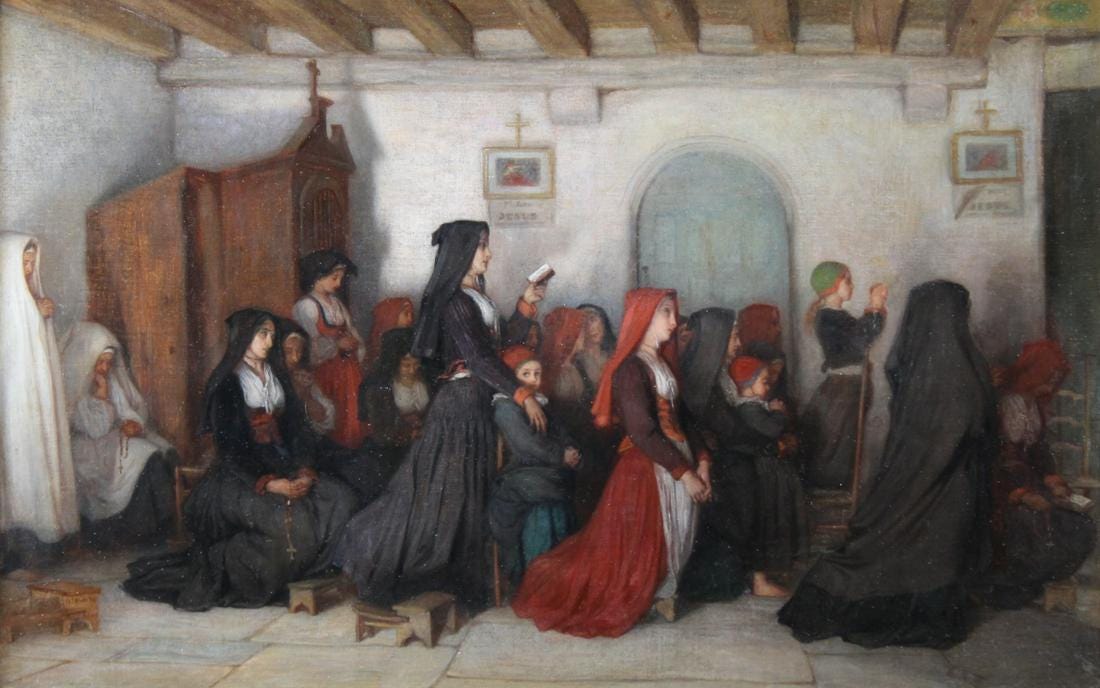
Charles Zacharie Landelle (France, 1821 - 1908)
Women at Prayer
Oil on canvas
11.5 x 18 in
Private collection

Catholic women and children in prayer with nuns in the background.

Zacharie Charles Landelle (2 June 1821 – 13 October 1908) was a French painter who specialized in portraits. He is best known for his Orientalist works.

He was born in Laval, where his father was employed by the préfecture. In 1827, his family moved to Paris when his father was transferred and he would not return to his hometown until near the end of his life. In 1837, at the age of sixteen, he was admitted to the École des Beaux-arts, where he studied with Paul Delaroche and Ary Scheffer. After trips to Italy and the south of France, he copied the Old Masters at the Louvre. He began by painting portraits largely as a means of supporting himself.

Charles Zacharie Landelle, 1812-1908
La Renaissance, c. 1853
Oil on canvas
H. 264, l. 198
Musee National du Chateau, Fontainebleau | France
Commissioned in 1848 for the decoration of the Salle des Bijoux of the Louvre museum

Charles Zacharie Landelle, 1812-1908
VAE VICTORIBUS! WOE TO THE VICTORS! c. 1871
Oil on canvas
25 3/4 by 15 5/8 in., 64.4 by 39.5 cm.
Private collection

Vae victoribus! Victory is a poor advisor, and nations tend to slip on the blood they have shed. Rome under its Caesers did not suspect that its Vae victis would apply in equal measure to Rome itself. After every victory, there's a new tomorrow. Waterloo follows Austerlitz. And so, too, our cry: Victor, beware! More on Vae victoribus

Charles Zacharie Landelle (French, 1812-1908)
The Storm, c. 1879
Oil on canvas
51 1/8 x 32 in. (130 x 81 cm.)
Private collection

Charles Zacharie Landelle (France, 1821 - 1908)
Young woman in a landscape, c. 1844
Oil on canvas
85 x 57.5 cm
Private collection

Charles Zacharie Landelle (France, 1821 - 1908)
A Quick Rest by the Fountain, c. 1865
Oil on canvas
55 by 39 3/4 in , 139.7 by 101 cm 
Private collection

Charles Zacharie Landelle (France, 1821 - 1908)
Beautiful woman reading
Oil on canvas
52 x 120 cm
Private collection

These were a great success and he had his first exhibit at the Salon in 1841. His works came to the attention of King Louis-Philippe and he was awarded a medal. Soon, he became an official painter and received numerous state commissions. His portrait sitters also now came from a higher level of society. In 1852, Napoleon III bought several of his works and became a great admirer. Thanks to him, Landelle was awarded the Legion of Honor in 1855.

Charles Zacharie Landelle (France, 1821 - 1908)
La sirène, c. 1879
Oil on canvas
H 134 x W 85 cm
Russell-Cotes Art Gallery & Museum

According to Greek myths, sirens were powerful and erotic creatures, and many unsuspecting sailors would fall prey to their seductive beauty. The common belief was that they would devour sailors after their ships would crash into the rocks, as most men couldn't resist the temptation of their sweet melodies and angelic faces. More on The Fisherman and The Siren

Charles Zacharie Landelle (France, 1821 - 1908)
Ismenie, Nymph of Diana, c. 1878
Oil on canvas
 130.0 x 87.0 cm
Art Gallery of NSW

A nymph in Greek and Latin mythology is a minor female nature deity typically associated with a particular location or landform. Different from other goddesses, nymphs are generally regarded as divine spirits who animate nature, and are usually depicted as beautiful, young nubile maidens who love to dance and sing; their amorous freedom sets them apart from the restricted and chaste wives and daughters of the Greek polis. They are beloved by many and dwell in mountainous regions and forests by lakes and streams. Although they would never die of old age nor illness, and could give birth to fully immortal children if mated to a god, they themselves were not necessarily immortal, and could be beholden to death in various forms. More on nymphs

Charles Zacharie Landelle (France, 1821 - 1908)
FONTANA
Oil on canvas
H x W in cm 55 x 38
Museum of Fine Arts of Reims

At the foot of large rocks, a young naiad leaning on an urn, with a stream.

In Greek mythology, the Naiads are a type of female spirit, or nymph, presiding over fountains, wells, springs, streams, brooks and other bodies of fresh water.

They are distinct from river gods, who embodied rivers, and the very ancient spirits that inhabited the still waters of marshes, ponds and lagoon-lakes, such as pre-Mycenaean Lerna in the Argolis.

Naiads were associated with fresh water, as the Oceanids were with saltwater and the Nereids specifically with the Mediterranean, but because the ancient Greeks thought of the world's waters as all one system, which percolated in from the sea in deep cavernous spaces within the earth, there was some overlap. Arethusa, the nymph of a spring, could make her way through subterranean flows from the Peloponnesus, to surface on the island of Sicily. More on Naiads

In 1857, he married Alice Letronne (1832–1882), daughter of the archaeologist Jean-Antoine Letronne who had served as Garde Général of the Archives Nationales and helped save them during the February Revolution. They had two sons who both predeceased their father.

In 1859, he received a major commission from the Emperor to decorate the salon of the Élysée Palace. He painted six doorways with allegories of the Four Elements plus Peace and War. He was very prolific overall, producing somewhere between 2,000 and 3,000 works, counting duplicates. One painting was redone in twenty-three different versions.

Attributed to Charles Zacharie Landelle (France, 1821 - 1908)
Orientalist street scene
Oil on panel
33 x 24 cm. 
Private collection

Charles Zacharie Landelle (France, 1821 - 1908)
Al Kantara
Oil on original canvas
32 x 54 cm 
Private collection

El Kantara is a town and commune in Biskra Province, Algeria. The 1911 Baedeker travel guide described it as "one of the most important caravan-stations in E. Algeria." The town is well known for the eponymous gorge nearby, described by locals as the "Mouth of the Desert". The area was named El Kantara by Arab conquerors. More on El Kantara

After voyages to North Africa and the Middle East in 1860, he produced a number of Orientalist works. He also visited Morocco in 1866, but went as part of an official delegation rather than as a painter. In 1875, he went to Egypt and sailed the Nile with the explorer Auguste-Édouard Mariette. Every year after, he made painting trips to Algeria. He became known as the peintre des fellahs (painter of fellahs).

Charles Zacharie Landelle (France, 1821 - 1908)
THE FELLAHA
Oil on canvas
131 x 84 cm 
Private collection

A Fellah is a farmer or agricultural laborer in the Middle East and North Africa. The word derives from the Arabic word for "ploughman" or "tiller".

Due to a continuity in beliefs and lifestyle with that of the Ancient Egyptians, the fellahin of Egypt have been described as the "true Egyptians".

A fellah could be seen wearing a simple Egyptian cotton robe called galabieh (jellabiya). The word galabieh originated around 1715–25 and derived from the Egyptian slang word gallabīyah. More on the Fallah

Charles Zacharie Landelle (France, 1821 - 1908)
L'ORIENTALE/ THE ORIENTAL
Oil on canvas
55.5 by 38.5cm., 22 by 15in 
Private collection

Charles Zacharie Landelle (France, 1821 - 1908)
Juive de Tanger/ Tangier Jewess, c. 1866
Oil on canvas
H x W in cm 61.4 x 50.6
Museum of Fine Arts of Reims

Young woman of three-quarter length left, in bust, in traditional costume.

Charles Zacharie Landelle (France, 1821 - 1908)
JEUNE FILLE À LA COURONNE DE LIERRE/ YOUNG GIRL WITH IVY CROWN
Oil on canvas
37,79 x 27,16 in 
Private collection

Charles Zacharie Landelle (France, 1821 - 1908)
Algérienne jouant de la Darbouka/ Algerian woman playing the Darbouka, c. 1886-1887
Oil on canvas
54 1/4 x 38 in. (137.5 x 96.5 cm.) 
Private collection

The darbouka is a percussion instrument with a determined sound that is part of the membranophones . According to its variants, it is a vase strangled in its middle and covered at one of its ends with a membrane, widespread throughout North Africa , and in the Middle East and the Balkans .

It would date from 1100 BC. AD and it is one of the main percussion instruments of the Arab world. More on the darbouka

Charles Zacharie Landelle (France, 1821 - 1908)
Odalisque
Oil on canvas
37.5 x 45.8 cm. (14¾ x 18 in.)
Private collection

An odalisque was a chambermaid or a female attendant in a Turkish seraglio, particularly the court ladies in the household of the Ottoman sultan. An odalık was not a concubine of the harem, but a maid, although it was possible that she could become one. An odalık was ranked at the bottom of the social stratification of a harem, serving not the man of the household, but rather, his concubines and wives as personal chambermaids. Odalık were usually slaves given as gifts to the sultan by wealthy Turkish men. Generally, an odalık was never seen by the sultan but instead remained under the direct supervision of his mother, the Valide Sultan. More on An odalisque


Charles Zacharie Landelle (France, 1821 - 1908)
Odalisque au collier de perles/ Odalisque with a pearl necklace, c. 1864
Oil on canvas
94 x 145 cm ; 37 by 57 in 
Private collection

He later began a campaign to create an art museum in Laval, which he inaugurated in 1895, along with President Félix Faure. Today, it is known as the Musée des Sciences [fr].

Charles Zacharie Landelle (France, 1821 - 1908)
Judith, c. 1887
Oil on canvas
H 138 x W 99.5 cm
Russell-Cotes Art Gallery & Museum

The Book of Judith is the Old Testament of the Bible. The story revolves around Judith, a daring and beautiful widow, who is upset with her Jewish countrymen for not trusting God to deliver them from their foreign conquerors. She goes with her loyal maid to the camp of the enemy general, Holofernes, with whom she slowly ingratiates herself, promising him information on the Israelites. Gaining his trust, she is allowed access to his tent one night as he lies in a drunken stupor. She decapitates him, then takes his head back to her fearful countrymen. The Assyrians, having lost their leader, disperse, and Israel is saved. Though she is courted by many, Judith remains unmarried for the rest of her life. More on The Book of Judith

Charles Zacharie Landelle (France, 1821 - 1908)
La Vierge et les saintes femmes allant au sépulcre/ The Virgin and the holy women going to the sepulcher
Oil on panel
h: 21,60 w: 15,90 cm 
Private collection

The sepulcher is a small room or monument, cut in rock or built of stone, in which a dead person is laid or buried.

On the third day after the Crucifixion, women visiting Christ's tomb are greeted by two angels surrounded by a blazing light of celestial radiance [Luke 24:4]. The angels deliver the astonishing news of the Resurrection. Each woman reacts differently to the miraculous announcement, contemplating the profound significance of what they have heard.

Charles Zacharie Landelle (French, 1812-1908)
In Mourning
Oil on canvas
51 x 32½ in. (129.5 x 82.6 cm.)
Private collection

Charles Zacharie Landelle (France, 1821 - 1908)
Les Femmes de Jérusalem captives à Babylone/ Women of Jerusalem held captive in Babylon
H. 232; L. 163
Oil on canvas
Musee Ingres, Montauban, France

Illustration from the Psalm of David 136 On the banks of the rivers of Babylon, we sat and wept, remembering Zion. From the willows of the country we had hung our harps. There our overcomers asked us for songs, and our oppressors for joy: Sing to us some of the songs of Zion. How would we sing the songs of the Lord in a foreign land? If I forget you, Jerusalein, let my right hand be forgotten. May my tongue stick to my palate, if I do not remember you, if I do not make Jerusalem the main subject of majesty. Andemel, remember the children of Edom, who said in the day of Jerusalein, Shave, shave to its foundations! Miserable daughter of Babylon, happy who returns the favor to you for the harm you have done to us! Miserable daughter of Babylon! More on this painting

After Charles Zacharie Landelle (France, 1821 - 1908)
Ruth (or The Gleaner)
Oil on canvas
H. 56; l. 39;
Soissons museum

Ruth was a Moabite woman had come to Israel as the widow of an Israelite man. She had returned with her mother-in-law, Naomi, who had also lost her husband. They lived together in a humble situation, and Ruth would go to the fields each day to glean food in the fields during the harvest.
 
Boaz was a landowner where Ruth came to find grain. He knew of her situation and told his workers to leave plenty of grain for her to find. Boaz also offered her food with the other workers and encouraged her to work in the safety of his fields throughout the harvest.
 
Naomi noted that Boaz was a close relative who, according to Jewish law, had the right to marry Ruth after the death of her husband. Naomi encouraged Ruth to go to Boaz in the evening and present herself willing to accept a marriage proposal from him. When she did, he was pleased, yet noted that there was one relative who was closer in line to marry Ruth.
 
The next day, Boaz met with this relative and presented the situation. The relative turned down the offer as he felt it would cause harm to his own family situation. Boaz then made a commitment in front of the town’s leaders that he would take Ruth as his wife. More about Ruth 

He died in Chennevières-sur-Marne in 1908, without descendants. The largest number of his works are in Laval, but may also be seen at the Louvre, the Palace of Versailles, Musée Ingres, Musée des beaux-arts de Reims, Musée de Grenoble and the Musée des beaux-arts de Rouen. More on Zacharie Charles Landelle


Please visit my other blogs: Art Collector, Mythology, Marine Art, Portrait of a Lady, The Orientalist, Art of the Nude and The Canals of Venice, Middle East Artists, 365 Saints and 365 Days, also visit my Boards on Pinterest

Images are copyright of their respective owners, assignees or others. Some Images may be subject to copyright

I don't own any of these images - credit is always given when due unless it is unknown to me. if I post your images without your permission, please tell me.

I do not sell art, art prints, framed posters or reproductions. Ads are shown only to compensate the hosting expenses.

If you enjoyed this post, please share with friends and family.

Thank you for visiting my blog and also for liking its posts and pages.

Please note that the content of this post primarily consists of articles available from Wikipedia or other free sources online.


A note to the readers of Zaidan Gallery

    A note to the readers of Zaidan Gallery It is with great sadness that we share the news that the author of this blog,  Henry Zaidan (194...