Showing posts with label nymphs. Show all posts

Sunday, December 26, 2021

20 Works, December 24th. is Fernand Cormon's day, his art, illustrated with footnotes #254

Fernand Cormon
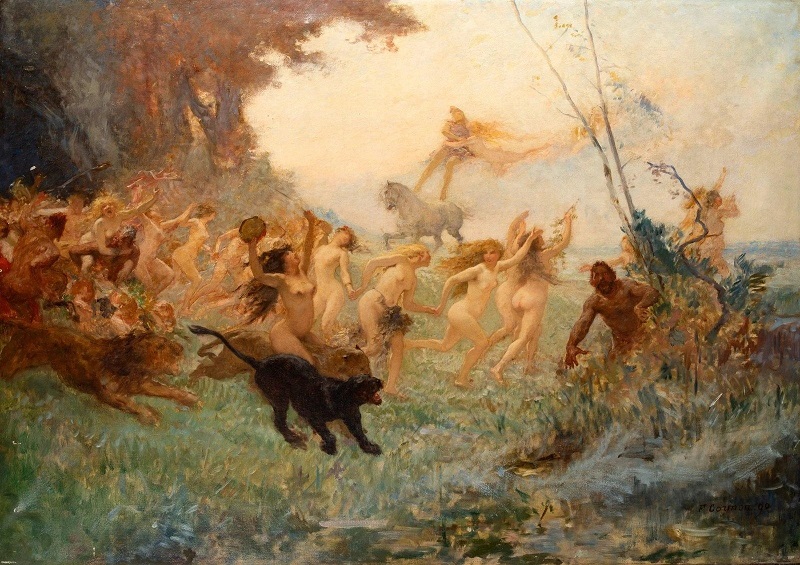
Bacchanalia of nymphs and satyrs
Oil on canvas
90 x 130 cm
Private collection

Fernand Cormon (24 December 1845 – 20 March 1924) was a French painter born in Paris. He became a pupil of Alexandre Cabanel, Eugène Fromentin, and Jean-François Portaels, and one of the leading historical painters of modern France.

His father was the playwright Eugène Cormon. His mother was Charlotte Furais, the actress.

Fernand Cormon
In the Harem
Oil on canvas
95 x 121 cm
Private collection

Harem refers to domestic spaces that are reserved for the women of the house in a Muslim family. A harem may house a man's wife or wives, their pre-pubescent male children, unmarried daughters, female domestic servants, and other unmarried female relatives. In harems of the past, concubines, which were enslaved women, were also housed in the harem. In former times some harems were guarded by eunuchs who were allowed inside. The structure of the harem and the extent of monogamy or polygamy has varied depending on the family's personalities, socio-economic status, and local customs. Similar institutions have been common in other Mediterranean and Middle Eastern civilizations, especially among royal and upper-class families, and the term is sometimes used in other contexts. More on Harem

Fernand Cormon
In the Harem
Oil on canvas
I have no further description, at this time

Fernand Cormon  (1845–1924)
The Harem, c. after 1877
Oil on canvas
Height: 53 cm (20.8 in) Width: 64 cm (25.1 in)
Musée d'art et d'histoire de Narbonne

Fernand Cormon  (1845–1924) 
The Deposed Favourite, c. 1870
Oil on canvas
21.3/8 x 25 in. (54.3 x 64.7 cm.)
Private collection

Dold for GBP 27,600 in  Jun 1999

Painted in 1870, early in his career, The deposed Favourite portrays the cut-throat world of the harem. There was often intense rivalry and power struggles between the kadins, or favourites, who aspired to higher rank and greater power and who would employ any means to achieve it. This intrigue led to plots of bribery, extortion and frequently, as in Cormon's 1874 masterpiece, Jealousy in the Seraglio, murder. In the present work, as the old kadin begs for clemency from the eunuch's waiting axe, 'the new favourite seems singularly unconcerned about the fate of her old rival' More on this painting

Ferdinand-Anne Piestre dit Fernand Cormon
The new favorite
Oil on canvas
49 by 38cm., 19¼ by 15in.
Private collection

Sold for 7,500 EUR in Nov 2011

Cormon had rather occasional relationships with the Orient. He only ventured once to Tunisia, in 1875, a stay which perhaps inspired his paintings. He painted a few orientalist paintings, playful, humorous and very imaginative, often inspired by the Thousand and one nights, for example A harem , kept at the Museum of Art and History of Narbonne (See above)More on this painting

Fernand Cormon  (1845–1924)
Jalousie au Sérail/ Jealousy in the Serail, c. 1874
Oil on canvas
Height: 160 cm (62.9 in); Width: 220 cm (86.6 in)
Musée des Beaux-Arts et d'Archéologie de Besançon 

A serail is the sequestered living quarters used by wives and concubines in an Ottoman household. The term harem is a generic term for domestic spaces reserved for women in a Muslim family, which can also refer to the women themselves. More on a serail

At an early age he attracted attention for the perceived sensationalism in his art, although for a time his powerful brush dwelled with particular delight on scenes of bloodshed, such as the Murder in the Seraglio (1868) and the Death of Ravara, King of Lanka at the Toulouse Museum. The Musée d'Orsay has his Cain fleeing before Jehovah's Curse; and for the Mairie of the fourth arrondissement of Paris he executed in grisaille a series of panels: Birth, Death, Marriage, War, etc. A Chiefs Funeral, and a series of large paintings for the Museum of natural history in Paris with themes from the Stone Age, occupied him for several years. He was appointed to the Legion of Honor in 1880. Subsequently he also devoted himself to portraiture.


Fernand Cormon
Cain, c. 1880
Oil on canvas
H. 400.0; L. 700.0 cm.
Musée d'Orsay

This painting illustrates the fate of Cain, eldest son of Adam and Eve, who after the murder of his younger brother Abel is condemned to flee perpetually. Cain painfully leads his tribe. His sons carry a wooden stretcher on which stand a bewildered woman and her dozing children. They carry pieces of bloody meat. Other men accompany them, hunters. One of them carries a young woman in his arms and a few dogs bring up the rear. The faces betray the fear of Jehovah's sentence.

Cormon lengthened the shadows, as if the light of truth was pursuing the guilty across the barren plain. The artist is concerned with anatomical accuracy: he has a living model for each figure placed in his studio.

Grandiloquent epic, the work is also an anthropological reconstruction. It introduces an unprecedented field, that of prehistory, even though we are discovering Paleolithic cave paintings. For lack of documents, Cormon speculates on life in those remote times, the existence of barbarians struggling for survival, going barefoot, disheveled hair, rough skin. More on this painting

Fernand Cormon
Hagar et Ismael
Oil on canvas
44¾ x 57¾ in
Private collection

Sold for EUR 5,625 in Apr 2012

Hagar is a biblical person in the Book of Genesis Chapter 16. She was an Egyptian handmaid of Sarah, who gave her to Abraham "to wife" to bear a child. The product of the union was Abraham's firstborn, Ishmael, the progenitor of the Ishmaelites.

After Sarah gave birth to Isaac, and the tension between the women returned. At a celebration after Isaac was weaned, Sarah found the teenage Ishmael mocking her son, and demanded that Abraham send Hagar and her son away. She declared that Ishmael would not share in Isaac's inheritance. Abraham was greatly distressed but God told Abraham to do as his wife commanded because God's promise would be carried out through both Isaac and Ishmael.
The name Hagar originates from the Book of Genesis, and is only alluded to in the Qur'an. She is considered Abraham's second wife in the Islamic faith and acknowledged in all Abrahamic faiths. In mainstream Christianity, she is considered a concubine to Abraham. More on Hagar

Fernand Cormon
The Battle of Aspern-Essling, May 1809
Oil on canvas
Musée des Beaux-Arts de Mulhouse

In the Battle of Aspern-Essling Napoleon attempted a forced crossing of the Danube near Vienna, but the French and their allies were driven back by the Austrians under Archduke Charles. It was the first time Napoleon had been personally defeated in a major battle. Archduke Charles drove out the French but fell short of destroying their army. The Austrian artillery dominated the battlefield, firing 53,000 rounds compared to 24,300 French. More on the Battle of Aspern-Essling

Fernand Cormon  (1845–1924)
La Mort de Ravana/ The Death of Ravana, c. 1875
Oil on canvas
Height: 180 cm (70.8 in); Width: 260 cm (102.3 in)
Augustins Museum

Ravana was a king of the island Lanka and the chief antagonist in the Hindu epic Ramayana and its adaptations.

In the Ramayana, Ravana is described to be the eldest son of sage Vishrava and Rakshasi Kaikesi. He abducted lord Rama's wife Sita and took her to his kingdom of Lanka, where he held her in Ashok Vatika. Later, Rama, with the support of vanara King Sugriva and his army of vanars, attacked Ravana in Lanka. They killed Ravana and Rama rescued his beloved wife Sita. More on Ravana

Attributed to Fernand Cormon
Study for La mort de Ravana, circa 1875
Oil on canvas
78 x 98 cm
Private collection

Sold for 14,838.18 CAD in Sep 2011

Fernand Cormon
Cephalus and Procris
Oil on canvas
h: 40,50 w: 64,50 cm
Private collection

Cephalus was married to Procris, a daughter of Erechtheus, an ancient founding-figure of Athens. One day the goddess of dawn, Eos, kidnapped Cephalus when he was hunting. The resistant Cephalus and Eos became lovers, and she bore him a son. However, Cephalus always pined for Procris, causing a disgruntled Eos to return him to her, making disparaging remarks about his wife's fidelity. 

Once reunited with Procris after an interval of eight years, Cephalus tested her by returning from the hunt in disguise, and managing to seduce her. In shame Procris fled to the forest, to hunt. In returning and reconciling, Procris brought two magical gifts, an inerrant javelin that never missed its mark, and a hunting hound, Laelaps that always caught its prey. The hound met its end chasing a fox (the Teumessian vixen) which could not be caught; both fox and the hound were turned into stone. But the javelin continued to be used by Cephalus, who was an avid hunter.

Procris then conceived doubts about her husband, who left his bride at the bridal chamber and climbed to a mountaintop and sang a hymn invoking Nephele, "cloud". Procris became convinced that he was serenading a lover. She climbed to where he was to spy on him. Cephalus, hearing a stirring in the brush and thinking the noise came from an animal, threw the never-erring javelin in the direction of the sound – and Procris was impaled. As she lay dying in his arms, she told him "On our wedding vows, please never marry Eos". Cephalus was distraught at the death of his beloved Procris, and went into exile. More on Cephalus and Procris

Fernand Cormon
The Captive
Oil on canvas
Height: 16 in. (40.64 cm), Width: 13 in. (33.02 cm)
Private collection

Despite the stationary central figures, the piece contains an abundance of movement and action, from the rearing horse in the background to the injured man at the feet of the central figures. The stillness and submissive pose of the captive woman are a sharp contrast to the remnants of the fight around her. Her face hidden in her arms in a gesture of fear and anguish as she hovers on the brink of collapse. More on this painting

Fernand CORMON Paris, 1901 - Paris, 1924
Bacchanal of nymphs and satyrs, c. 1901
Oil on canvas
h: 50.50 w: 61 cm
Private collection

Bacchanalia,  also called Dionysia, in Greco-Roman religion, any of the several festivals of Bacchus (Dionysus), the wine god. They probably originated as rites of fertility gods. Introduced into Rome from lower Italy, the Bacchanalia were at first held in secret, attended by women only, on three days of the year. Later, admission was extended to men, and celebrations took place as often as five times a month. The reputation of these festivals as orgies led in 186 bc to a decree of the Roman Senate that prohibited the Bacchanalia throughout Italy, except in certain special cases. Nevertheless, Bacchanalia long continued in the south of Italy.  More on Bacchanalia

Being well-accepted at the annual Salon, he also ran an art school, the Atelier Cormon in the 1880s where he tried to guide his students to create paintings which would be accepted by the Salon's jury. Among his students with whom he was unsuccessful on this point were, for instance: Henri de Toulouse-Lautrec, Louis Anquetin, Eugène Boch, Paul Tampier, Émile Bernard and Vincent van Gogh. Other students included Alphonse Osbert, Marius Borgeaud, Theodor Pallady, Chaïm Soutine and the Australian painter John Russell.

Fernand Cormon
Suzanne Valadon
Oil on canvas
26.5"H x 22.5"W
Private collection

Suzanne Valadon was a French painter who became the first woman painter admitted to the Société Nationale des Beaux-Arts. She was also the mother of painter Maurice Utrillo.

Valadon spent nearly 40 years of her life as an artist. The subjects of her drawings and paintings included mostly female nudes, portraits of women, still lifes, and landscapes. She never attended the academy and was never confined within a tradition.

She was a model for many renowned artists. Among them, Valadon appeared in such paintings as Dance at Bougival (1883) and Dance in the City by Pierre-Auguste Renoir (1883), and Suzanne Valadon (1885) by Henri de Toulouse-Lautrec. More on Suzanne Valadon

Fernand CORMON (1845-1924)
La Javanaise, c. 1876
Huile sur toile
75 x 64 cm
Private collection

Ferdinand-Anne Piestre aka Fernand Cormon
Extended Javanese, c. 1875
Oil on canvas
109.5 x 190.5 cm; 43 1/8 x 75 in
Private collection

The Javanese people are a Southeast Asian ethnic group native to the Indonesian island of Java. They form the largest ethnic group in Indonesia. They are predominantly located in the central to eastern parts of the island. More on Javanese people

An article published on Saturday, May 22, 1875 in Le Temps describes the Javanese exhibited by Cormon at the Salon of 1875, in these terms “Her hair, of a deep black, spreads in disorder over the splendors of the purple cushions; The lower part of her body is covered with a veil ”, a description which corresponds perfectly to our table. More on this painting

Fernand Cormon  (1845–1924)
In expectation
Oil on canvas
46 x 38 cm
Private collection

Fernand Cormon  (1845–1924)
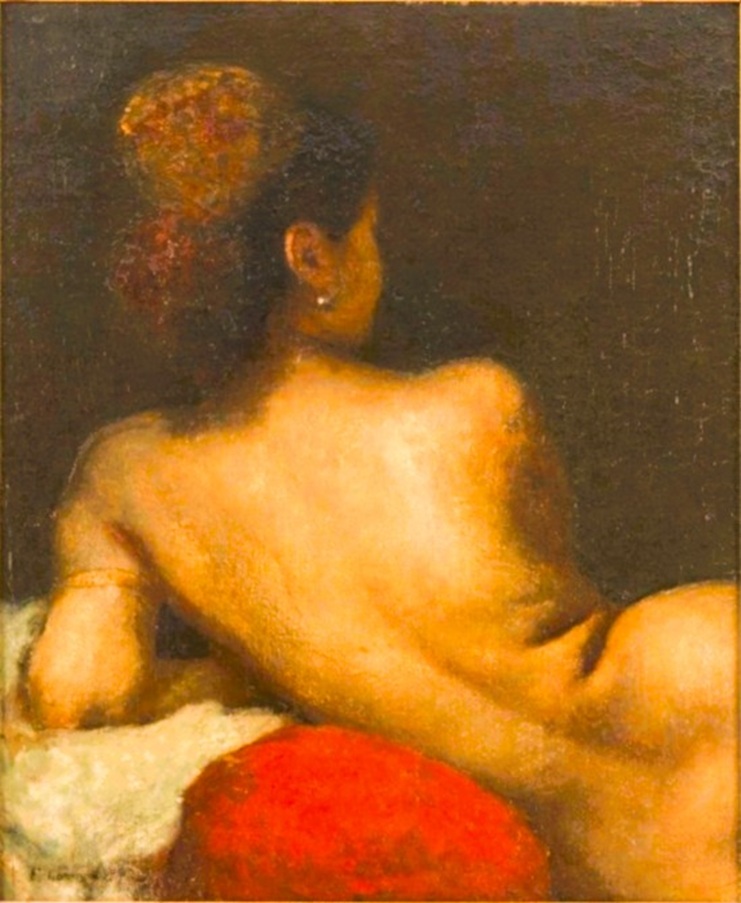
Nu/Nude, c. between 1845 and 1924
Oil on canvas
Height: 103 cm (40.5 in); Width: 71 cm (27.9 in) 
Musée Toulouse-Lautrec

Despite his moment of glory as a Beaux-Arts professor he was almost forgotten by 1924 when he was run over by a taxi outside his studio, and is barely remembered today save as the teacher of pupils more illustrious than himself. More on Fernand Cormon


Please visit my other blogs: Art CollectorMythologyMarine ArtPortrait of a Lady, The OrientalistArt of the Nude and The Canals of VeniceMiddle East Artists365 Saints365 Days, and Biblical Icons, also visit my Boards on Pinterest and my art stores at  deviantart and Aaroko

Images are copyright of their respective owners, assignees or others. Some Images may be subject to copyright

I don't own any of these images - credit is always given when due unless it is unknown to me. if I post your images without your permission, please tell me.

Ads are shown only to compensate the hosting expenses.

If you enjoyed this post, please share with friends and family.

Thank you for visiting my blog and also for liking its posts and pages.

Please note that the content of this post primarily consists of articles available from Wikipedia or other free sources online.


Saturday, July 17, 2021

17 Works, June 23rd. is John Reinhard Weguelin's day, his story, illustrated with footnotes #170

John Reinhard Weguelin, R.W.S. (1849-1927)
A nude seated on the shore, c. 1888
Oil on canvas
10 x 20¼ in. (25.4 x 51.4 cm.)
Private collection

John Reinhard Weguelin RWS ROI (23 June 1849 – 28 April 1927) was an English painter and illustrator, active from 1877 to after 1910.

He specialized in figurative paintings with lush backgrounds, typically landscapes or garden scenes. Weguelin emulated the neo-classical style of Edward Poynter and Lawrence Alma-Tadema, painting subjects inspired by classical antiquity and mythology. He depicted scenes of everyday life in ancient Greece and Rome, as well as mythological subjects, with an emphasis on pastoral scenes. Weguelin also drew on folklore for inspiration, and painted numerous images of nymphs and mermaids.

John Reinhard Weguelin (British, 1849-1927)
Lesbia, c. 1878
I have no further description, at this time

Lesbia is depicted as a young woman, standing contrapposto and framed in the gateway of a garden. She is clad only in a diaphanous gown through which sunlight is visible, and in her hair is a garland. Lesbia is feeding the birds, which fly and perch about her and gather at her feet. 

She is widely supposed to have been Clodia, around whom swirled rumors and scandals involving some of the most prominent men at Rome.

John Reinhard Weguelin (British, 1849-1927)
Pressing Grapes, c. 1880
Oil on canvas
 45 1/2 x 30"
Private collection

The two women stand on either side of a pole suspended from above, which they grasp with their hands to keep their balance. Stone jars and baskets of grapes line the wall. A young girl with a ribbon in her hair leans against a large vessel, her feet on a stool as she watches the women work. 

John Reinhard Weguelin (British, 1849-1927)
An Egyptian Difficulty in the Time of Augustus, c. 1885
Oil on canvas
36 x 24 ¼ in. (91.4 x 61.6 cm.)
Private collection

An Egyptian Difficulty in the time of Augustus, otherwise known as A Young Girl with Flamingoes, and probably the same as Dance of the Flamingos, was exhibited in the Grosvenor Gallery. The catalogue describes the painting as, "a girl with flamingoes; marble arch over bronze door. A characteristic picture by this artist." In one hand, the girl holds a hoop wound with ivy or a similar vine, and in the other a stalk of grass, which she waves toward one of a group of tame flamingos, apparently trying to coax it through the hoop.

John Reinhard Weguelin (British, 1849-1927)
The Obsequies of an Egyptian Cat, c. 1886
Oil on canvas
994 x 1425 x 85 mm
Auckland Unlimited

In 1889 eight illustrations by J R Weguelin, although not this image, were published in The Cat of Bubastes: A Tale of Ancient Egypt, by the popular and prolific historical novelist G A Henty. The plot turns on the accidental killing of a sacred cat.

So esteemed were even the most common animals of the cat tribe that, if a cat happened to die in a house, the inhabitants went into mourning and shaved their eyebrows in token of their grief; the embalmers were sent for, the dead cat made into a mummy, and conveyed with much solemnity to the great catacombs set aside for the burial of the sacred animals. More on this painting

A priestess offers gifts of food and milk to the spirit of a cat. On an altar stands the mummy of the deceased, and the tomb is decorated with frescoes, urns of fresh flowers, lotus blossoms, and statuettes. The priestess kneels as she wafts incense smoke toward the altar. In the background, a statue of Sekhmet or Bastet guards the entrance to the tomb.

His father, William Andrew Weguelin, was Rector of South Stoke, but was forced to relinquish his position about 1856, when he joined the Tractarian Movement, and became a Roman Catholic. When he was still a child, Weguelin's family departed Sussex for Italy, where they lived for several years. Weguelin spent much time at Rome, where he was inspired by art and history. 

John Reinhard Weguelin (British, 1849-1927)
Bacchus and the Choir of Nymphs, c. 1888
Oil on canvas
49 x 108 1/2"
Private collection

Bacchus is conceived conventionally enough, bedecked with vine leaves, holding his wand of 'thyrsis', a symbol of fertility, and reclining on a leopard skin. Leopards or tigers traditionally drew his triumphal car, a reflection of the popularity of his cult in Asia. The setting may well be the island of Naxos, where Bacchus came to the rescue of Ariadne after she had been abandoned there by Theseus. More on this painting

John Reinhard Weguelin  (1849–1927)
The Gardens of Adonis, c. 1888
Oil on canvas
93 x 135 cm
I have no further description, at this time
A group of maidens carry potted plants down to the sea, in commemoration of the death of Adonis. A girl plays a flute as the ceremony proceeds.

John Reinhard Weguelin  (1849–1927)
Rodantha or Rodanthe, circa 1894
Watercolor
Height: 13.7 in (34.9 cm); Width: 20.7 in (52.7 cm)


A nymph or woman turned into a rose by the goddess Diana (Artemis) so she could evade the unwanted attention of her suitors. In the painting she is draped in blue and reclining against a pile of cushions.

John Reinhard Weguelin
Psyche
Oil on canvas
24 x 20''
Private collection

Psyche was the youngest daughter of a Greek king and queen. She had two elder sisters. She was the fairest among her siblings and she looked like a goddess among mortals. She was so beautiful that people, including priests, compared her to Aphrodite, the Greek goddess of love and beauty. Many went to the extent of saying that she was even fairer than the goddess. When Aphrodite's temples were deserted because people started worshiping Psyche, the goddess was outraged. As a punishment, she sent her son, Eros, to make Psyche fall in love with a vile and hideous person. However, Eros fell in love when he saw her and decided to spare her from his mother's wrath. More on Psyche

Other than a few drawing lessons in Italy, Weguelin had no formal training in art during his childhood. In 1860, the eleven-year-old Weguelin was sent to Cardinal Newman's Oratory School in Edgbaston. From 1870 to 1873, he worked as an underwriter for Lloyd's of London.

John Reinhard Weguelin (British, 1849-1927)
GRECIAN GIRL 
Oil on canvas
67½ by 31⅜ in. 171.5 by 79.7 cm
Private collection

At the age of twenty-three in 1873, Weguelin enrolled in the Slade School of Fine Art. He studied there for five years. Weguelin's first exhibited work was a watercolour, The Death of the First-born, at the Dudley Gallery in 1877. On his graduation from "the Slade," he had his first painting exhibited at the Royal Academy. Although later celebrated as a watercolourist, Weguelin would not exhibit in this medium again until the 1890s, and nearly all of his paintings until 1893 were in oil.

John Reinhard Weguelin (British, 1849-1927)
The mermaid, c. 1906
Watercolour heightened with bodycolour
10 x 14 in. (25.4 x 35.7 cm.)
Private collection

A mermaid is a marine creature with the head and upper body of a female human and the tail of a fish. Mermaids appear in the folklore of many cultures worldwide. The first stories appeared in ancient Assyria. Mermaids can be benevolent or beneficent.

Weguelin illustrated Hans Andersen's classic The Little Mermaid in 1893 and, as seen by the work offered above, the subject of the Mermaid was one he returned to throughout his career.

John Reinhard Weguelin (British, 1849-1927)
The lone sea-maid
Watercolour heightened with bodycolour
10 x 14 in. (25.4 x 35.7 cm.)
Private collection

John Reinhard Weguelin (British, 1849-1927)
Mermaid, c. 1911
Watercolour,
25 x 36cm.
Private collection

Weguelin was heavily influenced by the work of Lawrence Alma-Tadema, but within a few years he developed his own interpretation of classical subjects. Beginning in 1878, he exhibited numerous paintings at various London galleries, including the Royal Academy, the Grosvenor Gallery, and the New Gallery. His work was also featured by the Society of British Artists. His subjects included landscapes, classical and Biblical themes, and pastoral scenes. He also produced illustrations for several books.

John Reinhard Weguelin (British, 1849-1927)
Cherry blossom, c. 1905
Watercolour
53 x 36 cm. (21 x 14 1/4 in.)
Private collection

John Reinhard Weguelin (British, 1849-1927)
Reflection, c. 1885
Oil on canvas
8 x 10 in. (20.3 x 25.4 cm.)
Private collection

Reflection depicts a nude lying on cushions before a pool of water. She plays with a long garland of roses.

John Reinhard Weguelin
A Pastoral, c. 1905
 Watercolour
15 x 21".
Private collection

A shepherdess plays the flute as sheep graze in a sun-dappled meadow on the edge of the woods.

The Library described Weguelin as one of the few decorative artists who seldom relied on pen, and habitually expressed themselves in "wash" rather than by line: "Mr. Weguelin has illustrated Anacreon in a manner to earn the appreciation of Greek scholars, and his illustrations to Hans Andersen have had a wider and not less appreciative reception. His drawings have movement and atmosphere."

John Reinhard Weguelin (British, 1849-1927)
The Tired Dancer/ Revelry, c. 1879
Oil on canvas
115 x 76.5cm (45 1/4 x 30 1/8in).
Private collection

The Tired Dancer, also known as Revelry (1879), was exhibited at the Grosvenor Gallery

An exhausted Roman dancer sleeps against a marble bench. She wears a diaphanous red gown, a necklace of turquoise beads, and a garland of yellow flowers, from which a number of petals have fallen as she sleeps. A tambourine lies at her feet, and revelers can be seen in the background. 

In 1893, Weguelin took up watercolour for the first time since leaving the Slade. He exhibited The Swing at the Royal Academy, and after a few months he was elected an associate of the Royal Society of Painters in Water Colours. He became a full member in 1897. From this time, Weguelin painted almost exclusively in watercolour, and produced little in oil. He exhibited regularly at a gallery in Pall Mall East.

In mature life, he settled at Hastings. He died 28 April 1927. More on John Reinhard Weguelin


Please visit my other blogs: Art CollectorMythologyMarine ArtPortrait of a Lady, The OrientalistArt of the Nude and The Canals of VeniceMiddle East Artists365 Saints and 365 Days, also visit my Boards on Pinterest

Images are copyright of their respective owners, assignees or others. Some Images may be subject to copyright

I don't own any of these images - credit is always given when due unless it is unknown to me. if I post your images without your permission, please tell me.

I do not sell art, art prints, framed posters or reproductions. Ads are shown only to compensate the hosting expenses.

If you enjoyed this post, please share with friends and family.

Thank you for visiting my blog and also for liking its posts and pages.

Please note that the content of this post primarily consists of articles available from Wikipedia or other free sources online.


Thursday, April 8, 2021

14 Works, Today, April 7th is artist Ferdinand Leeke's day, his story, illustrated with footnotes #96

Leeke, Ferdinand, 1859 Burg/Magdeburg - 1923 Nuremberg
Dancing nymphs, c. 1923/25
Oil on canvas
86 x 134cm
Private collection

Ferdinand Leeke (1859-1923) was a German painter best known for his illustrations of Richard Wagner’s operas and other mythological scenes. Born on April 7, 1859 in Burg bei Magdeburg, Germany.

Ferdinand Leeke  (1859–1937)
Bacchante
Oil on canvas
84 x 50.5 cm 
Private collection

In Greek mythology, maenads were the female followers of Dionysus and the most significant members of the Thiasus, the god's retinue. Their name literally translates as "raving ones." Maenads were known as Bassarids, Bacchae or Bacchantes in Roman mythology, after the penchant of the equivalent Roman god, Bacchus, to wear a bassaris or fox-skin.

Often the maenads were portrayed as inspired by Dionysus into a state of ecstatic frenzy through a combination of dancing and intoxication. During these rites, the maenads would dress in fawn skins and carry a thyrsus, a long stick wrapped in ivy or vine leaves and tipped with a pine cone. They would weave ivy-wreaths around their heads or wear a bull helmet in honor of their god, and often handle or wear snakes. More Bacchante

Ferdinand Leeke  (1859–1937)
The Amazonian warrior, c. 1906
Oil on canvas
90 x 54.5 cm 
Private collection

In Greek mythology, the Amazons were a race of woman warriors.
 
The legendary Amazons were thought to have lived in Pontus, which is part of modern-day Turkey near the southern shore of the Black Sea. There they formed an independent kingdom under the government of a queen named Hippolyta or Hippolyte. This area is known to have been occupied in the Late Bronze Age by a transhumant group known to the Hittites as the Kaŝka; though they were not directly known to Greeks, modern archaeologists have determined that they finally defeated their enemies, the Hittites, about 1200 BC. According to Plutarch, the Amazons lived in and about the Don river, which the Greeks called the Tanais; but which was called by the Scythians the "Amazon". The Amazons later moved to Terme on the River Thermodon, northern Turkey. More on the Amazons

Ferdinand Leeke  (1859–1937)
The Bust
Oil on canvas
88 x 134 cm 
Private collection

Ferdinand Leeke  (1859–1937)
The Mermaid and the Satyr, c. 1917
Oil on canvas
39 x 53.1 in. / 99 x 135 cm
Private collection

A mermaid is a marine creature with the head and upper body of a female human and the tail of a fish. Mermaids appear in the folklore of many cultures worldwide. The first stories appeared in ancient Assyria. Mermaids can be benevolent or beneficent.

In Greek mythology, a satyr is the member of a troop of ithyphallic male companions of Dionysus; they usually have horse-like ears and tails, as well as permanent, exaggerated erections. Early artistic representations sometimes include horse-like legs, but, in 6th-century BC black-figure pottery, human legs are the most common. The faun is a similar woodland-dwelling creature from Roman mythology, which had the body of a man, but the legs, horns, and tail of a goat. In myths, both are often associated with pipe-playing. Greek-speaking Romans often used the Greek term saturos when referring to the Latin faunus, and eventually syncretized the two (the female “Satyresses” were a later invention of poets). They are also known for their focus on sexual desires. They were characterized by the desire to have sexual intercourse with as many women as possible, known as satyriasis. More on satyr


Ferdinand Leeke  (1859–1937)
Snow White , circa 1890
Oil on panel
26.3 x 35 cm (10.3 x 13.7 in)
Private collection

Snow White is a 19th-century German fairy tale that is today known widely across the Western world. The Brothers Grimm published it in 1812 in the first edition of their collection Grimms' Fairy Tales and numbered as Tale 53. 

The fairy tale features such elements as the magic mirror, the poisoned apple, the glass coffin, and the characters of the Evil Queen and the Seven Dwarfs. More on Snow White

 Leeke received his formal training at the Academy of Fine Arts in Munich under Johann Caspar Herterich  and Sándor Liezen-Mayer, a genre and historical painter, and with Alexander von Wagner (1838-1919), a Hungarian genre and landscape painter. Leeke primarily painted portraits and traditional German genre paintings

Ferdinand Leeke  (1859–1937)
Undine charms the knight , c. 1916
Oil on wood
25.5 x 36 cm 
Private collection

Undines are almost invariably depicted as being female, which is consistent with the ancient idea that water is a female element. They are usually found in forest pools and waterfalls, and their beautiful singing voices are sometimes heard over the sound of water. The group contains many species, including nereides, limnads, naiades, mermaids and potamides.

What undines lack, compared to humans, is a soul. Marriage with a human shortens their lives on Earth, but earns them an immortal human soul.

Undine is a fairytale novella (Erzählung) by Friedrich de la Motte Fouqué in which Undine, a water spirit, marries a knight named Huldebrand in order to gain a soul. It is an early German romance, which has been translated into English and other languages. More on Undines

Ferdinand Leeke  (1859–1937)
Laurin, the King of the Dwarfs, at the Court of Dietrich von Bern
Oil on canvas
79 x 100 cm 
Private collection

King Laurin was the ruler of a thriving race of dwarves who lived and mined the mountains for precious jewels and valuable ores. He possessed a subterranean palace made of sparkling quartz. But his special pride and joy was the great garden located in front of the entranceway to his underground crystal castle.

Similde was the beautiful daughter of the “King on the River Etsch.” One day, he felt that the time had come to marry off the girl. So he invited all of the noblemen in the neighboring lands, but he did not invite Laurin. Because of this, Laurin decided to wear his magic Invisibility Cape and attend without being detected. But as he caught sight of Similde, he immediately fell in love with her. So he grabbed her, leaped onto his horse, and galloped away... More on Laurin, the King of the Dwarfs

Around 1889 Siegfried Wagner, son of the composer Richard Wagner, commissioned Leeke to paint a series based on ten different operas written by his father (See below). These paintings were then reproduced as posters via six-color photogravure, which was a new and revolutionary process at the time.

Ferdinand Leeke  (1859–1937)
Three daughters of Ren Woglind, Wellgund and Flosshild ensnare Siegfried , c. 1908
Oil on canvas
122 x 163 cm 
Private collection

The Rhinemaidens are the three water-nymphs who appear in Richard Wagner's opera cycle Der Ring des Nibelungen. Their individual names are Woglinde, Wellgunde and Flosshilde (Floßhilde), although they are generally treated as a single entity and they act together accordingly.

The Rhinemaidens are the first and the last characters seen in the four-opera cycle, appearing both in the opening scene of Das Rheingold, and in the final climactic spectacle of Götterdämmerung, when they rise from the Rhine waters to reclaim the ring from Brünnhilde's ashes. 

Götterdämmerung, Act 3 Scene 1. In a remote wooded valley Siegfried's horn is heard, and he soon appears, having lost his way while hunting. The maidens greet him with their old playfulness and offer to help him, for the price of the ring on his finger. After a flirtatious exchange, Siegfried offers, apparently sincerely, to give them the ring. But instead of wisely simply accepting his offer, the mood of the naive, formerly flirtatious Rhinemaidens suddenly becomes solemn: they warn Siegfried he will be killed that very day unless he delivers the ring to them. More on this painting

Ferdinand Leeke  (1859–1937)
Scene from Richard Wagner’s “Valkyrie”
Oil on canvas
135 x 100 cm
Private collection

Exhausted Siegmund enters Hunding’s house at the beginning of Act 1 of The Valkyrie, having no idea that he will come upon his sister there: Sieglinde was abducted as an infant and given in marriage to Hunding. She knows little of her family background and does not initially recognize her twin brother.

When Hunding returns home he discovers the enemy whom he has just wanted to fight in battle. However, he is obliged to offer hospitality for one night, even to his enemy, though he challenges Siegmund to a duel the next day.

Sieglinde feels herself increasingly drawn to the stranger and administers a sleeping potion to her husband. She tries to indicate to Siegmund the trunk of an ash tree in which a sword has been plunged, which, up till now, no-one has been able to pull out.

Suddenly the firelight reveals to him a place in the ash tree’s trunk and Sieglinde enters and tells him about the wondrous sword. They look at each other, recognise that they are twins, and – exhilarated by the mild spring night – become inflamed with passionate fervour.

Act 1, Scene 3, After he has succeeded in claiming the sword, Siegmund ecstatically stretches his arms out to Sieglinde.

The incestuous and passionate entanglement in Act 1 culminates with these famous closing words. What follows on the stage – and in Leeke’s painting – is omitted and left to the audience’s imagination. Wagner’s final stage directions are also to be understood in this sense: Siegmund draws her to him with raging ardour; she sinks with a cry onto his breast. The curtain falls quickly. More on this painting

In Norse mythology, a valkyrie (from Old Norse valkyrja "chooser of the slain") is one of a host of female figures who choose those who may die in battle and those who may live. Selecting among half of those who die in battle, the valkyries bring their chosen to the afterlife hall of the slain, Valhalla, ruled over by the god Odin. There, the deceased warriors become einherjar. When the einherjar are not preparing for the events of Ragnarök, the valkyries bear them mead. Valkyries also appear as lovers of heroes and other mortals, where they are sometimes described as the daughters of royalty, sometimes accompanied by ravens and sometimes connected to swans or horses. More on the Valkyrie

Ferdinand Leeke  (1859–1937)
Siegfried’s Rhine Journey, c. 1908
Richard Wagner, Götterdämmerung, Act I
Oil on canvas
100 x 120 cm
Private collection

Siegfried’s Rhine journey takes place almost at the beginning of Götterdämmerung and follows the first scene, in which the dragon slayer Siegfried and the Valkyrie Brünnhilde could still enjoy their love for each other unadulterated. Brünnhilde receives the Ring of the Nibelung from Siegfried and gives him her faithful steed Grane in return. They bid each other farewell, and Siegfried sets off on new adventures. The serene musical mood of Siegfried’s Rhine journey conveys this promising excitement and anticipation of new adventures. At the same time, it also forms the prelude to subsequent complications. These two aspects – anticipation and the suggestion of further action – can also be found in the present lot. Siegfried, beaming with youth and strength, sets off on a boat across the Rhine with the horse, Grane. The costume and the carving on the boat display Nordic ornaments and refer to the origin of the myth. The horse nuzzles his head faithfully on the hero’s shoulder, but in the worried look that the animal casts at the viewer, there seems to be a bleak premonition. More on this painting

Ferdinand Leeke  (1859–1937)
Wotan and Brünnhilde, c. 1930
Oil on canvas
146 x 107 cm 
Private collection

Ferdinand Leeke  (1859–1937)
The warrior's return
Oil on canvas
59½ x 46 in. (151.1 x 116.8 cm.)
Private collection

Ferdinand Leeke
A Viking's game
Oil on canvas
177 x 150 cm. 
Private collection

The Norse people delighted in games and sports. Both indoor board games and outdoor sporting competitions appear to have been regular leisure time activities, based on both saga literature and archaeological evidence.

Ferdinand Leeke died in 1923 in Nuremberg, Germany. More on Ferdinand Leeke


Please visit my other blogs: Art CollectorMythologyMarine ArtPortrait of a Lady, The OrientalistArt of the Nude and The Canals of VeniceMiddle East Artists365 Saints and 365 Days, also visit my Boards on Pinterest

Images are copyright of their respective owners, assignees or others. Some Images may be subject to copyright

I don't own any of these images - credit is always given when due unless it is unknown to me. if I post your images without your permission, please tell me.

I do not sell art, art prints, framed posters or reproductions. Ads are shown only to compensate the hosting expenses.

If you enjoyed this post, please share with friends and family.

Thank you for visiting my blog and also for liking its posts and pages.

Please note that the content of this post primarily consists of articles available from Wikipedia or other free sources online.

A note to the readers of Zaidan Gallery

    A note to the readers of Zaidan Gallery It is with great sadness that we share the news that the author of this blog,  Henry Zaidan (194...