Showing posts with label viking. Show all posts

Monday, May 10, 2021

20 Works, Today, May 6th. is artist John Charles Dollman's day, his story, illustrated with footnotes #125

John Charles Dollman (1851–1934)
The Ride of the Valkyries, c. 1908
Oil on canvas
111.8 x 182.9cm
Art Gallery of Western Australia

In Norse mythology, a valkyrie (from Old Norse valkyrja "chooser of the slain") is one of a host of female figures who choose those who may die in battle and those who may live. Selecting among half of those who die in battle, the valkyries bring their chosen to the afterlife hall of the slain, Valhalla, ruled over by the god Odin. There, the deceased warriors become einherjar. When the einherjar are not preparing for the events of Ragnarök, the valkyries bear them mead. Valkyries also appear as lovers of heroes and other mortals, where they are sometimes described as the daughters of royalty, sometimes accompanied by ravens and sometimes connected to swans or horses. More on the Valkyrie

John Charles Dollman RWS RI ROI (6 May 1851 – 11 December 1934) was an English painter and illustrator.

John Charles Dollman (1851–1934)
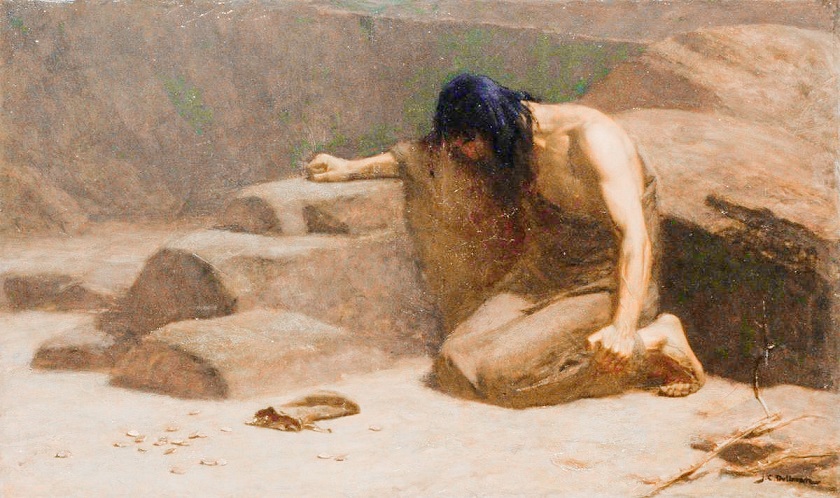
Thirty Pieces of Silver
Oil on canvas
H 76.8 x W 127 cm
Brighton and Hove Museums and Art Galleries

Thirty pieces of silver was the price for which Judas Iscariot betrayed Jesus, according to an account in the Gospel of Matthew 26:15 in the New Testament.[1] Before the Last Supper, Judas is said to have gone to the chief priests and agreed to hand over Jesus in exchange for 30 silver coins, and to have attempted to return the money afterwards, filled with remorse. More on Thirty pieces of silver

John Charles Dollman (1851–1934)
The Temptation Of Saint Anthony
Oil on canvas
111.8 x 174 cms | 44 x 68 1/2 ins
Art Gallery of New South Wales

John Charles Dollman (1851–1934)
The Temptation of Saint Anthony, c. 1897
Oil on canvas
I have no further description, at this time

The Temptation of Saint Anthony is an often-repeated subject in history of art and literature, concerning the supernatural temptation reportedly faced by Saint Anthony the Great during his sojourn in the Egyptian desert. Anthony's temptation is first discussed by Athanasius of Alexandria, Anthony's contemporary, and from then became a popular theme in Western culture. More on Temptation of Saint Anthony

John Charles Dollman (1851–1934)
Friends in Adversity, Christmas Day at the Dreadnought Hospital, Greenwich (Coming Down to Dinner), c. 1880
Oil on canvas
H 254 x W 193 cm
Nottingham City Museums & Galleries

On the right of the picture is a group of figures descending a staircase. Nearing the bottom, in the foreground, is a young Turk or Arab. He grasps the stair-rail with his right hand, and looks at the old sailor on his left, whom he is supporting. The old man, in his lapel he has a sprig of holly. He holds his walking stick in his left hand. Behind this group is a young man in a sailor's blue shirt and collar. His right arm is in a sling, and he tweaks the ear of a boy who offers him a sprig of mistletoe. The youngster, under his left arm he holds a violin and bow. Behind these two are a Chinese man and a Negro with a patch over his right eye. Further up on the stairs is a Negro on crutches, a man with a ginger beard and blue bandage round his forehead, an elderly, bearded man and two other men. 

At the very top of the stairs is an archway decorated with holly, with the Union Jack hanging down. Above the arch is a long blue plaque trimmed with holly, which reads: 'After, so, many, Ship- Wrecks, we, find, a, Port!' To the left of this inscription is a picture of a sailing ship with the name 'Elizabeth' beneath it. Underneath it is a blue plaque with the cross, anchor and heart sign of 'Faith, Hope and Charity', also trimmed with holly. On the left of the picture, in the background, are several figures descending a stairwell above. There is a Chinese man, his hair plaited down his back, looking over at the main figures. A Union Jack is draped over the banisters. On the extreme left on the wall is half a coat of arms. It shows a sailor with one leg missing and a crutch, standing beside a shield with three legs on it with the motto, 'One leg is better than none'. More on this painting

Dollman was born in Hove on 6 May 1851 and moved to London to study at South Kensington and the Royal Academy Schools, after which he set up a studio at Bedford Park, London. He exhibited at the Royal Academy from 1870 to 1912, and was elected RWS (Member of the Royal Watercolour Society) in 1913. Dollman was also an illustrator, working in black and white or colour for magazines such as the Graphic during and after the 1880s. Some of his early work has been said to have influenced Van Gogh.

John Charles Dollman (1851–1934)
A Viking Foray
Oil on canvas

John Charles Dollman
Viking Ship Returning Home, c. 1908
Oil on panel
10 1/2" x 14 3/4" in 
Private collection

John Charles Dollman (1851–1934)
Study for 'The Unknown', c. 1912
Oil on canvas
H 45.5 x W 76.5 cm
Laing Art Gallery

John Charles Dollman (1851–1934)
'The Unknown', c. 1912
Illustration
Library of Congress Prints and Photographs Division Washington, D.C.

Illustration shows a young woman, nude to the waist, kneeling with hand raised over a fire labeled "Equal Rights" among a cluster of chimpanzees with human faces; the chimpanzees appear to be afraid of the flames.

Expressing the attitude of the average politician toward the woman suffrage movement. More on this Illustration

A central theme was ambitious mythological pictures such as a Viking Foray (See above), a Viking horde entitled the Ravager, The Unknown (1912) (See above), featuring a girl surrounded by chimps. He also produced bold compositions of animals and people such as Mowgli made leader of the Bandar-log (1903) (See below). His best known work is possibly A London Cab Stand (1888) (See below), focussing on a group of horses in a stormy scene. He composed at least three variants of this picture, and there are other instances where he made copies or near-copies of individual pictures. In the 1890s he painted pictures of soldiers, and some less well regarded genre pictures of people with animals. He also painted wild animal pictures without attempting any narrative content.

John Charles Dollman (1851–1934)
Les miserables/ A London Cab Stand , c. 1888
Oil on canvas
H 98.5 x W 158 cm
Museum of London

John Charles Dollman (1851–1934)
Mowgli Made Leader of the Bandar-log, c. 1918
Oil on canvas
H 95.7 x W 128.3 cm
Shipley Art Gallery

Mowgli is a fictional character and the protagonist of Rudyard Kipling's The Jungle Book stories. He is a feral boy from the Pench area in Seoni, Madhya Pradesh, India, who originally appeared in Kipling's short story "In the Rukh" and then became the most prominent and arguably the most memorable character in the collections The Jungle Book and The Second Jungle Book (1894–1895), which also featured stories about other characters. More on Mowgli

John Charles Dollman (1851–1934)
Table d'Hote at a Dogs' Home, c. 1879
Oil on canvas
H 75 x W 129 cm
Walker Art Gallery

Dollman's works are in the collections of various galleries. The Immigrants' Ship (1884) is in the Art Gallery of South Australia, Adelaide. A version of The Unknown 
(See above) is in the Laing Art Gallery, Newcastle. His painting of Antarctic explorer Lawrence Oates as he walked to his death, A Very Gallant Gentleman (See below), hangs in the Cavalry Club in London. It was commissioned by officers of the Inniskilling Dragoons in 1913. It was exhibited at the Royal Academy in 1914. A preparatory sketch was exhibited in the Scott Polar Research Institute, at the University of Cambridge (See above) is in the London Museum. A Dog's Home, Table d'Hote (1879) (See above) is in the Walker Art Gallery, Liverpool, while Famine (1904) (See below) is at the Salford Museum and Art Gallery. Ride of the Valkyries (See top) is located in the Art Gallery of Western Australia, Perth.

John Charles Dollman (1851–1934)
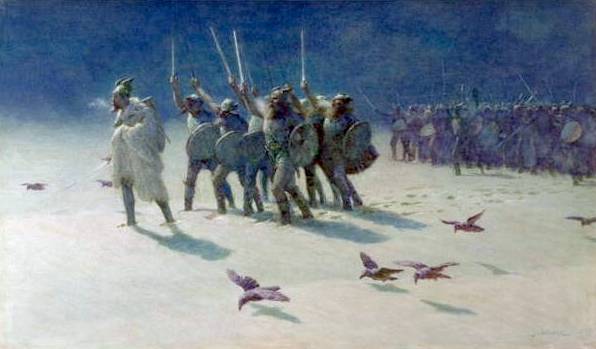
A Very Gallant Gentleman, c. 1913
Oil on canvas
H 75.5 x W 54.5 cm
Scott Polar Research Institute, University of Cambridge

John Charles Dollman
'A Very Gallant Gentleman' - Captain Lawrence Oates
Pen, ink and watercolour heightened with white
Works on Paper
59 x 99cm 
Private collection

Dollman captured a very poignant moment in history with his 1913 painting entitled  A Very Gallant Gentleman which depicts Captain Laurence “Titus” Oates walking out to his death in the blizzard, on Captain Scott’s return journey from the South Pole, in March 1912. Oates had been suffering from severe frostbite which became so severe that he could hardly climb into his sleeping bag and the “killer”, gangrene, had set in. Oates realised his physical condition was now hampering his three other colleagues’ safe return and he pleaded with them to leave him behind, but they refused. The next day he awoke, and knew what he must do.  He left his colleagues knowing that this may help them and uttered his immortal line:

“…I’m just going outside; I may be away some time…”

Captain Scott recorded in his diary that day that Oates had gone out into the blizzard never to be seen again. The final three members of the expedition party struggled on for a few more days before they too died before ever reaching safety. More on this painting

George Percy Jacomb-Hood
A Very Gallant Gentleman - Sketch for a proposed painting of an incident in the South Pole Exhibition
Oil on canvas
18ins x 23.5ins
Private collection

George Percy Jacomb-Hood
A Very Gallant Gentleman - Sketch for a proposed painting of an incident in the South Pole Exhibition
Oil on canvas
18ins x 23.5ins
Private collection

His painting of Antarctic explorer Lawrence Oates as he walked to his death, A Very Gallant Gentleman (See above), hangs in the Cavalry Club in London. It was commissioned by officers of the Inniskilling Dragoons in 1913. It was exhibited at the Royal Academy in 1914. A preparatory sketch was exhibited in the Scott Polar Research Institute, at the University of Cambridge (See above). 

John Charles Dollman (British, 1851–1934)
The cruel land, c. 1900
Oil on Canvas
77 x 128 cm. (30.3 x 50.4 in.)
Private collection

John Charles Dollman, R.W.S. (1851-1934)
Abandoned: vultures in the desert
Pencil and watercolour heightened with white
13½ x 23½ in. (34.3 x 59.6 cm.)
Private collection

John Charles Dollman (1851–1934)
Famine, c. 1904
Oil on canvas
H 122 x W 213 cm
Salford Museum & Art Gallery

Some people read this haunting painting as a starvation of the human body, with its vision of a shrouded death surrounded by hungry wolves. The artist, however, intended it to portray a famine of human spirit, or death of the soul after its neglect. More on this painting

John Charles DOLLMAN
The Awakening of Titania, c. 1898
Medium oil on canvas
136.5 x 203cm
Art Gallery of Western Australia

Titania is a character in William Shakespeare's 1595–1596 play A Midsummer Night's Dream. In the play, she is the queen of the fairies. Due to Shakespeare's influence, later fiction has often used the name "Titania" for fairy queen characters. More on Titania

Dollman died in London on 11 December 1934, aged 83. He was the father of the noted zoologist and taxonomist Guy Dollman. More on John Charles Dollman


Please visit my other blogs: Art Collector, Mythology, Marine Art, Portrait of a Lady, The Orientalist, Art of the Nude and The Canals of Venice, Middle East Artists, 365 Saints and 365 Days, also visit my Boards on Pinterest

Images are copyright of their respective owners, assignees or others. Some Images may be subject to copyright

I don't own any of these images - credit is always given when due unless it is unknown to me. if I post your images without your permission, please tell me.

I do not sell art, art prints, framed posters or reproductions. Ads are shown only to compensate the hosting expenses.

If you enjoyed this post, please share with friends and family.

Thank you for visiting my blog and also for liking its posts and pages.

Please note that the content of this post primarily consists of articles available from Wikipedia or other free sources online.


Thursday, April 8, 2021

14 Works, Today, April 7th is artist Ferdinand Leeke's day, his story, illustrated with footnotes #96

Leeke, Ferdinand, 1859 Burg/Magdeburg - 1923 Nuremberg
Dancing nymphs, c. 1923/25
Oil on canvas
86 x 134cm
Private collection

Ferdinand Leeke (1859-1923) was a German painter best known for his illustrations of Richard Wagner’s operas and other mythological scenes. Born on April 7, 1859 in Burg bei Magdeburg, Germany.

Ferdinand Leeke  (1859–1937)
Bacchante
Oil on canvas
84 x 50.5 cm 
Private collection

In Greek mythology, maenads were the female followers of Dionysus and the most significant members of the Thiasus, the god's retinue. Their name literally translates as "raving ones." Maenads were known as Bassarids, Bacchae or Bacchantes in Roman mythology, after the penchant of the equivalent Roman god, Bacchus, to wear a bassaris or fox-skin.

Often the maenads were portrayed as inspired by Dionysus into a state of ecstatic frenzy through a combination of dancing and intoxication. During these rites, the maenads would dress in fawn skins and carry a thyrsus, a long stick wrapped in ivy or vine leaves and tipped with a pine cone. They would weave ivy-wreaths around their heads or wear a bull helmet in honor of their god, and often handle or wear snakes. More Bacchante

Ferdinand Leeke  (1859–1937)
The Amazonian warrior, c. 1906
Oil on canvas
90 x 54.5 cm 
Private collection

In Greek mythology, the Amazons were a race of woman warriors.
 
The legendary Amazons were thought to have lived in Pontus, which is part of modern-day Turkey near the southern shore of the Black Sea. There they formed an independent kingdom under the government of a queen named Hippolyta or Hippolyte. This area is known to have been occupied in the Late Bronze Age by a transhumant group known to the Hittites as the Kaŝka; though they were not directly known to Greeks, modern archaeologists have determined that they finally defeated their enemies, the Hittites, about 1200 BC. According to Plutarch, the Amazons lived in and about the Don river, which the Greeks called the Tanais; but which was called by the Scythians the "Amazon". The Amazons later moved to Terme on the River Thermodon, northern Turkey. More on the Amazons

Ferdinand Leeke  (1859–1937)
The Bust
Oil on canvas
88 x 134 cm 
Private collection

Ferdinand Leeke  (1859–1937)
The Mermaid and the Satyr, c. 1917
Oil on canvas
39 x 53.1 in. / 99 x 135 cm
Private collection

A mermaid is a marine creature with the head and upper body of a female human and the tail of a fish. Mermaids appear in the folklore of many cultures worldwide. The first stories appeared in ancient Assyria. Mermaids can be benevolent or beneficent.

In Greek mythology, a satyr is the member of a troop of ithyphallic male companions of Dionysus; they usually have horse-like ears and tails, as well as permanent, exaggerated erections. Early artistic representations sometimes include horse-like legs, but, in 6th-century BC black-figure pottery, human legs are the most common. The faun is a similar woodland-dwelling creature from Roman mythology, which had the body of a man, but the legs, horns, and tail of a goat. In myths, both are often associated with pipe-playing. Greek-speaking Romans often used the Greek term saturos when referring to the Latin faunus, and eventually syncretized the two (the female “Satyresses” were a later invention of poets). They are also known for their focus on sexual desires. They were characterized by the desire to have sexual intercourse with as many women as possible, known as satyriasis. More on satyr


Ferdinand Leeke  (1859–1937)
Snow White , circa 1890
Oil on panel
26.3 x 35 cm (10.3 x 13.7 in)
Private collection

Snow White is a 19th-century German fairy tale that is today known widely across the Western world. The Brothers Grimm published it in 1812 in the first edition of their collection Grimms' Fairy Tales and numbered as Tale 53. 

The fairy tale features such elements as the magic mirror, the poisoned apple, the glass coffin, and the characters of the Evil Queen and the Seven Dwarfs. More on Snow White

 Leeke received his formal training at the Academy of Fine Arts in Munich under Johann Caspar Herterich  and Sándor Liezen-Mayer, a genre and historical painter, and with Alexander von Wagner (1838-1919), a Hungarian genre and landscape painter. Leeke primarily painted portraits and traditional German genre paintings

Ferdinand Leeke  (1859–1937)
Undine charms the knight , c. 1916
Oil on wood
25.5 x 36 cm 
Private collection

Undines are almost invariably depicted as being female, which is consistent with the ancient idea that water is a female element. They are usually found in forest pools and waterfalls, and their beautiful singing voices are sometimes heard over the sound of water. The group contains many species, including nereides, limnads, naiades, mermaids and potamides.

What undines lack, compared to humans, is a soul. Marriage with a human shortens their lives on Earth, but earns them an immortal human soul.

Undine is a fairytale novella (Erzählung) by Friedrich de la Motte Fouqué in which Undine, a water spirit, marries a knight named Huldebrand in order to gain a soul. It is an early German romance, which has been translated into English and other languages. More on Undines

Ferdinand Leeke  (1859–1937)
Laurin, the King of the Dwarfs, at the Court of Dietrich von Bern
Oil on canvas
79 x 100 cm 
Private collection

King Laurin was the ruler of a thriving race of dwarves who lived and mined the mountains for precious jewels and valuable ores. He possessed a subterranean palace made of sparkling quartz. But his special pride and joy was the great garden located in front of the entranceway to his underground crystal castle.

Similde was the beautiful daughter of the “King on the River Etsch.” One day, he felt that the time had come to marry off the girl. So he invited all of the noblemen in the neighboring lands, but he did not invite Laurin. Because of this, Laurin decided to wear his magic Invisibility Cape and attend without being detected. But as he caught sight of Similde, he immediately fell in love with her. So he grabbed her, leaped onto his horse, and galloped away... More on Laurin, the King of the Dwarfs

Around 1889 Siegfried Wagner, son of the composer Richard Wagner, commissioned Leeke to paint a series based on ten different operas written by his father (See below). These paintings were then reproduced as posters via six-color photogravure, which was a new and revolutionary process at the time.

Ferdinand Leeke  (1859–1937)
Three daughters of Ren Woglind, Wellgund and Flosshild ensnare Siegfried , c. 1908
Oil on canvas
122 x 163 cm 
Private collection

The Rhinemaidens are the three water-nymphs who appear in Richard Wagner's opera cycle Der Ring des Nibelungen. Their individual names are Woglinde, Wellgunde and Flosshilde (Floßhilde), although they are generally treated as a single entity and they act together accordingly.

The Rhinemaidens are the first and the last characters seen in the four-opera cycle, appearing both in the opening scene of Das Rheingold, and in the final climactic spectacle of Götterdämmerung, when they rise from the Rhine waters to reclaim the ring from Brünnhilde's ashes. 

Götterdämmerung, Act 3 Scene 1. In a remote wooded valley Siegfried's horn is heard, and he soon appears, having lost his way while hunting. The maidens greet him with their old playfulness and offer to help him, for the price of the ring on his finger. After a flirtatious exchange, Siegfried offers, apparently sincerely, to give them the ring. But instead of wisely simply accepting his offer, the mood of the naive, formerly flirtatious Rhinemaidens suddenly becomes solemn: they warn Siegfried he will be killed that very day unless he delivers the ring to them. More on this painting

Ferdinand Leeke  (1859–1937)
Scene from Richard Wagner’s “Valkyrie”
Oil on canvas
135 x 100 cm
Private collection

Exhausted Siegmund enters Hunding’s house at the beginning of Act 1 of The Valkyrie, having no idea that he will come upon his sister there: Sieglinde was abducted as an infant and given in marriage to Hunding. She knows little of her family background and does not initially recognize her twin brother.

When Hunding returns home he discovers the enemy whom he has just wanted to fight in battle. However, he is obliged to offer hospitality for one night, even to his enemy, though he challenges Siegmund to a duel the next day.

Sieglinde feels herself increasingly drawn to the stranger and administers a sleeping potion to her husband. She tries to indicate to Siegmund the trunk of an ash tree in which a sword has been plunged, which, up till now, no-one has been able to pull out.

Suddenly the firelight reveals to him a place in the ash tree’s trunk and Sieglinde enters and tells him about the wondrous sword. They look at each other, recognise that they are twins, and – exhilarated by the mild spring night – become inflamed with passionate fervour.

Act 1, Scene 3, After he has succeeded in claiming the sword, Siegmund ecstatically stretches his arms out to Sieglinde.

The incestuous and passionate entanglement in Act 1 culminates with these famous closing words. What follows on the stage – and in Leeke’s painting – is omitted and left to the audience’s imagination. Wagner’s final stage directions are also to be understood in this sense: Siegmund draws her to him with raging ardour; she sinks with a cry onto his breast. The curtain falls quickly. More on this painting

In Norse mythology, a valkyrie (from Old Norse valkyrja "chooser of the slain") is one of a host of female figures who choose those who may die in battle and those who may live. Selecting among half of those who die in battle, the valkyries bring their chosen to the afterlife hall of the slain, Valhalla, ruled over by the god Odin. There, the deceased warriors become einherjar. When the einherjar are not preparing for the events of Ragnarök, the valkyries bear them mead. Valkyries also appear as lovers of heroes and other mortals, where they are sometimes described as the daughters of royalty, sometimes accompanied by ravens and sometimes connected to swans or horses. More on the Valkyrie

Ferdinand Leeke  (1859–1937)
Siegfried’s Rhine Journey, c. 1908
Richard Wagner, Götterdämmerung, Act I
Oil on canvas
100 x 120 cm
Private collection

Siegfried’s Rhine journey takes place almost at the beginning of Götterdämmerung and follows the first scene, in which the dragon slayer Siegfried and the Valkyrie Brünnhilde could still enjoy their love for each other unadulterated. Brünnhilde receives the Ring of the Nibelung from Siegfried and gives him her faithful steed Grane in return. They bid each other farewell, and Siegfried sets off on new adventures. The serene musical mood of Siegfried’s Rhine journey conveys this promising excitement and anticipation of new adventures. At the same time, it also forms the prelude to subsequent complications. These two aspects – anticipation and the suggestion of further action – can also be found in the present lot. Siegfried, beaming with youth and strength, sets off on a boat across the Rhine with the horse, Grane. The costume and the carving on the boat display Nordic ornaments and refer to the origin of the myth. The horse nuzzles his head faithfully on the hero’s shoulder, but in the worried look that the animal casts at the viewer, there seems to be a bleak premonition. More on this painting

Ferdinand Leeke  (1859–1937)
Wotan and Brünnhilde, c. 1930
Oil on canvas
146 x 107 cm 
Private collection

Ferdinand Leeke  (1859–1937)
The warrior's return
Oil on canvas
59½ x 46 in. (151.1 x 116.8 cm.)
Private collection

Ferdinand Leeke
A Viking's game
Oil on canvas
177 x 150 cm. 
Private collection

The Norse people delighted in games and sports. Both indoor board games and outdoor sporting competitions appear to have been regular leisure time activities, based on both saga literature and archaeological evidence.

Ferdinand Leeke died in 1923 in Nuremberg, Germany. More on Ferdinand Leeke


Please visit my other blogs: Art Collector, Mythology, Marine Art, Portrait of a Lady, The Orientalist, Art of the Nude and The Canals of Venice, Middle East Artists, 365 Saints and 365 Days, also visit my Boards on Pinterest

Images are copyright of their respective owners, assignees or others. Some Images may be subject to copyright

I don't own any of these images - credit is always given when due unless it is unknown to me. if I post your images without your permission, please tell me.

I do not sell art, art prints, framed posters or reproductions. Ads are shown only to compensate the hosting expenses.

If you enjoyed this post, please share with friends and family.

Thank you for visiting my blog and also for liking its posts and pages.

Please note that the content of this post primarily consists of articles available from Wikipedia or other free sources online.


A note to the readers of Zaidan Gallery

    A note to the readers of Zaidan Gallery It is with great sadness that we share the news that the author of this blog,  Henry Zaidan (194...