Showing posts with label Cain. Show all posts

Tuesday, December 28, 2021

19 Works, December 28th. is Alessandro Rosi's day, his art, illustrated with footnotes #256

Alessandro Rosi  (1627–1697) 
St Sébastien cared for by Ste Irene
Oil on canvas
Height: 132 cm (51.9 in); Width: 167.5 cm (65.9 in)
Brest’s Museum of Fine Arts

Sebastian stood by a staircase where the emperor was to pass and harangued Diocletian for his cruelties against Christians. This freedom of speech greatly astonished the emperor; who gave orders for his being seized and beaten to death with cudgels, and his body thrown into the common sewer. A pious lady, called Irene, admonished by the martyr in a vision, got it privately removed, and buried it in the catacombs at the entrance of the cemetery of Calixtus, where now stands the Basilica of St. Sebastian. More on St. Sebastian

Alessandro Rosi (28 December 1627 in Rovezzano – 19 April 1697 in Florence) was an Italian artist, working during the Baroque period.

Alessandro Rosi, (Florence 1627–1697)
Diana, a Satyr and Cupid
Oil on canvas
85 x 67 cm
Private collection

Sold for EUR 32,800.- in May 2019

The present painting is an allegory of Chastity tempted by Vice, represented respectively by Diana and a Satyr. The subject created here by Alessandro Rosi attained considerable success among the painters of his day. More on this painting

In Roman mythology, Diana was the goddess of the hunt, the moon and nature being associated with wild animals and woodland, and having the power to talk to and control animals. She was eventually equated with the Greek goddess Artemis, though she had an independent origin in Italy. Diana was worshipped in ancient Roman religion and is revered in Roman Neopaganism and Stregheria. Diana was known to be the virgin goddess of childbirth and women. She was one of the three maiden goddesses — along with Minerva and Vesta — who swore never to marry. More on Diane

Alessandro Rosi
The Judgment of Paris
Oil on canvas
70 x 55 cm
Private collection

Sold for  €89,940.00 in Jun 2010

Alessandro Rosi
The judgement of Paris
oil on canvas
28 1/2  by 23 in.; 72.5 by 58.5 cm.
Private collection

Estimate for 120,000 - 180,000 USD in January 2013

The present canvas is an early work by Rosi. Compared with his more complicated and multi figured mature pictures, compositions from his early career can be generally categorized as simpler, and with only a few essential figures.

Rosi executed another version of the present composition, of slightly smaller dimensions. (See above)

According to the myth, which varies slightly between Greek and Roman sources, Zeus held a banquet to celebrate the marriage of Achilles' parents. Having not been invited, Eris, the Goddess of Discord, threw a golden apple into the fray, which was inscribed 'to the fairest one'. Athena (Goddess of War), Hera (Zeus's wife and Queen of the Gods) and Aphrodite (Goddess of Love) each claimed that the apple was certainly meant for them, and the mortal Paris was appointed by Zeus to judge who should receive the prize. Having each bathed in the spring of Ida, the goddesses appeared to Paris, who was tending his flock on the mountain, and attempted to bribe him with various prizes. Hera offered to make him King, Athena to transform him into the ultimate warrior, and Aphrodite offered the love of the world's most beautiful woman. In the end, he awarded the apple to Aphrodite and received in return the love of Helen, wife of King Menelaus of Sparta, thereby providing the catalyst for the Trojan War. More on The judgement of Paris

Alessandro Rosi
Ceres
Oil on canvas
22 3/8 by 33 1/4 in.; 56.8 by 84.5 cm.
Private collection

Estimated for  $20,000 USD - $30,000 USD in Jan 2008

In ancient Roman religion, Ceres was a goddess of agriculture, grain crops, fertility and motherly relationships. She was originally the central deity in Rome's so-called plebeian or Aventine Triad, then was paired with her daughter Proserpina in what Romans described as "the Greek rites of Ceres". Her seven-day April festival of Cerealia included the popular Ludi Ceriales (Ceres' games) She is usually depicted as a mature woman.

Ceres is the only one of Rome's many agricultural deities to be listed among the Dii Consentes, Rome's equivalent to the Twelve Olympians of Greek mythology. The Romans saw her as the counterpart of the Greek goddess Demeter, whose mythology was reinterpreted for Ceres in Roman art and literature. More on Ceres

Alessandro Rosi
Bacchanalia, c. 1670
Oil on canvas, 67 x 90 cm
Private collection

Bacchanalia,  also called Dionysia, in Greco-Roman religion, any of the several festivals of Bacchus (Dionysus), the wine god. They probably originated as rites of fertility gods. Introduced into Rome from lower Italy, the Bacchanalia were at first held in secret, attended by women only, on three days of the year. Later, admission was extended to men, and celebrations took place as often as five times a month. The reputation of these festivals as orgies led in 186 bc to a decree of the Roman Senate that prohibited the Bacchanalia throughout Italy, except in certain special cases. Nevertheless, Bacchanalia long continued in the south of Italy.  More on Bacchanalia

Rosi trained in the workshops of Jacopo Vignali and Cesare Dandini, along with other young Florentine artists such as Carlo Dolci. It seems that he undertook a study trip to Rome, where he saw the work of Simon Vouet and Giovanni Lanfranco. In his early works the influence of his teacher Dandini can be seen, especially in the treatment of drapery, to which the latter always paid great attention. His biographer Baldinucci described him as having the extravagant temperament of an artist. Rosi enjoyed the patronage of some of the most important Florentine families of the time, such as the Corsini or Rinuccini families, for which he undertook large decorative projects. He also made a series of ten designs for tapestries commissioned by Cosimo III de' Medici, Grand Duke of Tuscany. His foremost pupil was Alessandro Gherardini. He died at the age of seventy after being struck by a falling column while walking along the Via Condotta in Florence.

Alessandro Rosi
The guardian angel
Oil on canvas
69.3 by 55.9 cm.; 27 1/4  by 22 in.
Private collection

Sold for 37,500 GBP in December 2014

This engaging image embodies those qualities of emotional and religious intensity depicted in the sinuous style of the Florentine Seicento for which Alessandro Rosi is admired. The theme of the guardian angel was employed several times by Carlo Dolci, the leading figure in Florence of the generation preceeding Rosi's. Dolci's influence can be felt in the in the use of the half-length figures, the intensity of the relationship between the angel and youth, and in the distinctive profile of the angel. More on this painting


Alessandro Rosi
Cain and Abel
oil on canvas
26 3/4  by 20 1/2  in.; 68 by 52 cm.
Private collection

Sold for 37,500 USD in January 2018

In the dramatic scene, Rosi depicts the moment just after Cain has slain his brother Abel, who lays ashen in the foreground, as God the Father appears in a swirl of clouds above.  In Rosi's striking composition, Cain's back is turned to the viewer as he looks up at God above, the drama of their encounter enhanced by the stormy blue and purple sky. More on this painting

Alessandro Rosi
Rebecka at the well
Oil on canvas
117 x 92 cm
Private collection

Abraham wanted a wife for his son Isaac and sent his senior steward to his homeland of Mesopotamia to find a suitable woman. Tired after his long journey, the steward stopped at a well and prayed for guidance. When Rebecca came to get water, she offered it to the old man and his camels, and he recognized her as the appointed bride.

Alessandro Rosi
Hagar and the Angel
Oil on canvas
101 x 80 cm
Private collection

Sold for GBP 24,000 in Jul 2005

In this biblical narrative, which appears in Genesis 21:15–19, Hagar and her son Ishmael are expelled from Abraham’s house and wander in the wilderness for days. Having run out of water, Hagar can no longer bear the sight of her suffering son, so she leaves Ishmael under a bush and goes off to pray. 

Then an angel appears to her and says, “What is the matter, Hagar? Do not be afraid; God has heard the boy crying as he lies there. Lift the boy up and take him by the hand, for I will make him into a great nation.” God opens her eyes, and she sees a well to provide water for her dying son. She fills her empty flask with water and returns to the young boy to revive him. More on Hagar and the Angel

Alessandro Rosi
The Holy family
Oil on canvas
Musée départemental de l'Oise

Alessandro Rosi
The Holy Family
Oil on canvas
47 5/8 x 43 7/8 in. (121 x 111.5 cm.)
Private collection

Sold for GBP 344,750 in Jul 2018

The Holy Family consists of the Child Jesus, the Virgin Mary, and Saint Joseph. Veneration of the Holy Family was formally begun in the 17th century by Saint François de Laval, the first bishop of New France, who founded a Confraternity.

Matthew and Luke narrate the episodes from this period of Christ's life, namely his Circumcision and later Presentation, the Flight to Egypt, the return to Nazareth, and the Finding in the Temple.[Joseph and Mary were apparently observant Jews, as Luke narrates that they brought Jesus with them on the annual pilgrimage to Jerusalem with other Jewish families. More on The Holy Family

The arrangement of the Madonna and Child is drawn from a successful invention by Dandini, which Rosi’s master treated on a number of occasions, including versions in the Ospedale di Santa Maria Nuova in Florence and a private collection in Milan (S. Bellesi, Cesare Dandini, Turin, 1996, pp. 177-8, nos. 119-120). Rosi elaborates on the composition with a touch of humour and domestic realism, as the cat paws at the dish on the table, and the Child plays with the bows of the Madonna’s dress; the embroidered draperies and architectural setting meanwhile speak of a new baroque exuberance. More on this painting

Alessandro Rosi (Florence 1627–1697)
The Incredulity of Saint Thomas
Oil on canvas
108 x 84 cm
Private collection

Estimated for EUR 40,000.- to EUR 60,000.- in Oct 2017

The painting shows the episode that gave rise to the term "Doubting Thomas" which, formally known as the Incredulity of Thomas, had been frequently represented in Christian art since at least the 5th century, and used to make a variety of theological points. According to the Gospel of John, Thomas the Apostle missed one of Jesus's appearances to the Apostles after his resurrection, and said "Unless I see the nail marks in his hands and put my finger where the nails were, and put my hand into his side, I will not believe it."John 20:25 A week later, Jesus appeared and told Thomas to touch him and stop doubting. Then Jesus said, "Because you have seen me, you have believed; blessed are those who have not seen and yet have believed."John 20:29 More on The Incredulity of Saint Thomas

Alessandro Rosi
Mary Magdalene
Oil on canvas
144 x 89.5 cm
Private collection

Sold for 30.000,00 EUR

Mary Magdalene is sitting on a rock with a wooden crucifix in hand and surrounded by angels. The color of the drapery, lying in order to create subtle chiaroscuro effects, gives plasticity to the figure.

Mary Magdalene,  literally translated as Mary the Magdalene or Mary of Magdala, is a figure in Christianity who, according to the Bible, traveled with Jesus as one of his followers. She is said to have witnessed Jesus' crucifixion and resurrection. Within the four Gospels she is named more than most of the apostles. Based on texts of the early Christian era in the third century, it seems that her status as an “apostle" rivals even Peter's.

The Gospel of Luke says seven demons had gone out of her. She is most prominent in the narrative of the crucifixion of Jesus, at which she was present. She was also present two days later when, she was, either alone or as a member of a group of women, the first to testify to the resurrection of Jesus. John 20 and Mark 16:9 specifically name her as the first person to see Jesus after his resurrection.

During the Middle Ages, Mary Magdalene was regarded in Western Christianity as a repentant prostitute or promiscuous woman, claims not found in any of the four canonical gospels. More Mary Magdalene

Alessandro Rosi (Florence 1627-1707)
The Ecstasy of Saint Mary Magdalene de' Pazzi
oil on canvas
47¼ x 40 in. (120 x 101.6 cm.)
Private collection

Sold for GBP 46,100 in Apr 2008

St. Mary Magdalene de' Pazzi was a Carmelite nun of Florence who lived from 1566 to 1607. Baptised Caterina, she was the daughter of a union between two great noble families--her father being Camillo Geri de' Pazzi and her mother a member of the Buondelmonti house. Caterina received her first ecstatic vision at the age of 12. From the age of 14 she studied at the Calaresse, where the sisters observed her remarkable piety and prophesied that she would become a great saint. At the age of 16, having convinced her parents of her decision to dedicate herself to God, Caterina entered the Carmelite convent of Santa Maria degl' Angeli, well-known for its strict observance; she was clothed in 1583--taking the name Maria Maddalena--and professed in 1584.

The extraordinary was ordinary for this saint. She read the thoughts of others and predicted future events. During her lifetime, Mary Magdalene appeared to several persons in distant places and cured a number of sick people.

St. Mary held a number of offices in the convent before rising to that of Superior in 1604. Throughout her life, she continued to experience divine raptures, which often led her to utter maxims of Divine Love and spiritual counsel that were later collected as her Works. Beatified by Urban VII on 8 May 1626, she was canonised by Clement IX on 28 April 1669; her feast is kept on 27 May. More on Alessandro Rosi

Alessandro Rosi (Florence 1627 - 1697)
Sant'Agata curated by San Pietro, c. 1650-60
Oil on octagonal canvas
98x77 cm and 94x78 cm
Private collection

Sold for 70 000 € in May 2019

Rosi adopted this style that led him to success: dense and flagrant brushstrokes, drapery puffy, bright and enameled colors, strong chiaroscuro effects.

Pietro is caught in the act of spreading the ointment on the battered breast of the young woman who perhaps out of modesty looks away from the loving gesture, showing us the profile, the shoulder and the breast left uncovered by the shirt. The pose of this female figure recurs throughout Rosi's work. 

The sacred book and the palm of martyrdom in the foreground and the three blond cherubs with tufts wind in the background. More on this painting

Having dedicated her virginity to God, fifteen-year-old Agatha rejected the amorous advances of tRoman prefect Quintianus, who then persecuted her for her Christian faith. He sent Agatha to Aphrodisia, the keeper of a brothel. The madam finding her intractable, Quintianus sent for her, argued, threatened, and finally had her put in prison. Amongst the tortures she underwent was the cutting off of her breasts with pincers. After further dramatic confrontations with Quintianus, Saint Agatha was then sentenced to be burnt at the stake, but an earthquake saved her from that fate; instead, she was sent to prison where St. Peter the Apostle appeared to her and healed her wounds. Saint Agatha died in prison.  More on Saint Agatha of Sicily

Alessandro Rosi  (1627–1697)
Santa Cristina consoled by the Angels, c. 1650-60
Oil on octagonal canvases
98x77 cm and 94x78 cm
Private collection

Estimated for  £15,000 GBP - £25,000 GBP in Jul 2005

The painting narrates the tortures inflicted by the father and the emperor on the young and beautiful Cristina, first segregated in a tower and then pierced by arrows following her obstinacy not to want to renounce the Christian faith. Her bruised complexion is the clear sign of the suffering she is undergoing.

Wrapped in a lilac-colored dress, on which rests a white shawl embellished with blue and golden borders, Cristina is tied by a rope to a pole, exposed to the wrath of torturers who nevertheless do not appear in the representation. Unbalanced on one side, with her head bent, looking afflicted and aching, the young woman seems to find comfort only in the little angel who offers her the palm of martyrdom and in the two cherubs that look out into the sky crossed by clouds streaked with the same lilac of the his dress. More on this painting

Alessandro Rosi  (1627–1697)
S. Michele e S. Benedetto/S. Michele and S. Benedetto, c. 1665
Oil on canvas
Monastero di San Clemente (Prato)

San Michele is the Italian name of Saint Michael the Archangel.

The earliest surviving mentions of his name are in 3rd and 2nd century BCE Jewish works, often but not always apocalyptic, where he is the chief of the angels and archangels and responsible for the care of Israel. Christianity adopted nearly all the Jewish traditions concerning him, and he is mentioned explicitly in Revelation where he does battle with Satan, and in the Epistle of Jude, where the author denounces heretics by contrasting them with the Michael. He is also mentioned in surah of the Quran, where the Jews of Medina challenge Muhammed to tell them the name of the angel from whom he received revelation, and when told that it was Gabriel they reply that revelations came from Michael. More on Saint Michael

Saint Benedict founded twelve communities for monks at Subiaco, Lazio, Italy, before moving to Monte Cassino in the mountains of southern Italy. The Order of Saint Benedict is of later origin and, moreover, not an "order" as commonly understood but merely a confederation of autonomous congregations.

Benedict's main achievement, his "Rule of Saint Benedict", contains a set of rules for his monks to follow. Heavily influenced by the writings of John Cassian, it shows strong affinity with the Rule of the Master, but it also has a unique spirit of balance, moderation and reasonableness, which persuaded most Christian religious communities founded throughout the Middle Ages to adopt it. As a result, his Rule became one of the most influential religious rules in Western Christendom. For this reason, Giuseppe Carletti regarded Benedict as the founder of Western Christian monasticism. More on Saint Benedict

Alessandro Rosi  (1627–1697)
Female Saint with Putto
c. 1646
Oil on canvas, 64 x 51 cm
Private collection

Sold for GBP 37,600 in Dec 2001

The life and career of Alessandro Rosi had long remained hidden from scholarly attention, until 1989 when Alessandra Guicciardini published a study on his commission for the Palazzo Corsini in Florence. Until that point, many of his pictures had routinely been attributed to Sigismondo Coccapani, a Florentine contemporary, close in style. Rosi led a colourful life, noted by his biographers as a skilled draughtsman, who trained with Cesare Dandini and worked for Ferdinand de’ Medici, and died in an ‘extraordinary accident’: while walking on the via Condotta in Florence, a column fell from a terrace above and killed him. More on Alessandro Rosi


Please visit my other blogs: Art CollectorMythologyMarine ArtPortrait of a Lady, The OrientalistArt of the Nude and The Canals of VeniceMiddle East Artists365 Saints and 365 Days, also visit my Boards on Pinterest

Images are copyright of their respective owners, assignees or others. Some Images may be subject to copyright

I don't own any of these images - credit is always given when due unless it is unknown to me. if I post your images without your permission, please tell me.

I do not sell art, art prints, framed posters or reproductions. Ads are shown only to compensate the hosting expenses.

If you enjoyed this post, please share with friends and family.

Thank you for visiting my blog and also for liking its posts and pages.

Please note that the content of this post primarily consists of articles available from Wikipedia or other free sources online.


Sunday, December 26, 2021

20 Works, December 24th. is Fernand Cormon's day, his art, illustrated with footnotes #254

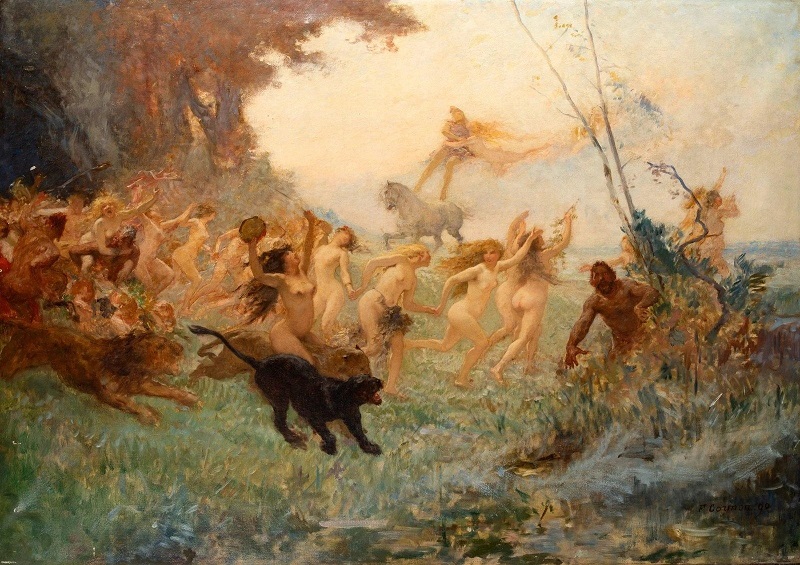
Fernand Cormon
Bacchanalia of nymphs and satyrs
Oil on canvas
90 x 130 cm
Private collection

Fernand Cormon (24 December 1845 – 20 March 1924) was a French painter born in Paris. He became a pupil of Alexandre Cabanel, Eugène Fromentin, and Jean-François Portaels, and one of the leading historical painters of modern France.

His father was the playwright Eugène Cormon. His mother was Charlotte Furais, the actress.

Fernand Cormon
In the Harem
Oil on canvas
95 x 121 cm
Private collection

Harem refers to domestic spaces that are reserved for the women of the house in a Muslim family. A harem may house a man's wife or wives, their pre-pubescent male children, unmarried daughters, female domestic servants, and other unmarried female relatives. In harems of the past, concubines, which were enslaved women, were also housed in the harem. In former times some harems were guarded by eunuchs who were allowed inside. The structure of the harem and the extent of monogamy or polygamy has varied depending on the family's personalities, socio-economic status, and local customs. Similar institutions have been common in other Mediterranean and Middle Eastern civilizations, especially among royal and upper-class families, and the term is sometimes used in other contexts. More on Harem

Fernand Cormon
In the Harem
Oil on canvas
I have no further description, at this time

Fernand Cormon  (1845–1924)
The Harem, c. after 1877
Oil on canvas
Height: 53 cm (20.8 in) Width: 64 cm (25.1 in)
Musée d'art et d'histoire de Narbonne

Fernand Cormon  (1845–1924) 
The Deposed Favourite, c. 1870
Oil on canvas
21.3/8 x 25 in. (54.3 x 64.7 cm.)
Private collection

Dold for GBP 27,600 in  Jun 1999

Painted in 1870, early in his career, The deposed Favourite portrays the cut-throat world of the harem. There was often intense rivalry and power struggles between the kadins, or favourites, who aspired to higher rank and greater power and who would employ any means to achieve it. This intrigue led to plots of bribery, extortion and frequently, as in Cormon's 1874 masterpiece, Jealousy in the Seraglio, murder. In the present work, as the old kadin begs for clemency from the eunuch's waiting axe, 'the new favourite seems singularly unconcerned about the fate of her old rival' More on this painting

Ferdinand-Anne Piestre dit Fernand Cormon
The new favorite
Oil on canvas
49 by 38cm., 19¼ by 15in.
Private collection

Sold for 7,500 EUR in Nov 2011

Cormon had rather occasional relationships with the Orient. He only ventured once to Tunisia, in 1875, a stay which perhaps inspired his paintings. He painted a few orientalist paintings, playful, humorous and very imaginative, often inspired by the Thousand and one nights, for example A harem , kept at the Museum of Art and History of Narbonne (See above)More on this painting

Fernand Cormon  (1845–1924)
Jalousie au Sérail/ Jealousy in the Serail, c. 1874
Oil on canvas
Height: 160 cm (62.9 in); Width: 220 cm (86.6 in)
Musée des Beaux-Arts et d'Archéologie de Besançon 

A serail is the sequestered living quarters used by wives and concubines in an Ottoman household. The term harem is a generic term for domestic spaces reserved for women in a Muslim family, which can also refer to the women themselves. More on a serail

At an early age he attracted attention for the perceived sensationalism in his art, although for a time his powerful brush dwelled with particular delight on scenes of bloodshed, such as the Murder in the Seraglio (1868) and the Death of Ravara, King of Lanka at the Toulouse Museum. The Musée d'Orsay has his Cain fleeing before Jehovah's Curse; and for the Mairie of the fourth arrondissement of Paris he executed in grisaille a series of panels: Birth, Death, Marriage, War, etc. A Chiefs Funeral, and a series of large paintings for the Museum of natural history in Paris with themes from the Stone Age, occupied him for several years. He was appointed to the Legion of Honor in 1880. Subsequently he also devoted himself to portraiture.


Fernand Cormon
Cain, c. 1880
Oil on canvas
H. 400.0; L. 700.0 cm.
Musée d'Orsay

This painting illustrates the fate of Cain, eldest son of Adam and Eve, who after the murder of his younger brother Abel is condemned to flee perpetually. Cain painfully leads his tribe. His sons carry a wooden stretcher on which stand a bewildered woman and her dozing children. They carry pieces of bloody meat. Other men accompany them, hunters. One of them carries a young woman in his arms and a few dogs bring up the rear. The faces betray the fear of Jehovah's sentence.

Cormon lengthened the shadows, as if the light of truth was pursuing the guilty across the barren plain. The artist is concerned with anatomical accuracy: he has a living model for each figure placed in his studio.

Grandiloquent epic, the work is also an anthropological reconstruction. It introduces an unprecedented field, that of prehistory, even though we are discovering Paleolithic cave paintings. For lack of documents, Cormon speculates on life in those remote times, the existence of barbarians struggling for survival, going barefoot, disheveled hair, rough skin. More on this painting

Fernand Cormon
Hagar et Ismael
Oil on canvas
44¾ x 57¾ in
Private collection

Sold for EUR 5,625 in Apr 2012

Hagar is a biblical person in the Book of Genesis Chapter 16. She was an Egyptian handmaid of Sarah, who gave her to Abraham "to wife" to bear a child. The product of the union was Abraham's firstborn, Ishmael, the progenitor of the Ishmaelites.

After Sarah gave birth to Isaac, and the tension between the women returned. At a celebration after Isaac was weaned, Sarah found the teenage Ishmael mocking her son, and demanded that Abraham send Hagar and her son away. She declared that Ishmael would not share in Isaac's inheritance. Abraham was greatly distressed but God told Abraham to do as his wife commanded because God's promise would be carried out through both Isaac and Ishmael.
The name Hagar originates from the Book of Genesis, and is only alluded to in the Qur'an. She is considered Abraham's second wife in the Islamic faith and acknowledged in all Abrahamic faiths. In mainstream Christianity, she is considered a concubine to Abraham. More on Hagar

Fernand Cormon
The Battle of Aspern-Essling, May 1809
Oil on canvas
Musée des Beaux-Arts de Mulhouse

In the Battle of Aspern-Essling Napoleon attempted a forced crossing of the Danube near Vienna, but the French and their allies were driven back by the Austrians under Archduke Charles. It was the first time Napoleon had been personally defeated in a major battle. Archduke Charles drove out the French but fell short of destroying their army. The Austrian artillery dominated the battlefield, firing 53,000 rounds compared to 24,300 French. More on the Battle of Aspern-Essling

Fernand Cormon  (1845–1924)
La Mort de Ravana/ The Death of Ravana, c. 1875
Oil on canvas
Height: 180 cm (70.8 in); Width: 260 cm (102.3 in)
Augustins Museum

Ravana was a king of the island Lanka and the chief antagonist in the Hindu epic Ramayana and its adaptations.

In the Ramayana, Ravana is described to be the eldest son of sage Vishrava and Rakshasi Kaikesi. He abducted lord Rama's wife Sita and took her to his kingdom of Lanka, where he held her in Ashok Vatika. Later, Rama, with the support of vanara King Sugriva and his army of vanars, attacked Ravana in Lanka. They killed Ravana and Rama rescued his beloved wife Sita. More on Ravana

Attributed to Fernand Cormon
Study for La mort de Ravana, circa 1875
Oil on canvas
78 x 98 cm
Private collection

Sold for 14,838.18 CAD in Sep 2011

Fernand Cormon
Cephalus and Procris
Oil on canvas
h: 40,50 w: 64,50 cm
Private collection

Cephalus was married to Procris, a daughter of Erechtheus, an ancient founding-figure of Athens. One day the goddess of dawn, Eos, kidnapped Cephalus when he was hunting. The resistant Cephalus and Eos became lovers, and she bore him a son. However, Cephalus always pined for Procris, causing a disgruntled Eos to return him to her, making disparaging remarks about his wife's fidelity. 

Once reunited with Procris after an interval of eight years, Cephalus tested her by returning from the hunt in disguise, and managing to seduce her. In shame Procris fled to the forest, to hunt. In returning and reconciling, Procris brought two magical gifts, an inerrant javelin that never missed its mark, and a hunting hound, Laelaps that always caught its prey. The hound met its end chasing a fox (the Teumessian vixen) which could not be caught; both fox and the hound were turned into stone. But the javelin continued to be used by Cephalus, who was an avid hunter.

Procris then conceived doubts about her husband, who left his bride at the bridal chamber and climbed to a mountaintop and sang a hymn invoking Nephele, "cloud". Procris became convinced that he was serenading a lover. She climbed to where he was to spy on him. Cephalus, hearing a stirring in the brush and thinking the noise came from an animal, threw the never-erring javelin in the direction of the sound – and Procris was impaled. As she lay dying in his arms, she told him "On our wedding vows, please never marry Eos". Cephalus was distraught at the death of his beloved Procris, and went into exile. More on Cephalus and Procris

Fernand Cormon
The Captive
Oil on canvas
Height: 16 in. (40.64 cm), Width: 13 in. (33.02 cm)
Private collection

Despite the stationary central figures, the piece contains an abundance of movement and action, from the rearing horse in the background to the injured man at the feet of the central figures. The stillness and submissive pose of the captive woman are a sharp contrast to the remnants of the fight around her. Her face hidden in her arms in a gesture of fear and anguish as she hovers on the brink of collapse. More on this painting

Fernand CORMON Paris, 1901 - Paris, 1924
Bacchanal of nymphs and satyrs, c. 1901
Oil on canvas
h: 50.50 w: 61 cm
Private collection

Bacchanalia,  also called Dionysia, in Greco-Roman religion, any of the several festivals of Bacchus (Dionysus), the wine god. They probably originated as rites of fertility gods. Introduced into Rome from lower Italy, the Bacchanalia were at first held in secret, attended by women only, on three days of the year. Later, admission was extended to men, and celebrations took place as often as five times a month. The reputation of these festivals as orgies led in 186 bc to a decree of the Roman Senate that prohibited the Bacchanalia throughout Italy, except in certain special cases. Nevertheless, Bacchanalia long continued in the south of Italy.  More on Bacchanalia

Being well-accepted at the annual Salon, he also ran an art school, the Atelier Cormon in the 1880s where he tried to guide his students to create paintings which would be accepted by the Salon's jury. Among his students with whom he was unsuccessful on this point were, for instance: Henri de Toulouse-Lautrec, Louis Anquetin, Eugène Boch, Paul Tampier, Émile Bernard and Vincent van Gogh. Other students included Alphonse Osbert, Marius Borgeaud, Theodor Pallady, Chaïm Soutine and the Australian painter John Russell.

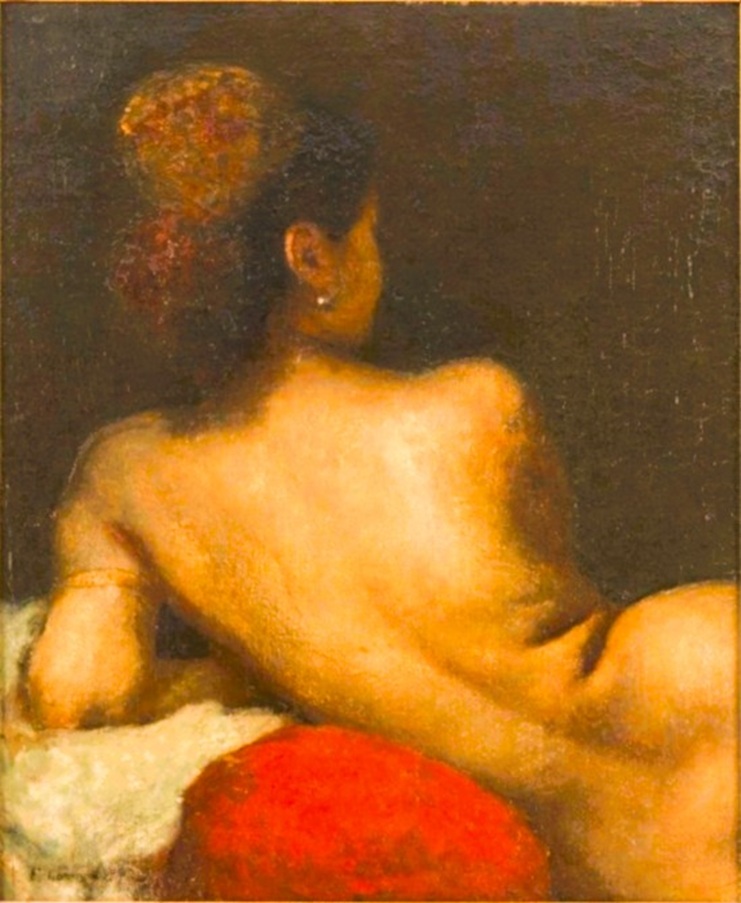
Fernand Cormon
Suzanne Valadon
Oil on canvas
26.5"H x 22.5"W
Private collection

Suzanne Valadon was a French painter who became the first woman painter admitted to the Société Nationale des Beaux-Arts. She was also the mother of painter Maurice Utrillo.

Valadon spent nearly 40 years of her life as an artist. The subjects of her drawings and paintings included mostly female nudes, portraits of women, still lifes, and landscapes. She never attended the academy and was never confined within a tradition.

She was a model for many renowned artists. Among them, Valadon appeared in such paintings as Dance at Bougival (1883) and Dance in the City by Pierre-Auguste Renoir (1883), and Suzanne Valadon (1885) by Henri de Toulouse-Lautrec. More on Suzanne Valadon

Fernand CORMON (1845-1924)
La Javanaise, c. 1876
Huile sur toile
75 x 64 cm
Private collection

Ferdinand-Anne Piestre aka Fernand Cormon
Extended Javanese, c. 1875
Oil on canvas
109.5 x 190.5 cm; 43 1/8 x 75 in
Private collection

The Javanese people are a Southeast Asian ethnic group native to the Indonesian island of Java. They form the largest ethnic group in Indonesia. They are predominantly located in the central to eastern parts of the island. More on Javanese people

An article published on Saturday, May 22, 1875 in Le Temps describes the Javanese exhibited by Cormon at the Salon of 1875, in these terms “Her hair, of a deep black, spreads in disorder over the splendors of the purple cushions; The lower part of her body is covered with a veil ”, a description which corresponds perfectly to our table. More on this painting

Fernand Cormon  (1845–1924)
In expectation
Oil on canvas
46 x 38 cm
Private collection

Fernand Cormon  (1845–1924)
Nu/Nude, c. between 1845 and 1924
Oil on canvas
Height: 103 cm (40.5 in); Width: 71 cm (27.9 in) 
Musée Toulouse-Lautrec

Despite his moment of glory as a Beaux-Arts professor he was almost forgotten by 1924 when he was run over by a taxi outside his studio, and is barely remembered today save as the teacher of pupils more illustrious than himself. More on Fernand Cormon


Please visit my other blogs: Art CollectorMythologyMarine ArtPortrait of a Lady, The OrientalistArt of the Nude and The Canals of VeniceMiddle East Artists365 Saints365 Days, and Biblical Icons, also visit my Boards on Pinterest and my art stores at  deviantart and Aaroko

Images are copyright of their respective owners, assignees or others. Some Images may be subject to copyright

I don't own any of these images - credit is always given when due unless it is unknown to me. if I post your images without your permission, please tell me.

Ads are shown only to compensate the hosting expenses.

If you enjoyed this post, please share with friends and family.

Thank you for visiting my blog and also for liking its posts and pages.

Please note that the content of this post primarily consists of articles available from Wikipedia or other free sources online.


A note to the readers of Zaidan Gallery

    A note to the readers of Zaidan Gallery It is with great sadness that we share the news that the author of this blog,  Henry Zaidan (194...