John Everett Millais (1829–1896)
The Ransom, circa 1860 and circa 1862
Oil on canvas
114.3 × 129.5 cm (45 × 50.9 in)
Getty Center
An armored knight, still in his riding boots and accompanied by his page in mud-splattered stockings, seems to have hastily gotten off his horse to meet for this ransom exchange. The knight’s daughters embrace him while he tries to hand over precious jewels, but their arms are still being held by the kidnapper, whose plainer clothing contrasts with their finery. The page in a blue and white striped ensemble is watching closely and reaches into his purse, sensing that the kidnappers will demand more ransom. These characters—not based on any historical or literary source, but invented by the artist—dramatize a narrative through their expressive gestures and glances. The outcome still seems uncertain and even the dog looks expectantly at the central figures for the resolution of the story. More on this painting
Sir John Everett Millais, 1st Baronet, PRA (June 1829 – 13 August 1896) was born in Southampton, the son of John William Millais, a wealthy gentleman from an old Jersey family. His mother's family were prosperous saddlers. Considered a child prodigy, he came to London in 1838. He was sent to Sass's Art School, and won a silver medal at the Society of Arts at the age of nine.
Sir John Everett Millais
The Tribe of Benjamin Seizing the Daughters of Shiloh
Oil on canvas
40¼ x 50⅜ in
Private collection
The subject is from the Book of Judges in the Old Testament. The Tribe of Benjamin, at war with the other tribes of Israel, had been reduced to only 600 men and feared extinction. The Benjamites sought wives, and they planned to ambush a tabernacle feast in Shiloh where young women were dancing in the vineyards: "So they instructed the Benjamites, saying 'Go and hide in the vineyards and watch. When the young women of Shiloh come out to join the dancing, rush from the vineyards and each of you seize one of them to be your wife. Then return to the land of Benjamin'" (Judges 21: 20-21). More on this painting
In 1840 he was admitted to the Royal Academy Schools as their youngest ever student, winning a silver medal in 1843 for drawing from the antique, and a gold medal in 1847 for his painting The Tribe of Benjamin Seizing the Daughters of Shiloh (See above). He first exhibited at the Royal Academy in 1846, with Pizarro Seizing the Inca of Peru (Victoria and Albert Museum, London) (See below) .
Sir John Everett Millais
Pizarro Seizing the Inca of Peru, c. 1846
Oil on canvas
height: 128.3cm, width: 171.7cm
Victoria and Albert Museum, London
The unusual subject of this painting is the capture of the Inca emperor Atahualpa by the Spanish conquistador Francisco Pizarro in 1532. As a model for Pizarro, Millais used an actor who had recently appeared in a play of the same name. Millais was only 16 when he painted this work. More on this painting
John Everett Millais
Isabella (also known as Lorenzo and Isabella), c. 1849
Oil on Canvas
103 cm x 142.8 cm
Walker Art Gallery
Isabella, sister of rich Florentine merchants, shares an orange with poor apprentice Lorenzo - their love symbolized by roses, passionflowers and faithful dog.
The orange is a blood-orange. Her three brothers want to increase their fortune by marrying Isabella to a wealthy husband. Lorenzo's in the way. They lean or gesture threateningly towards the couple while the rest of the family, eyes averted, resolutely ignore what's going on. The nearest brother, snarling, explodes with pent-up violence, cracking a nut and kicking the dog.
If you've already seen the Simone Martini painting, you'll remember the bright colours. Millais wanted to achieve a similar effect - also painting on white as medieval artists did to enhance their vibrancy. He exaggerates the medieval lack of spatial depth through harsh, even lighting and distortion, particularly in the cardboard-cutout-like family. To be true to reality he depicts every single object - natural or man-made - with equal precision. The characters are even modeled on real people. The man with the napkin is Millais' father, the man draining his glass is the artist Rossetti. The aggressive brother is probably a fellow Academy student.
What happens next in the story is tha the brothers murder Lorenzo. Finding his body, Isabella cuts off his head and buries it on the verandah, in a pot of basil - watered with her tears. More on this painting

John Everett Millais (1829–1896)
Autumn Leaves, c. 1856
Oil on canvas
H 104.3 x W 74 cm
Manchester Art Gallery
Autumnal garden scene, depicting four melancholy young girls mounding gathered leaves. The two older girls gaze directly at the viewer; they are dressed in identical, dark green dresses with their long hair loose; of this pair, the girl on the left holds a wicker basket from which the second girl removes leaves and adds them to the smouldering pile. To their right are the other two figures: standing in profile to the right with her head turned in three-quarter view is a girl with brilliant red hair, tied into a ponytail, wearing a rust-coloured garment and leaning on a rake, she gazes down at the mound of leaves; the fourth girl, the smallest of the group, stands at the right edge of the composition in three-quarter view to the left, wearing a purple dress with a red necktie, holding in her hand an apple and small posy of blue flowers. More on this painting
Millais's Christ in the House of His Parents (1849–50) (See above) was highly controversial because of its realistic portrayal of a working class Holy Family labouring in a messy carpentry workshop. Later works were also controversial, though less so. Millais achieved popular success with A Huguenot (1851–52) (See below), which depicts a young couple about to be separated because of religious conflicts. He repeated this theme in many later works.
John Everett Millais (1829–1896)
Christ in the House of His Parents or The Carpenter's Shop, c. between 1849 and 1850
Oil on canvas
Height: 86.4 cm (34 in); Width: 139.7 cm (55 in)
Tate Britain
Depicted people: Jesus, Virgin Mary, Joseph, John the Baptist, Saint Anne
This is Millais's first important religious subject, showing a scene from the boyhood of Christ. When it was exhibited at the Royal Academy in 1850 it was given no title, but accompanied by a biblical quotation: 'And one shall say unto him, What are those wounds in thine hands? Then he shall answer, Those with which I was wounded in the house of my friends.' (Zech. 13:6)
Christian symbolism figures prominently in the picture. The carpenter's triangle on the wall, above Christ's head, symbolises the Holy Trinity. The wood and nails prefigure the crucifixion, as does the blood on the young Christ's hand, which he has cut on a nail, and which drips onto his foot. The young St John is shown fetching a bowl of water with which to bathe the wound. This clearly identifies him as the Baptist, and the image is extended by the white dove perched on the ladder, symbol of the Holy Spirit, which descended from Heaven at the baptism of Christ. More on this painting

John Everett Millais (1829–1896)
A Huguenot, c. 1852
Oil on canvas
Height: 92.7 cm (36.5 in); Width: 64.1 cm (25.2 in)
Private collection
A Huguenot, on St. Bartholomew's Day, Refusing to Shield Himself from Danger by Wearing the Roman Catholic Badge, is the full, exhibited title, of a painting by John Everett Millais, and was produced at the height of his Pre-Raphaelite period.
The painting depicts a pair of young lovers and is given a dramatic twist because the girl, who is Catholic, is attempting to get her beloved, who is a Protestant, to wear the white armband declaring allegiance to Roman Catholicism. The young man firmly pulls off the armband at the same time that he gently embraces his lover, and stares into her pleading eyes. The incident refers to the St. Bartholomew's Day Massacre on August 24, 1572, when around 3,000 French Protestants (Huguenots) were murdered in Paris, with around 20,000 massacred across the rest of France. A small number of Protestants escaped from the city through subterfuge by wearing white armbands. More on this painting
John Everett Millais (1829–1896)
Ophelia, circa 1851
Oil on canvas
Height: 76.2 cm (30 in); Width: 111.8 cm (44 in)
Tate Britain
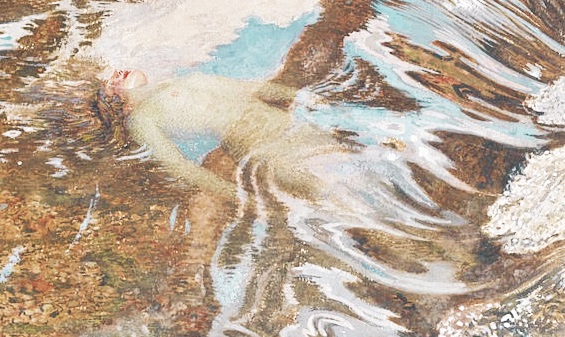
The scene depicted is from Shakespeare's Hamlet, Act IV, Scene vii, in which Ophelia, driven out of her mind when her father is murdered by her lover Hamlet, falls into a stream and drowns.
Shakespeare was a favourite source for Victorian painters, and the tragic-romantic figure of Ophelia from Hamlet was an especially popular subject, featuring regularly in Royal Academy exhibitions. More on this painting
The model for this painting was Elizabeth Eleanor Siddall (25 July 1829 – 11 February 1862), styled and commonly known as Lizzie, an English artist, poet, and artists' model. (Her surname was shortened to Siddal after her marriage to Dante Gabriel Rossetti.) Siddall was an important and influential artist and poet. She was painted and drawn extensively by artists of the Pre-Raphaelite Brotherhood, including Walter Deverell, William Holman Hunt, John Everett Millais (including his notable 1852 painting Ophelia), and her husband, Dante Gabriel Rossetti. More on Elizabeth Eleanor Siddall
All these early works were painted with great attention to detail, often concentrating on the beauty and complexity of the natural world. In paintings such as Ophelia (1851–52) (See above) Millais created dense and elaborate pictorial surfaces based on the integration of naturalistic elements. This approach has been described as a kind of "pictorial eco-system."
John Everett Millais (1829–1896)
Mariana, c. 1851
Oil on mahogany wood
Height: 59.7 cm (23.5 in); Width: 49.5 cm (19.4 in)
Tate Britain
Tennyson's poem was inspired by the character of Mariana in Shakespeare's Measure for Measure. Rejected by her fiancé, Angelo, after her dowry was lost in a shipwreck, she leads a lonely existence in a moated grange. She is still in love with Angelo - now Deputy to the Duke of Vienna - and longs to be reunited with him.
In the picture the autumn leaves mark the passage of time. Mariana has been working at some embroidery and pauses to stretch her back. The stained-glass windows in front of her show the Annunciation, contrasting the Virgin's fulfilment with Mariana's frustration and longing. Millais copied the scene from the window of the Chapel of Merton College, Oxford. However, the heraldic design appears to have been his own invention. The motto 'In coelo quies' means 'In Heaven there is rest' and clearly refers to Mariana's desire to be dead. More on this painting
This style was promoted by the critic John Ruskin, who had defended the Pre-Raphaelites against their critics. Millais's friendship with Ruskin introduced him to Ruskin's wife Effie. Soon after they met, she modelled for his painting The Order of Release (See below). As Millais painted Effie, they fell in love. Despite having been married to Ruskin for several years, Effie was still a virgin. Her parents realised something was wrong and she filed for an annulment. The couple settled in Perth, where he painted Autumn Leaves (1855-6, City of Manchester Art Galleries) (See above).
John Everett Millais (1829–1896)
The Order of Release 1746, c. 1853
Oil on canvas
Height: 73.7 cm (29 in); Width: 102.9 cm (40.5 in)
Tate Britain
Bonnie Prince Charlie (1720-1788) was defeated by the English at Culloden on 16 April 1746 and many of his supporters were imprisoned. The subject of this picture is the release of one of these Jacobite rebels from prison.
The rebel's wife, supporting their small child and comforting her exhausted, wounded husband, hands an order of release to the gaoler. The expression on her face is inscrutable. She appears strangely detached from the action, and the suggestion is that she may have been forced to sacrifice her virtue in order to save her husband. The picture's original title was The Ransom and early sketches reveal that Millais originally showed a purse of money being handed over. However, in the finished work he substitutes the order of release which gives the painting its current title. The signature on the document is clearly visible as that of Sir Hilgrove Turner, who encouraged Millais's artistic talent from an early age. More on this painting
Between 1855 and 1864 Millais made illustrations for numerous publications, including the Moxon edition of Tennyson's poems (1857), the magazine Once a Week (1859 onwards) and several novels by Trollope. He moved back to London in 1861, where he achieved popular success as a painter of child subjects such as Bubbles (1886, A. & F. Pears Ltd.), which became famous as an advertisement for Pears soap. Also popular were his paintings of beautiful young women, such as Stella (1868, Manchester City Art Gallery) (See below). He built up a practice as a portraitist from the early 1870s, his sitters including Thomas Carlyle (1877) (See below), Lillie Langtry (1878) (See below), Gladstone (1879 and 1885) (See below), Disraeli (1881) (See below) and Tennyson (1881) (See below).
John Everett Millais (1829–1896)
Stella, c. 1868
Oil on canvas
H 112.7 x W 92.1 cm
Manchester Art Gallery
Three-quarter length portrait of a young woman depicted as 'Stella', the subject of Jonathan Swift's 'Journal to Stella', in profile to the right with her face turned to three-quarter view. She has long dark hair, which is tied away from her face with a lace and ribbon cap, a string of coral beads around her neck, and an ivory-coloured dress patterned with bouquets and posies of flowers with half-length sleeves. She is seen standing next to a highly elaborate wooden sideboard with a marble top, a sheet from a letter in her hand (presumably from Swift); before her, on the top of the sideboard, are the other sheets of the letter, a bronze figurine, and a large dark aquamarine-coloured jar. The drawer of the sideboard is slightly open. More on this painting
Sir John Everett Millais, 1st Bt
Thomas Carlyle, c. 1877
Oil on canvas,
46 in. x 34 3/4 in. (1168 mm x 883 mm)
National Portrait Gallery, London
Thomas Carlyle (4 December 1795 – 5 February 1881) was a Scottish historian, satirical writer, essayist, translator, philosopher, mathematician, and teacher. In his book On Heroes, Hero-Worship, and The Heroic in History (1841), he argued that the actions of the "Great Man" play a key role in history, claiming that "the history of the world is but the biography of great men". Other major works include The French Revolution: A History, 3 vols (1837) and The History of Friedrich II of Prussia, Called Frederick the Great, 6 vols (1858–65). More on Thomas Carlyle
John Everett Millais (1829–1896)
A Jersey Lily, portrait of Lillie Langtry, c. 1878
Oil on canvas
Unknown
Emilie Charlotte Langtry (née Le Breton; October 13, 1853 – February 12, 1929), known as Lillie (or Lily) Langtry and nicknamed "The Jersey Lily", was a British-American socialite, actress and producer.
Born on the island of Jersey, upon marrying she moved to London in 1876. Her looks and personality attracted interest, commentary, and invitations from artists and society hostesses, and she was celebrated as a young woman of great beauty and charm.
By 1881, she had become an actress and starred in many plays in the UK and the United States. In later life she performed "dramatic sketches" in vaudeville. She was also known for her relationships with noblemen, including the Prince of Wales, the Earl of Shrewsbury, and Prince Louis of Battenberg. She was the subject of widespread public and media interest. More on A Jersey Lily
Sir John Everett Millais, 1st Bt
William Ewart Gladstone, c. 1879
Oil on canvas
49 1/2 in. x 36 in. (1257 mm x 914 mm)
National Portrait Gallery, London
Famous as the ‘grand old man’ of British politics; Gladstone was leader of the Liberal Party and prime minister in four governments from 1868 to 1894. Gladstone was responsible for major reforms in every sphere of national life, and for the development of imperial foreign policy. He divided the party on the issue of Irish Home Rule and stamped his moral authority on the politics of his time. Gladstone’s father, John Gladstone was one of the largest owners of enslaved Africans in the Caribbean and this wealth supported Gladstone’s early career in politics. As a politician, Gladstone supported the proposal to compensate slave-owners for the loss of their ‘property’ after slavery was abolished and the introduction of the apprenticeship system that required newly freed Africans to continue working for their masters for four to six years. More on William Ewart Gladstone
Sir John Everett Millais, 1st Bt
Benjamin Disraeli, 1st Earl of Beaconsfield (1804-1881), c. 1881
Oil on panel
61.0 x 43.6 cm
The Royal Collection Trust
Benjamin Disraeli, 1st Earl of Beaconsfield KG PC MP FRS (21 December 1804 – 19 April 1881) was a British statesman and Conservative politician, who twice served as Prime Minister of the United Kingdom. He played a central role in the creation of the modern Conservative Party, defining its policies and its broad outreach. Disraeli is remembered for his influential voice in world affairs, his political battles with the Liberal Party leader William Ewart Gladstone, and his one-nation conservatism or "Tory democracy". He made the Conservatives the party most identified with the glory and power of the British Empire. He is the only British prime minister to have been of Jewish birth. He was also a novelist, publishing works of fiction even as prime minister. More on Benjamin Disraeli
Disraeli was seriously ill when Millais was painting this portrait, commissioned by the Fine Art Society, in March 1881. He died in April after only three sittings so the picture was unfinished, but Millais completed it, at Queen Victoria’s command. Millais was sent photographs to assist him with this replica and the Queen judged it ‘a fine picture’. She thought Millais had ‘given the peculiar, intellectual, and gentle expression of his face’ and the painting had for her ‘a peculiar and melancholy interest from being the last portrait her dear and ever-lamented friend and great Minister ever sat for, and when, as it were, the shadow of death was already upon him’. More on this painting
John Everett Millais (1829–1896)
Lord Alfred Tennyson
Oil on canvas
Private collection
Alfred Tennyson, 1st Baron Tennyson FRS (6 August 1809 – 6 October 1892) was a British poet. He was the Poet Laureate during much of Queen Victoria's reign and remains one of the most popular British poets. In 1829, Tennyson was awarded the Chancellor's Gold Medal at Cambridge for one of his first pieces, "Timbuktu". He published his first solo collection of poems, Poems Chiefly Lyrical in 1830. "Claribel" and "Mariana", which remain some of Tennyson's most celebrated poems, were included in this volume. Although decried by some critics as overly sentimental, his verse soon proved popular and brought Tennyson to the attention of well-known writers of the day, including Samuel Taylor Coleridge. Tennyson's early poetry, with its medievalism and powerful visual imagery, was a major influence on the Pre-Raphaelite Brotherhood. More on Alfred Tennyson
Millais was made an Associate of the Royal Academy in 1853, and a full member in 1863. In 1885 he was created a baronet and in 1896 was elected President of the Royal Academy, but died shortly thereafter in London. He is buried in St Paul's Cathedral. More on John Everett Millais

Sir John Everett Millais, Bt 1829–1896
The Knight Errant, c. 1870
Oil paint on canvas
1841 × 1353 mm
Tate
The Knight Errant, when shown at the Royal Academy in 1870, was accompanied by a text of Millais's own invention which was printed in the exhibition catalogue: 'The order of Knights errant was instituted to protect widows and orphans, and to succour maidens in distress.' The moonlit scene apparently depicts an act of medieval chivalry in which one such Knight errant, clad in armour, is on the point of freeing a woman who has been stripped and tied to a tree. The woman's clothes lie on the ground to the left and her molesters, assumed to be robbers, are seen fleeing the scene in the top right corner of the canvas. There is blood on the Knight's sword and the torso of a dead man is visible behind him. More on this painting
Please visit my other blogs: Art
Collector, Mythology, Marine
Art, Portrait of a Lady, The
Orientalist, Art of the Nude and The
Canals of Venice, Middle
East Artists, 365
Saints and 365 Days, also visit my Boards on Pinterest
Images are copyright of their respective owners, assignees or others.
Some Images may be subject to copyright
I don't own any of these images - credit is always given when due unless
it is unknown to me. if I post your images without your permission, please tell
me.
I do not sell art, art prints, framed posters or reproductions. Ads are
shown only to compensate the hosting expenses.
If you enjoyed this post, please share with friends and family.
Thank you for visiting my blog and also for liking its posts and pages.
Please note that the content of this post primarily consists of articles
available from Wikipedia or other free sources online.