Showing posts with label Eve. Show all posts

Saturday, November 13, 2021

26 Works, November 13th. is Byam Shaw's day, his art, illustrated with footnotes #234

Byam Shaw  (1872–1919)
Love the Conqueror
Oil on canvas
I have no further description, at this time

107 famous historical and literary figures are indicated and are represented in the painting, all belonging to the army of the Conqueror Love.

John Byam Liston Shaw (13 November 1872 – 26 January 1919), commonly known as Byam Shaw, was a British painter, illustrator, designer and teacher.

Byam Shaw  (1872–1919)
Omphale, c. 1914
Watercolor and bodycolor
Height: 72.5 cm (28.5 in); Width: 29 cm (11.4 in)
Private collection

Dressed in skin of Nemean lion and holding Hercules' club; the labors of Hercules are in the background

In Greek mythology, Omphale was queen of the kingdom of Lydia in Asia Minor. In her best-known myth, she is the mistress of the hero Heracles during a year of required servitude, a scenario that offered writers and artists opportunities to explore sexual roles and erotic themes. More on Omphale

John Liston Byam Shaw, British 1872 - 1919
Diana of the Hunt
Oil on canvas
I have no further description, at this time

In Roman mythology, Diana was the goddess of the hunt, the moon and nature being associated with wild animals and woodland, and having the power to talk to and control animals. She was eventually equated with the Greek goddess Artemis, though she had an independent origin in Italy. Diana was worshipped in ancient Roman religion and is revered in Roman Neopaganism and Stregheria. Diana was known to be the virgin goddess of childbirth and women. She was one of the three maiden goddesses — along with Minerva and Vesta — who swore never to marry. More on Diane

Shaw was born in Madras; his father, John, was the registrar of the High Court at Madras. The family returned to England in 1878 where they settled in Kensington. He showed early artistic promise, and in 1887 his work was shown to John Everett Millais, who recommended that the 15-year-old should enter the St John's Wood Art School. There, he first met fellow artists Gerald Fenwick Metcalfe (also born in India) and Rex Vicat Cole. He also met Evelyn Pyke-Nott, his future wife, there. From 1890, Shaw studied at the Royal Academy Schools where he won the Armitage Prize in 1892 for his work The Judgement of Solomon.

John Byam Shaw
Goblin Market, c. 1899
Oil on panel
29 x 24 cm.
Private collection

Goblin Market (composed in April 1859 and published in 1862) is a narrative poem by Christina Rossetti. The poem tells the story of Laura and Lizzie who are tempted with fruit by goblin merchants. In a letter to her publisher, Rossetti claimed that the poem, which is interpreted frequently as having features of remarkably sexual imagery, was not meant for children. However, in public Rossetti often stated that the poem was intended for children, and went on to write many children's poems. When the poem appeared in her first volume of poetry, Goblin Market and Other Poems, it was illustrated by her brother, the Pre-Raphaelite Brotherhood artist Dante Gabriel Rossetti. More on Goblin Market

John Byam Shaw
THE LURE
Oil on panel
23 3/4 by 26 1/8 in.60.3 by 66.4 cm
Private collection

Kneeling at the tomb of her deceased husband, a grieving young widow is suddenly interrupted by the impish figure of Love, who mischievously beckons her away from her wifely duty to follow him. While the exact source of the scene is unknown, John Liston Byam Shaw sought artistic inspiration in literature and history and often painted compositions with a clear narrative or underlying moral. More on this painting

John Byam Liston Shaw, 1872-1919
A Dirge
And All Winds Go Sighing
Oil on canvas
1872 x 1919 cms | 737 x 755 1/2 ins
Private collection


JOHN BYAM LISTON SHAW (BRITISH, 1872-1919)
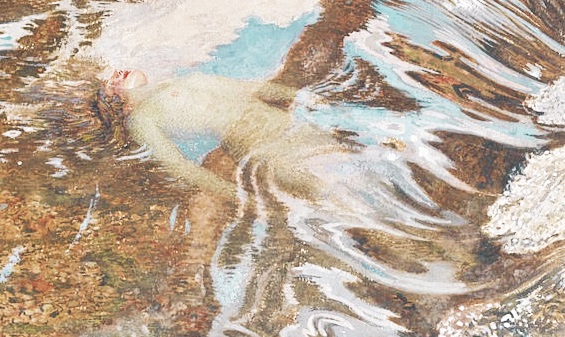
Ophelia
Watercolour heightened with bodycolour
30 x 25cm (11 13/16 x 9 13/16in)
Private collection

Ophelia is a character in William Shakespeare's drama Hamlet. She is a young noblewoman of Denmark, the daughter of Polonius, sister of Laertes and potential wife of Prince Hamlet, who, due to Hamlet's actions, ends up in a state of madness that ultimately leads to her drowning. More on Ophelia

JOHN BYAM LISTON SHAW (BRITISH, 1872-1919)
Detail; Ophelia
Watercolour heightened with bodycolour
30 x 25cm (11 13/16 x 9 13/16in)
Private collection

Byam Shaw  (1872–1919)
The Arrested Spear, c. 1916
Oil on Canvas
157.50 cm x 183.00 cm
 City Art Gallery, Vancouver

Byam Shaw's most important painting unconnected with the War consisted of his large picture in the Academy of 1916, The Arrested Spear from a scene in Parsifal. It was purchased after his death by the late Lord Leverhulme and presented by him to the City Art Gallery, Vancouver.

Parsifal, hero of Richard Wagner’s opera of the same name, was a knight of the Arthurian Legend, finder of the Holy Grail. The scene portrays Parsifal standing in the garden of the evil magician Klingsor. The Flower Maidens lie at his feet, rejected by his indifference to their temptations. He seizes and holds suspended in mid-air the Sacred Spear, which Klingsor has hurled at him. As Parsifal makes the sign of the cross, Klingsor’s domain falls in ruins. More on this painting

Throughout his career Byam Shaw worked competently in a wide variety of media including oils, watercolour, pastels, pen and ink and deployed techniques such as dyeing and gilding. He was influenced by the Pre-Raphaelites and took many of his subjects from the poems of Rossetti. He exhibited frequently at Dowdeswell and Dowdeswell's gallery in New Bond Street, where he had at least five solo exhibitions between 1896 and 1916.

John Byam Liston Shaw, 1872-1919
The Angel Before Adam
Oil on panel
45.7 x 34.3 cms | 17 3/4 x 13 1/2 ins
Private collection

The Angel offering the fruits of the Garden of Eden to Adam and Eve

Byam Shaw  (1872–1919)
The Woman, the Man and the Serpent, c. 1911
Oil on canvas
Height: 182.3 cm (71.7 in); Width: 54.1 cm (21.2 in)
Private collection

Adam and Eve, according to the creation myth of the Abrahamic religions, were the first man and woman and the ancestors of all humans. The story of Adam and Eve is central to the belief that YHWH created human beings to live in a paradise on earth, although they fell away from that state and formed the present world full of suffering and injustice. It provides the basis for the belief that humanity is in essence a single family, with everyone descended from a single pair of original ancestors. It also provides much of the scriptural basis for the doctrines of the fall of man and original Sin, important beliefs in Christianity, although not generally shared by Judaism or Islam. More on Adam and Eve

John Byam Liston Shaw (1872–1919)
The Prodigal's Return
Oil on canvas
H 89.5 x W 64 cm
Russell-Cotes Art Gallery & Museum

The Parable of the Prodigal Son is one of the parables of Jesus Christ, which he shares it with his disciples, the Pharisees and others.
 
In the story, a father has two sons. The younger son asks for his inheritance and after wasting his fortune, becomes destitute. He returns home with the intention of begging his father to be made one of his hired servants, expecting his relationship with his father is likely severed. The father welcomes him back and celebrates his return. The older son refuses to participate. The father reminds the older son that one day he will inherit everything. But, they should still celebrate the return of the younger son because he was lost and is now found. More on the prodigal son

John Byam Liston Shaw, 1872-1919
The Judgement of Solomon
'And who knoweth whether he shall be a wise man or a fool? Yet shall he have rule over all my labour wherein I have laboured, and wherein I have showed myself wise.'
Oil on panel
40 x 25.1 cms | 15 1/2 x 9 3/4 ins
Private collection

The Judgement of Solomon is a story from the Hebrew Bible in which Solomon ruled between two women both claiming to be the mother of a child. Solomon revealed their true feelings and relationship to the child by suggesting the baby be cut in two, each woman to receive half. With this strategy, he was able to discern the non-mother as the woman who entirely approved of this proposal, while the actual mother begged that the sword might be sheathed and the child committed to the care of her rival. Some consider this approach to justice an archetypal example of an impartial judge displaying wisdom in making a ruling. More on The Judgement of Solomon

John Byam Liston Shaw (1872–1919)
Jezebel, c. 1896
Oil on canvas
H 148.5 x W 81 cm
Russell-Cotes Art Gallery & Museum

Jezebel (fl. 9th century BCE) was a queen, identified in the Book of Kings as the daughter of Ithobaal I of Sidon and the wife of Ahab, King of Israel.

According to the Hebrew Bible, Jezebel incited her husband King Ahab to abandon the worship of Yahweh and encourage worship of the deities Baal and Asherah instead. Jezebel persecuted the prophets of Yahweh, and fabricated evidence of blasphemy against an innocent landowner who refused to sell his property to King Ahab, causing the landowner to be put to death. For these transgressions against the God and people of Israel, Jezebel met a gruesome death – thrown out of a window by members of her own court retinue, and the flesh of her corpse eaten by stray dogs.

Jezebel became associated with false prophets. In some interpretations, her dressing in finery and putting on makeup led to the association of the use of cosmetics with "painted women" or prostitutes. More on Jezebel

The painting, exhibited at the Royal Academy in 1896, originally depicted Jezebel nude, flanked by her hand-maidens. The model was Rachel Lee, a close friend of Byam Shaw. Unable to sell the painting, he later reworked it so that the central figure was shown clothed.

Byam Shaw  (1872–1919)
The Greatest of All Heroes is One, c. 1905
I have no further description, at this time

John Byam Shaw
'The Greatest of All Heroes is One
Pencil sketch
48.5 x 74.5cm 
Private collection

Later in his life his popularity as an artist waned, and he turned to teaching for his living. He taught at the Women's Department of King's College London from 1904 and in 1910, with Rex Vicat Cole, he founded the Byam Shaw and Vicat Cole School of Art later renamed simply the "Byam Shaw School of Art". Evelyn Shaw had an active role in the new school, teaching the miniatures class, her area of expertise. Shaw had had a long association with the artist and illustrator Eleanor Fortescue-Brickdale, who taught at the new school.

John Byam Liston Shaw (1872-1919)
The Queen of Hearts, c. 1896
Oil on canvas
36 x 28 in. (91.4 x 71.1 cm.)
Private collection

The Queen of Hearts is a picture from the artist’s playful imagination. Its heroine is his fiancée, Evelyn Pyke-Nott, who he was to marry three years after this picture was painted. They met at the Royal Academy schools. Clearly already deeply in love with her, Byam Shaw has presented her as the Queen of Hearts from the children’s nursery rhyme. All gallery visitors at that date would have known this piece of verse, having been raised on the illustrations of Randolph Caldecott. Presented in a frame of the artist’s own design, she steps out from a pack of playing cards, moving forward as if to break through the picture plane. To anchor the narrative further, her sister, the artist Isabel Codrington, holds a plate of jam tarts behind her. More on this painting

John Byam Shaw (British, 1872–1919)
The Queen of Spades , c. 1898
Pencil, watercolour, and bodycolour heightened with gum arabic and with scratching out on paper
178 x 91.5 cm. (70.1 x 36 in.)
Private collection

Executed in 1897-1898 after the success enjoyed with The Queen of Hearts (see lot 5) the previous year it continues to personify the Queens in a pack of playing cards. Sadly the Queens of Clubs and Diamonds were never attempted. As with The Queen of Hearts, the narrative of the nursery rhyme is not closely followed although the spirit of the queen’s character is portrayed. According to cartomancy, (the custom of fortune telling with cards), the Queen of Spades is often personified as a widow who is cold and calculating. More on this painting

Attributed to John Byam Shaw, A.R.W.S., R.I. (1872-1919)
The triumph of love
Oil on canvas
12 x 16 1/3 in. (30.5 x 41.6 cm.)
Private collection

John Byam Shaw (British, 1872–1919)
'Who knoweth the spirit of man that goeth upward, and the spirit...'
Oil on Panel
35.6 x 24.8 cm. (14 x 9.8 in.)
Private collection

1 Corinthians

 But God hath revealed them unto us by his Spirit: for the Spirit searcheth all things, yea, the deep things of God.

For what man knoweth the things of a man, save the spirit of man which is in him? even so the things of God knoweth no man, but the Spirit of God.

Byam Shaw  (1872–1919)
Rising Spring, c. before 1911
Private collection

Kristina Anapau recreates John Byam Liston Shaw's "Rising Spring"

John Byam Liston Shaw (1872–1919)
The Fool Who Would Please Every Man, c. 1903
Oil on canvas
H 98.7 x W 128.6 cm
Laing Art Gallery

The man who wanted to please everyone has ended up making a ridiculous journey. He has the effort of carrying his donkey, and the donkey is uncomfortably tied upside down to a carrying pole. The story was told in the Fables by the ancient Greek writer Aesop.

John Byam Liston Shaw
Boer War (1900–1901), Last Summer Things Were Greener, c. 1901
Oil on canvas
H 101.8 x W 76 cm
Birmingham Museums Trust

The subject is the artist's sister, Margaret Glencairn. She is depicted mourning her cousin George killed in the Boer War, South Africa.

John Byam Liston Shaw (1872–1919)
Such Is Life, c. 1907
Oil on canvas
H 129.5 x W 174.6 cm
Leeds Art Gallery, Leeds Museums and Galleries

John Byam Liston Shaw (1872–1919)
The Entrance of Mary I with Princess Elizabeth into London,1553, c. 1910
Oil on canvas
H 205.7 x W 210.8 cm
Parliamentary Art Collection

The original scheme for the East Corridor as set out by the Fine Art Commission in 1847 was very different to how it is today. It was thought to be a good space to illustrate events from before Christianity and after the Revolution. However the scheme was abandoned and it was not until 1907 that renewed interest arose for the east corridor under a new and more liberal government. It was decided that the decoration of this corridor was a priority and the select committee suggested that the Tudor period would be suitable for the illustrated scheme. Individual artists were commissioned to paint each section and to keep visual unity a colour scheme of predominantly black, red and gold was employed and the height of the characters was defined at 1.68m. This illustration depicts Queen Mary I with Princess Elizabeth entering London in 1553. More on this painting

John Byam Liston Shaw (British, 1872-1919)
Cleopatra
Oil on panel
12 x 9 7/8 in. (30.5 x 25.1 cm.)
Private collection

Cleopatra VII Philopator (69 – August 12, 30 BC), was the last active pharaoh of Ptolemaic Egypt, briefly survived as pharaoh by her son Caesarion. After her reign, Egypt became a province of the recently established Roman Empire. More on Cleopatra

At the outbreak of the First World War Byam Shaw and Vicat Cole enlisted in the Artists Rifles although Shaw soon transferred to the Special Constabulary. He produced war cartoons that were published in many newspapers and also found work with memorial commissions. Not long after the war ended, Shaw collapsed and died at age 46 in the 1918-1919 influenza epidemic and was interred at Kensal Green Cemetery. His funeral was held at St Barnabas', Addison Road. Years before, he had designed two yellow-hued stained glass windows for this church, depicting Saints Cecilia and Margaret.] An ornate red, green and gilt monument to his life, in a 15th-century style, still stands there. More on Byam Shaw


Please visit my other blogs: Art CollectorMythologyMarine ArtPortrait of a Lady, The OrientalistArt of the Nude and The Canals of VeniceMiddle East Artists365 Saints and 365 Days, also visit my Boards on Pinterest

Images are copyright of their respective owners, assignees or others. Some Images may be subject to copyright

I don't own any of these images - credit is always given when due unless it is unknown to me. if I post your images without your permission, please tell me.

I do not sell art, art prints, framed posters or reproductions. Ads are shown only to compensate the hosting expenses.

If you enjoyed this post, please share with friends and family.

Thank you for visiting my blog and also for liking its posts and pages.

Please note that the content of this post primarily consists of articles available from Wikipedia or other free sources online.


Thursday, September 16, 2021

14 Works, September 16th. is Solomon Joseph Solomon's day, his story, illustrated with footnotes #203

Solomon Joseph Solomon, R.A., P.R.B.A. (1860-1927)
The life class
Oil on canvas
25 ¼ x 31 ½ in. (64.2 x 80 cm.)
Private collection

Alife classes is an art class in which students draw or paint a live model, typically one who is nude.

Solomon Joseph Solomon RA RBA (16 September 1860 – 27 July 1927) was a British painter, a founding member of the New English Art Club and member of the Royal Academy.

Solomon Joseph Solomon, 1860-1927
The Bathers Alarmed
Oil on canvas
54.6 x 80 cms | 21 1/4 x 31 1/4 ins
Russell-Cotes Art Gallery and Museum, Bournemouth


Solomon made an important contribution to the development of camouflage in the First World War, working in particular on tree observation posts and arguing tirelessly for camouflage netting.


Born in London in 1860, Solomon studied at various art schools, sequentially, Heatherley School of Fine Art, the Royal Academy Schools, the Munich Academy, and École des Beaux-Arts (under Alexandre Cabanel). Solomon also studied separately under Rev. S. Singer. He exhibited his first works as early as 1881, and showed at the Royal Academy, the New Gallery, and the Society of British Artists. In 1886, he became one of the founding members of the New English Art Club. In 1896, he became an associate of the Royal Academy, with full membership following in 1906. He joined, and became president of, the Royal Society of British Artists in 1919. In 1921 "Col. S.J. Solomon, R.A., P.R.B.A." was listed as one of the early members of the newly formed Society of Graphic Art.

Solomon Joseph Solomon  (1860–1927)
The Judgment of Paris, c. 1891
Oil on canvas
Height: 93 in (236.2 cm); Width: 65.2 in (165.7 cm)
Private collection

The Judgement of Paris is a well-known tale from Greek mythology in which Paris, a Trojan goat-herder, is asked by Zeus, the king of the gods, to choose the fairest goddess between Hera, the queen of the gods, Athena, the goddess of wisdom and war, and Aphrodite, the goddess of love, and award a golden apple to his chosen victor. Each goddess promises him a prize, with Aphrodite offering him the most beautiful woman in the world, Helen of Sparta, married to the Greek king Menelaus. In awarding Aphrodite the apple, Paris receives Helen but also gains the wrath of the Greeks, and thus sparks the Trojan War.

In Solomon’s composition the viewer assume's Paris's role of judge. We are faced by the three goddesses, the apple and one of Paris's goats. Aphrodite stands as the proud victor in the centre, with Athena seated to the left, and Hera hidden under the blossom to the right. Whilst Athena and Hera hold their gaze jealously towards Aphrodite, she stands unashamedly proud looking directly at the viewer. More on this painting

Solomon's painting was grounded in his influence from his teacher Alexandre Cabanel, but was also influenced by Frederic Leighton and Lawrence Alma-Tadema. Solomon painted mainly portraits to earn a living, but also painted dramatic, theatrical scenes from mythology and the bible on large canvasses. These scenes include some of his more popular paintings. In 1897 he painted a mural for the Royal Exchange, London Charles I demanding the Five Members at the Guildhall, 1641–42. 

Solomon Joseph Solomon  (1860–1927)
Samson and Delilah, c. 1887
Oil on canvas
Walker Art Gallery  

Samson  is one of the last of the judges of the ancient Israelites mentioned in the Hebrew Bible. According to the biblical account, Samson was given supernatural strength by God in order to combat his enemies and perform heroic feats. Samson had two vulnerabilities—his attraction to untrustworthy women and his hair, without which he was powerless. These vulnerabilities ultimately proved fatal for him.
 
Samson eventually fell in love with a woman named Delilah. The Philistines bribed Delilah with 1,100 silver pieces from each of the Philistine leaders, to get her to figure out the secret of Samson's strength and tell them. 
 
After asking him several times what the secret to his strength is: "Finally he disclosed to her all his heart and said to her: 'A razor has never come upon my head, because I am a Naz′i·rite of God from my mother’s belly. If I did get shaved, my power also would certainly depart from me, and I should indeed grow weak and become like all other men.'" 
 
She relayed this to the Philistine axis lords, got Samson to fall asleep, and while he was sleeping, had his head shaved. The Philistines then took him captive, put out both his eyes, and made him their slave. More Samson

Solomon Joseph Solomon (1860–1927)
An Allegory of the Dead Christ, c. 1904
Oil on canvas
H 269 x W 150 cm
Harris Museum & Art Gallery

Solomon Joseph Solomon (1860–1927)
An Allegory of the Dead Christ (study)
Oil on canvas
H 45.5 x W 51 cm
Usher Gallery

Solomon J. Solomon RA (1860 - 1927)
St George, ca. 1906
Oil on canvas
2130 mm x 1062 mm
Royal Academy of Arts

Some biographers have suggested that by selecting the subject of 'St. George' for his Diploma work, Solomon was self-consciously asserting his English patriotism. The subject however was a popular one particularly after the Boer War (1899-1902) when images of chivalric gallantry were well received by the English public.

Solomon's painting depicts St. George slaying the dragon and carrying a maiden out of its claws to safety. The model for the saint was Solomon's younger brother Albert. Solomon creates a swirling composition with the maiden's dress and the dragon both encircling the figure of St. George. The artist's interest in the work of Rubens and Velasquez is demonstrated through the broad brushwork and brown-grey colouring with its red and gold accents. More on this painting

Solomon Joseph Solomon, 1860-1927
St. George (study)
Oil on paper on board
68.6 x 33.6 cms | 27 x 13 ins
Private collection

After Solomon J. Solomon RA (1860 - 1927)
Sanctus Georgius
Oil on canvas
cm. 213 x 106

Solomon Joseph Solomon, 1860-1927
Job
Oil on canvas
127.5 x 101.5 cms | 50 x 39 3/4 ins
Walker Art Gallery, Liverpool | United Kingdom

Job is the central figure of the Book of Job in the Bible. In rabbinical literature, Job is called one of the prophets of the Gentiles. In Islam, Job is also considered a prophet.

Job is presented as a good and prosperous family man who is beset by Satan with God's permission with horrendous disasters that take away all that he holds dear, including his offspring, his health, and his property. He struggles to understand his situation and begins a search for the answers to his difficulties

 The Book of Job he is described as a blessed man who lives righteously in the Land of Uz. The Lord's praise of Job prompts an angel with the title of "satan" to suggest that Job served God simply because God protected him. God removes Job's protection, and gives permission to the angel to take his wealth, his children, and his physical health (but not his life). Despite his difficult circumstances, he does not curse God. 

God followed by Job being restored to an even better condition than his former wealthy state. More on Job

One of Solomon's most popular works was Samson (1887) (See above), depicting a scene from the biblical story of Samson and Delilah. This painting was praised for its use of multiple male nudes in active poses. Samson is one of few Solomon paintings on regular display, at the Walker Art Gallery in Liverpool. Some other Solomon paintings that have received significant attention include Ajax and Cassandra (See below) and The Birth of Love (1896).

Solomon Joseph Solomon, 1860-1927
Ajax and Cassandra
Oil on canvas
H: 304.5 x W: 152.5 cm
Ballarat Central | Australia

In Greek mythology, Cassandra was one of the princesses of Troy, daughter of Priam and Hecuba. According to the Myth, Cassandra was astonishingly beautiful and blessed with the gift of foreseeing the future. Her curse was that no one believed her, a fact that weighed heavily on the destruction of Troy during the Trojan War.

Cassandra foresaw the destruction of Troy by the Greeks; when the Trojans found the big wooden horse outside the gates of their city Cassandra told them that Greeks will destroy them if they bring the horse in the city. The famous phrase “Beware of Danaos (Greeks) bearing gifts” belongs to he.

At the fall of Troy, Cassandra sought shelter in the temple of Athena. There she embraced the wooden statue of Athena in supplication for her protection, but was abducted and brutally raped by Ajax the Lesser. Cassandra clung so tightly to the statue of the goddess that Ajax knocked it from its stand as he dragged her away. More on Ajax and Cassandra

Solomon Joseph Solomon R.A., P.R.B.A.
Eve
Oil on canvas
309.9 x 142.2 cms | 122 x 56 ins
Private collection

Eve is a figure in the Book of Genesis in the Hebrew Bible. According to the creation myth of the Abrahamic religions, she was the first woman. In Islamic tradition, Eve is known as Adam's wife and the first woman although she is not specifically named in the Quran.

According to the second chapter of Genesis, Eve was created by God by taking her from the rib of Adam, to be Adam's companion. She succumbs to the serpent's temptation to eat the forbidden fruit from the tree of the knowledge of good and evil. She shares the fruit with Adam, and as a result the first humans are expelled from the Garden of Eden. Christian churches differ on how they view both Adam and Eve's disobedience to God, and to the consequences that those actions had on the rest of humanity. Christian and Jewish teachings sometimes hold Adam and Eve to a different level of responsibility for the fall, although Islamic teaching holds both equally responsible. More on Eve

Solomon Joseph Solomon’s Eve was first exhibited at the Royal Academy in 1908, when the artist was at the height of his powers. His subject, the first woman, was a popular source of inspiration for Victorian artists, and gallery walls had displayed countless interpretations of her creation. Yet, when encountering Solomon’s monumental composition with its life-size Eve held aloft by great-winged angels against a sky of swirling clouds, exhibition-goers and critics alike were little prepared for its dynamic impact. More on this painting

Joseph Solomon Solomon (British, 1860–1927)
STUDY FOR 'EVE'
Oil on Canvas
27.5 x 22.3 in. (69.8 x 56.6 cm.)
Private collection

Solomon became well known as an innovative portrait artist by the time he painted Mrs Patrick Campbell as 'Paula Tanqueray' ARA (1894), her role in Arthur Wing Pinero's The Second Mrs Tanqueray, and went on to paint a number of portraits of well-known people, including the architect Sir Aston Webb, and later in life, the royals King George V, Queen Mary, and Prince Edward (later King Edward VIII). Solomon was also in demand as a book illustrator, particularly adventure books. In 1914, Solomon authored The Practice of Oil Painting and Drawing. More on Solomon Joseph Solomon


Please visit my other blogs: Art CollectorMythologyMarine ArtPortrait of a Lady, The OrientalistArt of the Nude and The Canals of VeniceMiddle East Artists365 Saints and 365 Days, also visit my Boards on Pinterest

Images are copyright of their respective owners, assignees or others. Some Images may be subject to copyright

I don't own any of these images - credit is always given when due unless it is unknown to me. if I post your images without your permission, please tell me.

I do not sell art, art prints, framed posters or reproductions. Ads are shown only to compensate the hosting expenses.

If you enjoyed this post, please share with friends and family.

Thank you for visiting my blog and also for liking its posts and pages.

Please note that the content of this post primarily consists of articles available from Wikipedia or other free sources online.


Thursday, July 22, 2021

20 Works, June 26th. is Pierre-Jules Jollivet's day, his story, illustrated with footnotes #173

Pierre Jules Jollivet, 1794-1871
The Creation of Eve
Painting on lava
Malesherbes city, IX ardt.
I have no further description, at this time

According to the second chapter of Genesis, Eve was created by God (Yahweh) by taking her from the rib of Adam, to be Adam's companion.

Pierre-Jules Jollivet (26 June 1794, Paris – 7 September 1871, Paris) was a French painter and lithographer who worked mostly in the Romantic style and is largely known for genre scenes.

Pierre Jules Jollivet, 1794-1871
The original sin
Painting on lava
Malesherbes city, IX ardt.
I have no further description, at this time

Christians have traditionally taken the story told in Genesis 3, in which Adam and Eve disobey God by eating the fruit of the forbidden tree and are consequently expelled from Eden, as telling of the origin of all human sin, but it is not named as sin in Genesis and many contemporary scholars have cast doubt on this traditional understanding of the origins of humans and of sin. The original sin

He initially studied architecture. It was only in 1822 that he decided to focus on painting instead. That year, he entered the École des Beaux-arts de Paris and remained there until 1825. His primary instructors were François-Louis Dejuinne and Antoine-Jean Gros; both painters of historical and genre scenes.

Pierre Jules Jollivet, 1794-1871
The Artist's Studio
37.1 x 46.3 cms | 14 1/2 x 18 ins
Oil on panel
Private collection

Pierre Jules Jollivet, 1794-1871
Ladies In A Pompeian Interior, c. 1866
Oil on panel
32.6 x 41 cms | 12 3/4 x 16 ins
I have no further description, at this time

At the same time, he became interested in lithography, a new printing method devised in the 1790s by the actor, Alois Senefelder. In 1826, this interest took him to Spain to work on a catalog of the paintings belonging to King Ferdinand VII at the Royal Palace of Madrid. He eventually contributed eighteen plates for that publication. he remained there for a short time after completing his work before returning to Paris.

Jollivet, Pierre-Jules 
Godefroy de Bouillon holds the first meetings of the kingdom of Jerusalem, January 1100, c. 1838-1839
Oil on canvas
H. 70; L. 79 cm.
National Museum of the Palaces of Versailles and Trianon

Godfrey of Bouillon was a Frankish nobleman and one of the pre-eminent leaders of the First Crusade. He was the first ruler of the Kingdom of Jerusalem from 1099 to 1100.

Jollivet, Pierre-Jules 
Louis le Gros takes the banner at Saint-Denis, 1124, c. 
Oil on canvas
H. 64.5; L. 106 cm
National Museum of the Palaces of Versailles and Trianon

The Oriflamme was the sacred gold and red banner of St. Denis, patron saint of France, borne by the kings of France in battle. It was first taken to battle by King Louis le Gros in 1124. It is depicted in Medieval manuscript images variously as without decoration, or bearing the gold words "S. Denys", or a golden sun. Displayed in battle, it meant that no quarter was to be given, no mercy shown. It was carried alongside the blue and gold fleur de lys Banner of France. It was a great honor to be chosen the Bearer of the Oriflamme, and the Bearer swore an oath to guard the Oriflamme with his life. More on the banner at Saint-Denis

Pierre-Jules Jollivet  (1794–1871)
Capture of Foix castle, 1272, c. 1837
Oil on canvas
Height: 387 cm (12.6 ft); Width: 273 cm (107.4 in)
Museum of the History of France / Palace of Versailles 

The Château de Foix (Languedocien: Castèl de Fois) is a castle which dominates the town of Foix in the French département of Ariège. 

Built In the style of 7th-century fortification, the castle is known from 987. In 1002, it was mentioned in the will of Roger I, Count of Carcassonne, who bequeathed the fortress to his youngest child, Bernard. In effect, the family ruling over the region were installed here which allowed them to control access to the upper Ariège valley and to keep surveillance from this strategic point over the lower land, protected behind impregnable walls.

The castle resisted repeated sieges (1212–17) by the Norman crusader Simon de Montfort but was taken by King Philip the Bold of France (See below) in 1272. More on Capture of Foix castle

Pierre-Jules Jollivet  (1794–1871)
Philippe III, the Bold, King of France (1245-1285), c. 1837
Oil on canvas
H. 65; L. 56 cm
Museum of the History of France / Palace of Versailles 

Pierre-Jules Jollivet  (1794–1871)
Capture of Foix castle, 1272, c. 1837
Oil on canvas
 H. 68; L. 140 cm
Museum of the History of France / Palace of Versailles 

In order to reconquer the lost papal lands, Julius II organized an anti-Venetian alliance, the League of Cambrai (1508). All the great powers of Italy, along with those across the Alps—the Holy Roman Empire, France, and Spain—joined forces to defeat the Venetians at Agnadello (May 14, 1509). But dissension among the victorious allies, who were manipulated by skillful Venetian diplomacy, turned the alliance against France, because that kingdom now seemed to be the greatest power in Italy. A Holy League, organized in 1511 to curtail French power in Lombardy, restored the Medici in Florence in 1512 with the help of Spanish arms and allowed Venice to keep its old terra ferma (mainland) empire. Nonetheless, Agnadello profoundly shook Venetian self-confidence and remained the turning point in the republic’s imperial ambitions in mainland Italy. More on Battle of Agnadello

Pierre-Jules Jollivet  (1794–1871)
Combat of Hooglede, June 13, 1794, c.  1835-1836
Oil on canvas
H. 247; L. 162.5 cm.
National Museum of the Palaces of Versailles and Trianon

The Combat of Hooglede takes place during the Peasants' War of of 1798; a counter-revolutionary insurrection of peasants from Flanders , the Liège region and Luxembourg against the French Republic .

In 1794 , the French victory at the Battle of Fleurus provokes the invasion and annexation to the French Republic of the Austrian Netherlands which become the nine departments united . The insurgency breaks out in October 1798, by rejecting anti-Catholic laws and conscription established by the Republicans. It ends in December when the gatherings are crushed by the French during various decisive battles in Bornem , Diest , Mol and Hasselt. More on Combat of Hooglede

He established himself as a painter of genre and historical scenes and drew on his experiences in Spain for inspiration. After acquiring a small amount of notoriety, he began to exhibit his works in 1831. His initial presentation consisted entirely of Spanish-themed works; some in homage to Diego Velázquez. In 1833, he was awarded a prize at the Salon for his "Brigands of the Kingdom of Valencia".

Jollivet, Jules (Paris, 1794 - Paris, 1871)
Guerrilla, c. 1834
Oil on canvas
Height: 0.74 m; Width: 0.922 m
Musée du Louvre

Group of men armed with rifles in a lighted cave including one leaning against a donkey. Silhouttes stand between the rocks. More on this painting

Pierre-Jules Jollivet  (1794–1871)
Gypsies Resting in the Mountains of Ronda, c. 1832
Oil on canvas
Height: 46 cm (18.1 in); Width: 38.1 cm (15 in)
Musée Rolin

The Mountains of Ronda abounds with tales of gypsies, bandits and smugglers set in a landscape of cork oak forest, hidden mountain trails and open pastures. In fact, the role of the bandit is so entrenched in local culture that Ronda even has a Museo de Bandolero, the only one of its kind, the museum details the folklore and psychology of the bandits and highwaymen who once frequented the landscape. More on Mountains of Ronda

Pierre-Jules Jollivet
Couple of Gypsies playing dice, c. 1830
Watercolor
30 x 22 cm
Private collection

Jollivet, Jules (Paris, 1794 - Paris, 1871)
Lara, c. 1834
Oil on canvas
Height: 1.31 m: 1.57 m; Width: 1.145 m
Musée du Louvre

Lara, A Tale was first published anonymously by Lord Byron in 1814. This tragic narrative poem is seen as a continuation of another poem of Byron's, The Corsair. It details Count Lara's return home after spending a few years travelling abroad. With a page as his only company, Lara's story continues as he encounters problems with his fellow men. First, this leads to a duel that Count Lara ends up winning and as the story progresses, he must also fight both friends and foes. Count Lara is successful in his battle against all odds, until one night he encounters a large group and attempts to fight them. Unfortunately, he is mortally wounded in the process and dies at the end of the poem. More on Lara

A privateer standing with his fist on a table covered with a velvet carpet bordered with a book and a skull. Page Kaled in dark doublet and red stockings beside him is Gulnare the woman in love with him. More on this painting

Back in France, according to Ossorio, with a large collection of studies and sketches of our costumes and customs, he painted genre paintings set in romantic Spain such as the Gypsy Parade in the mountains of Ronda at the Rolin de Autun museum, and A Guerrilla (See above) of the Museum of the Louvre, presented at the Salon of 1834.

Pierre-Jules JOLLIVET (1794-1871)
Peasants in the countryside
Oil on canvas
Soissons museum

Pierre-Jules JOLLIVET (1794-1871)
Resting place
Oil on canvas
65 x 80 cm. 
Private collection

For many years, works on Spanish subjects would predominate in his oeuvre. In the latter part of the 1830s, King Louis-Philippe I placed him in charge of creating a series of large historical panels for the Musée de l’Histoire de France. Two of the best known depict the Battle of Hooglede (1794) and Godefroy de Bouillon presenting the first assizes for the Kingdom of Jerusalem. He also did an etching, showing the Battle of Tourcoing.


JOLLIVET: Paris, 1794; Paris, 1871
The Massacre of the Innocents, c. 1844
Oil on canvas
Height in cm: 326; Width in cms: 421
Rouen ; Museum of Fine Arts

The Massacre of the Innocents is the incident in the nativity narrative of the Gospel of Matthew in which Herod the Great, king of Judea, orders the execution of all male children two years old and under in the vicinity of Bethlehem. The Catholic Church regards them as the first Christian martyrs. A majority of Herod biographers, and "probably a majority of biblical scholars," hold the event to be myth, legend or folklore. The Massacre of the Innocents

Drawing for a study of a grieving woman and her dead child on the far right of the painting

Pierre Jules JOLLIVET (Paris 1794 - 1871)
The crowning with thorns, c. 1839
Oil on canvas
40 x 32 cm
Private collection

One of the soldiers is about to place the sorrowful crown on Christ's head, and another presents him with the fragile scepter which becomes a reason for laughing by the multitude. This situation allowed the painter to give, without inconvenience, to the figure of Christ, an expression of calm and serenity which suits the resignation and the dignity of his character. More on this painting

This painting is probably a completed sketch of the painting presented by the artist at the Salon of 1840, currently not located.

Pierre-Jules Jollivet  (1794–1871)
The Entombment, c. 1840
Oil on canvas
Height: 81.1 cm (31.9 in); Width: 53 cm (20.8 in)
Musée des Beaux-Arts de la ville de Paris

The burial of Jesus refers to the burial of the body of Jesus after crucifixion, described in the New Testament. According to the canonical gospel accounts, he was placed in a tomb by a man named Joseph of Arimathea. In art, it is often called the Entombment of Christ. More on The Entombment

Jollivet, Pierre-Jules (Paris, 26–06–1794 - Paris, 09–1871), painter
Saint Peter healing a lame man at the temple door, c. 1843
Sketch for the old Saint-Ambroise church
Oil on canvas
Petit Palais, Museum of Fine Arts of the City of Paris

He painted some religious works as well, such as a "Massacre of the Innocents" (See above), and participated in the decoration of several Parisian churches; including Saint-Ambroise, Saint-Antoine-des-Quinze-Vingts and Saint-Vincent-de-Paul. For the latter, he used an innovative ceramic painting technique; applied to large slabs of lava from Volvic. In 1844, he returned to Saint-Vincent-de-Paul to create a tableau representing the Trinity. Other paintings were added later. One, depicting Adam and Eve in Paradise, contained nudity and created a scandal. It was removed in 1861, placed out of sight, and not restored to its original position until 2011. More on Pierre-Jules Jollivet


Please visit my other blogs: Art CollectorMythologyMarine ArtPortrait of a Lady, The OrientalistArt of the Nude and The Canals of VeniceMiddle East Artists365 Saints and 365 Days, also visit my Boards on Pinterest

Images are copyright of their respective owners, assignees or others. Some Images may be subject to copyright

I don't own any of these images - credit is always given when due unless it is unknown to me. if I post your images without your permission, please tell me.

I do not sell art, art prints, framed posters or reproductions. Ads are shown only to compensate the hosting expenses.

If you enjoyed this post, please share with friends and family.

Thank you for visiting my blog and also for liking its posts and pages.

Please note that the content of this post primarily consists of articles available from Wikipedia or other free sources online.


A note to the readers of Zaidan Gallery

    A note to the readers of Zaidan Gallery It is with great sadness that we share the news that the author of this blog,  Henry Zaidan (194...