Showing posts with label Susanna. Show all posts

Friday, December 10, 2021

26 Works, December 11th. is Johann Michael Rottmayr's day, his art, illustrated with footnotes #247

Johann Franz Michael Rottmayr (Austrian, 1654–1730)
Venus and Adonis
Oil on Canvas
95 x 197 cm. (37.4 x 77.6 in.)
Private collection

Venus and Adonis is a narrative poem by William Shakespeare published in 1593. It is probably Shakespeare's first publication.

The poem tells the story of Venus, the goddess of Love; of her unrequited love; and of her attempted seduction of Adonis, an extremely handsome young man, who would rather go hunting. The poem is pastoral, and at times erotic, comic and tragic. It contains discourses on the nature of love, and observations of nature. More on Venus and Adonis

Johann Michael Rottmayr (11 December 1656 – 25 October 1730) was the first native-born Austrian painter of the 18th century to achieve preeminence over the Italians, thus beginning the great century of Austrian baroque painting.

Johann Michael Rottmayr  (1656–1730)
Homage to a Tutelary Goddess
Oil on canvas
Height: 135 cm (53.1 in); Width: 170 cm (66.9 in)
Residenzgalerie Salzburg

A tutelary is a deity or a spirit who is a guardian, patron, or protector of a particular place, geographic feature, person, lineage, nation, culture, or occupation. The etymology of "tutelary" expresses the concept of safety and thus of guardianship.

In late Greek and Roman religion, one type of tutelary deity, the genius, functions as the personal deity or daimon of an individual from birth to death. Another form of personal tutelary spirit is the familiar spirit of European folklore. 

A similar concept in Christianity would be the patron saint example of archangels "Michael, Gabriel, Raphael, etc." or to a lesser extent, the guardian angel. More on a Tutelary Goddess

This oil sketch depicts the apotheosis of a flourishing reign over a country or city. It is not known whether the sketch was translated into a larger painting.

Rottmayr born in Laufen, a small town near Salzburg, and probably learned the rudiments of his craft from his mother, who was a painter. About 1675 he went to Venice, entering the workshop of Karl Loth, an expatriate Bavarian, with whom he remained for 13 years. About 1688 he returned to Austria and soon entered the service of the prince-bishop of Salzburg, Johann Ernst Graf Thun, who favored German artists over the Italians, who still dominated art north of the Alps.

Johann Michael Rottmayr  (1656–1730)
Tarquinius and Lucretia, c. 1692
Oil on canvas
118 x 169 cm
Austrian Gallery Belvedere

Lucretia, legendary heroine of ancient Rome. According to tradition, she was the beautiful and virtuous wife of the nobleman Lucius Tarquinius Collatinus. Her tragedy began when she was raped by Sextus Tarquinius, son of Lucius Tarquinius Superbus, the tyrannical Etruscan king of Rome. After exacting an oath of vengeance against the Tarquins from her father and her husband, she stabbed herself to death. Lucius Junius Brutus then led the enraged populace in a rebellion that drove the Tarquins from Rome. The event (traditionally dated 509 BCE) marks the foundation of the Roman Republic. The story is first found in the work of the earliest Roman historian, Fabius Pictor (late 3rd century BCE). Its classic form is Livy’s version (late 1st century BCE). Lucretia’s story is also recounted in Shakespeare’s narrative poem The Rape of Lucrece. More on Lucretia

Johann Michael Rottmayr
Death of Seneca, c. after 1692
Oil on canvas
height 127 cm, width 181 cm
National Gallery Prague

Lucius Annaeus Seneca the Younger, usually known as Seneca, was a Roman Stoic philosopher, statesman, dramatist, and, in one work, satirist, from the post-Augustan age of Latin literature.

Seneca was exiled to the island of Corsica under emperor Claudius, but was allowed to return in 49 to become a tutor to Nero. When Nero became emperor in 54, Seneca became his advisor and the praetorian prefect Sextus Afranius Burrus, provided competent government for the first five years of Nero's reign. Seneca's influence over Nero declined with time, and in 65 Seneca was forced to take his own life for alleged complicity in the Pisonian conspiracy to assassinate Nero, in which he was likely to have been innocent. His stoic and calm suicide has become the subject of numerous paintings. More on Seneca

The canvas was painted in the first half of the 1690s, soon after Rottmayr’s return from Italy at the turn of 1687. After that, the painter was employed by the new Archbishop of Salzburg, Johann Ernst Thun, and soon he also started working for other members of the Thun family in Bohemia. The painting, Death of Seneca, was commissioned by Maximilian Thun, along with other canvases by Rottmayr, now held by the Czech and Austrian collections, to decorate his residence in the Lesser Town of Prague. According to Tacitus‘ Annales, Seneca, Emperor Nero’s tutor, was accused of conspiracy, and at the command of the emperor, he committed suicide. Seneca is supported by a soldier, whereas one of his servants is getting ready to fulfil Seneca’s wish and cut his vein. Also present at the scene is one of his pupils, who records the philosopher’s last words. In the background, Nero and his wife look on. More on this painting
 
Johann Michael Rottmayr
Diana and Endymion, c. 1690–1695
Oil on canvas
32 × 49 1/2 in. (81.3 × 125.2 cm)
Art Institute of Chicago

The painting depicts the Roman goddess Diana, one of the twelve Gods and Goddesses of Olympus, falling in love with Endymion, a symbol of timeless beauty. The story tells of Diana's love for the beautiful youth Endymion. 

Endymion used to go to sleep on the mountaintop where he guarded his sheep. Diana was falling in love with his beauty, but her love remained unfulfilled, because Diana was a chaste goddess. Diana has her gaze fixed on the sleeping youth's body, with a mixture of desire and despair.

According to the legend Diana used to come and kiss Endymion when he was asleep on the top of the mountain each night. Diana's light touch partly drew Endymion from his slumber and he caught a brief glance of her. Incredulous at her beauty, he attributed it to a dream and began to prefer his dreamlike state over mundane daily routines yet he was never awake when she was present. Through her love, Endymion was granted eternal youth and timeless beauty. More on Diana and Endymion

Johann Michael Rottmayr  (1656–1730)
Kephalos and Prokris, c. 1706
Oil on canvas
Height: 145 cm (57 in); Width: 121 cm (47.6 in)
Vienna Museum

The earliest version of Procris' story comes from Pherecydes of Athens. Cephalus remains away from home for eight years because he wanted to test Procris. When he returns, he succeeds in seducing her while disguised. Although they are reconciled, Procris suspects that her husband has a lover because he is often away hunting. A servant tells her that Cephalus called to Nephele (cloud) to come to him. Procris follows him the next time he goes hunting and leaps out of the thicket when she hears him call out to Nephele again. He is startled and shoots her with an arrow, thinking that she is a wild animal, and kills her. More on Kephalos and Prokris

Johann Michael Rottmayr  (1656–1730)
Die Opferung Iphigeniens/ The sacrifice of Iphigenies, c. between 1690 and 1691
Oil on canvas
Height: 205 cm (80.7 in); Width: 135 cm (53.1 in)
Austrian Gallery Belvedere

In Greek mythology, Iphigenia was a daughter of King Agamemnon and Queen Clytemnestra, and thus a princess of Mycenae.

In the story, Agamemnon offends the goddess Artemis on his way to the Trojan War by accidentally killing one of Artemis' sacred stags. She retaliates by preventing the Greek troops from reaching Troy unless Agamemnon kills his eldest daughter, Iphigenia, at Aulis as a human sacrifice. In some versions, Iphigenia dies at Aulis, and in others, Artemis rescues her. In the version where she is saved, she goes to the Taurians and meets her brother Orestes. More on Iphigenia

Johann Michael Rottmayr
Jove casts his Thunderbolts at the Rebellious Giants, c. 1690–1695
Oil on canvas
32 × 49 1/2 in. (81.3 × 125.2 cm)
Art Institute of Chicago

Jove is an alternative name of the Roman god, Jupiter, who was a Latinized copy of the Greek god, Zeus. Therefore, the myth that inspired this scene with ‘Jove’ and his thunderbolts came not from Rome, but from ancient Greece. For the story depicted in the painting, we must go back in the mythological timeline to the so-called Titanomachy (the war in which Zeus and the Olympian gods overthrew the Titans). During that war, the primordial earth goddess, Gaia, forsook her Titan children and became an ally (or at least an advisor) to Zeus. Although Gaia apparently did not mind the authority of her children being usurped by her grandchildren, she did evidently feel anger at the decision made by Zeus to imprison certain Titans in Tartarus. As the story goes, Gaia let her rage fester for a long time, and she only decided to act after the hero, Heracles, had been born. Nevertheless, when she decided to act, Gaia brought about the scene featured above in the painting. Hoping to punish Zeus and his followers, Gaia looked to another race of her offspring—the giants—and incited a war between them and the Olympians.

This chaotic battle between the gods and the giants is what inspired Johann Michael Rottmayr’s painting. He focused on Zeus’ actions during the mayhem, but as can be seen from the quote above, it was a group effort involving all of the Olympians and their allies. Most important of all was Heracles, whose role of finishing off the incapacitated giants was pivotal to the victory of the gods. More on this painting

Johann Michael Rottmayr
Mercury rescues the disguised Io after beheading Argus, c. 1685–1700
Oil on canvas
32 × 49 1/2 in. (81.3 × 125.2 cm)
Art Institute of Chicago

Jupiter (Zeus) falls in love with Io, a priestess of Hera, his wife, who quickly discovers the affair. Jupiter transforms himself into a bull and transforms Io into a beautiful, white heifer in order to hide from Hera's wrath. Hera understands his strategy and demands the heifer as a present. To end their affair, Hera puts Io under the guard of the giant Argus Panoptes, who has 100 eyes. Jupiter commands his son Mercury (Hermes) to set Io free by lulling Argus to sleep with an enchanted flute. Mercury, disguised as a shepherd, is invited by Argus to his camp. Mercury charms him with lullabies and then cuts his head off. More on Mercury and Io

Johann Michael Rottmayr
Venus and Cupid at the Forge of Vulcan, c. 1690–1695
Oil on canvas
32 × 49 1/2 in. (81.3 × 125.2 cm)
Art Institute of Chicago

In the Aeneid, the Roman poet Virgil tells how Venus, the goddess of love, visits Vulcan's forge to obtain for her son Aeneas the invincible arms that only this god could make. In the foreground we see the recumbent Venus in a tender embrace with Cupid, hinting at the night of love that would be granted Vulcan in recompense. More on this painting

Rottmayr's lifelong friendship and collaboration with the architect Johann Bernhard Fischer von Erlach began in Salzburg. Rottmayr painted altarpieces and frescoes for most of Fischer's buildings in Salzburg—the Church of the Trinity (ca. 1702), the Church of the Hospital of St. John (1709), and the University Church (1721-1722)—as well as for the Residenz (1689, 1710-1714) and other secular and religious buildings in the city. The two men also collaborated at Frain Castle (Vranov) in Moravia (1695), creating, in the so-called Ancestral Hall, the first of their huge oval cupolas, where through painted illusionistic foreshortening and perspective the impression is given of seeing the open sky filled with mythological beings glorifying, in this case, the family of the owner. Rottmayr's early style, though very much like that of his master, Loth, is characterized by his own bright local color, massive forms, and strong movement.

Johann Franz Michael Rottmayr (Austrian, 1654--1730)
Cleopatra
Oil on canvas
105 x 82 cm (41.3 x 32.3 in)
Private collection

Cleopatra VII Philopator (69 – August 12, 30 BC), was the last active pharaoh of Ptolemaic Egypt, briefly survived as pharaoh by her son Caesarion. After her reign, Egypt became a province of the recently established Roman Empire.

Cleopatra was a member of the Ptolemaic dynasty, a family of Macedonian Greek origin that ruled Egypt after Alexander the Great's death. The Ptolemies spoke Greek throughout their dynasty, and refused to speak Egyptian, which is the reason that Greek as well as Egyptian languages were used on official court documents such as the Rosetta Stone. By contrast, Cleopatra did learn to speak Egyptian and represented herself as the reincarnation of the Egyptian goddess Isis.

Cleopatra originally ruled jointly with her father Ptolemy XII Auletes, and later with her brothers Ptolemy XIII and Ptolemy XIV, whom she married as per Egyptian custom, but eventually she became sole ruler. As pharaoh, she consummated a liaison with Julius Caesar that solidified her grip on the throne.

After Caesar's assassination in 44 BC, she aligned with Mark Antony in opposition to Caesar's legal heir Gaius Julius Caesar Octavianus (later known as Augustus). With Antony, she bore the twins Cleopatra Selene II and Alexander Helio. Antony committed suicide after losing the Battle of Actium to Octavian's forces, and Cleopatra followed suit. According to tradition, she killed herself by means of an asp bite on August 12, 30 BC. More on Cleopatra

Rottmayr moved to Vienna about 1699, where he continued to work with Fischer on such projects as Schönbrunn Palace (1700). But Rottmayr also began to receive other commissions, notably the fresco decoration of the Jesuit Church in Breslau (1704-1706) and of the Liechtenstein Summer Palace outside Vienna (1706-1707), as well as paintings for the Council Chamber of the Vienna City Hall (1712).

Johann Michael Rottmayr (1654 Laufen an der Salzach - 1730 Vienna)
Lamentation for Abel, c. 1692
Oil on canvas
191 × 127 cm
Austrian Gallery Belvedere

Cain and Abel were sons of Adam and Eve in the biblical Book of Genesis. Cain, the firstborn, was a farmer, and his brother Abel was a shepherd. The brothers made sacrifices to God, each of his own produce, but God favored Abel's sacrifice instead of Cain's. Cain then murdered Abel, whereupon God punished Cain to a life of wandering. Cain then dwelt in the land of Nod, where he built a city and fathered the line of descendants beginning with Enoch.

The narrative never explicitly states Cain's motive for murdering his brother, nor God's reason for rejecting Cain's sacrifice, nor details on the identity of Cain's wife. Some traditional interpretations consider Cain to be the originator of evil, violence, or greed. According to Genesis, Cain was the first human born and Abel was the first to die.  More on Cain and Abel

Attributed to Johann Michael Rottmayr
Job mocked by his wife
Oil on canvas
123 x 108 cm
Private collection

The painting depicts a scene from the Old Testament in which Job, a once rich and influential man who in a short space of time lost his children, his possessions and his health but not his piety, is being chided by his wife for maintaining his faith and urged to curse God and die.

Johann Michael Rottmayr  (1656–1730)
Susanna and the two old people
Oil on canvas
118 x 169 cm
Austrian Gallery Belvedere

A fair Hebrew wife named Susanna was falsely accused by lecherous voyeurs. As she bathes in her garden, having sent her attendants away, two lustful elders secretly observe the lovely Susanna. When she makes her way back to her house, they accost her, threatening to claim that she was meeting a young man in the garden unless she agrees to have sex with them.
She refuses to be blackmailed and is arrested and about to be put to death for promiscuity when a young man named Daniel interrupts the proceedings, shouting that the elders should be questioned to prevent the death of an innocent. After being separated, the two men are questioned about details of what they saw, but disagree about the tree under which Susanna supposedly met her lover. In the Greek text, the names of the trees cited by the elders form puns with the sentence given by Daniel. The first says they were under a mastic, and Daniel says that an angel stands ready to cuthim in two. The second says they were under an evergreen oak tree, and Daniel says that an angel stands ready to saw him in two. The great difference in size between a mastic and an oak makes the elders' lie plain to all the observers. The false accusers are put to death, and virtue triumphs. More about Susanna

Circle of Johann Franz Michael Rottmayr (Austrian, 1654–1730)
Suzanne and the Elders
Oil on canvas
76 x 96 cm. (29.9 x 37.8 in.)
Private collection

Johann Michael Rottmayr  (1656–1730)
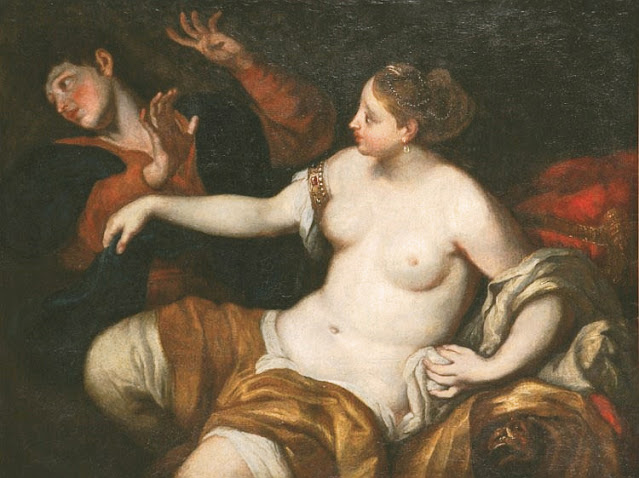
The chaste Joseph and Potiphar's wife
Oil on canvas
101.5 x 132.5 cm
Private collection

Potiphar's wife is a minor character in the Hebrew Bible and the Quran. She was the wife of Potiphar, the captain of Pharaoh's guard in the time of Jacob and his twelve sons. According to the Book of Genesis, she falsely accused Joseph of attempted rape after he rejected her sexual advances, resulting in his imprisonment.

In Genesis she is given no name, but in later medieval Jewish sources and Islamic tradition, she is identified as Zuleikha. More on Joseph and Potiphar's wife

Johann Michael Rottmayr
Lot and His Daughters
Oil on canvas
45 by 38 in.; 114.3 by 96.5 cm.
Private collection

Lot and his two daughters, Genesis 19:30-38,  left Zoar and settled in the mountains, for he was afraid to stay in Zoar. He and his two daughters lived in a cave. One day the older daughter said to the younger, “Our father is old, and there is no man around here to give us children—as is the custom all over the earth. 32 Let’s get our father to drink wine and then sleep with him and preserve our family line through our father.”
 
That night they got their father to drink wine, and the older daughter went in and slept with him. He was not aware of it when she lay down or when she got up.
 
The next day the older daughter said to the younger, “Last night I slept with my father. Let’s get him to drink wine again tonight, and you go in and sleep with him so we can preserve our family line through our father.” So they got their father to drink wine that night also, and the younger daughter went in and slept with him. Again he was not aware of it when she lay down or when she got up.
 
So both of Lot’s daughters became pregnant by their father. The older daughter had a son, and she named him Moab; he is the father of the Moabites of today. The younger daughter also had a son, and she named him Ben-Ammi; he is the father of the Ammonites of today. More on Lot and his two daughters

Trinity Sunday, which falls on the first Sunday after Pentecost, is one of the few feasts in the Christian calendar that celebrate a doctrine rather than an event.

In Vienna, Rottmayr's style became more fluid, with subtler, more ingratiating color and more harmonious compositions, suggesting the influence of the works of Peter Paul Rubens and Anthony Van Dyck available to him there; yet it retained the strong plasticity and dynamic movement of his early years. During the first 2 decades of the 18th century he was the leading painter of Vienna and the Hapsburg domains. Although he continued to work intermittently elsewhere in the Holy Roman Empire—Salzburg, Franconia, and Bohemia—his work from this time on was largely in Vienna and its environs. He decorated the interior of the church of the monastery of Melk with frescoes and altarpieces (1716-1722), and in the Karlskirche in Vienna, Fischer von Erlach's most famous creation, Rottmayr painted the Glorification of St. Charles Borromeo in the dome as well as the entire fresco decoration of the church (1725-1729). One of his last important commissions was the frescoes for the church of the monastery of Klosterneuburg outside Vienna (1729).

Johann Michael Rottmayr (Austrian, 1654-1730)
The Deposition from the Cross, ca. 1712
Oil on canvas
44 1/2 x 26 15/16 in. (113 x 68.5 cm)
Walters Art Museum

The Descent from the Cross, or Deposition of Christ, is the scene, as depicted in art, from the Gospels' accounts of Joseph of Arimathea and Nicodemus taking Christ down from the cross after his crucifixion. In Byzantine art the topic became popular in the 9th century, and in the West from the 10th century. The Descent from the Cross is the 13th Station of the Cross.
 
Other figures not mentioned in the Gospels who are often included in depictions of this subject include St. John the Evangelist, who is sometimes depicted supporting a fainting Mary, and Mary Magdalene. The Gospels mention an undefined number of women as watching the crucifixion, including the Three Marys and Mary Salome.  More on Deposition of Christ


This oil sketch depicting Christ being taken down from the cross is a study for a larger canvas commissioned for a private chapel in the monastery of Kremsmünter in Austria. Rottmayr painted many altars and ceiling frescoes in churches throughout Austria. His extremely fluid brush strokes bind the composition together. Preliminary studies like this could be used to show a patron what the final altarpiece would look like before work was begun. They were increasingly appreciated as works of art and collected during the 18th century. More on this painting

Johann Michael Rottmayr (Laufen 1654-1730 Vienna)
The Lamentation
Oil on canvas
64 7/8 x 47 ¼ in. (164.8 x 119.8 cm.)
Private collection

The Lamentation of Christ is a very common subject in Christian art from the High Middle Ages to the Baroque. After Jesus was crucified, his body was removed from the cross and his friends mourned over his body. This event has been depicted by many different artists.
 
Lamentation works are very often included in cycles of the Life of Christ, and also form the subject of many individual works. One specific type of Lamentation depicts only Jesus' mother Mary cradling his body. These are known as Pietà (Italian for "pity") More on The Lamentation of Christ

Rottmayr, Johann Michael 1654-1730
Lamentation of Christ, c. 1692
Oil on canvas.
42.0 cm × 32.7 cm 
Salzburg, Residenzgalerie.

SHOWING: CHRIST, MARIA MAGDALENA (HEILIGE), MARY, MARY JACOBEA, ST. JOHN THE EVANGELIST
Rottmayr, Johann Michael 1654-1730
Mary Magdalene
Oil on canvas
110 x 93 cm
Private collection

Mary Magdalene,  literally translated as Mary the Magdalene or Mary of Magdala, is a figure in Christianity who, according to the Bible, traveled with Jesus as one of his followers. She is said to have witnessed Jesus' crucifixion and resurrection. Within the four Gospels she is named more than most of the apostles. Based on texts of the early Christian era in the third century, it seems that her status as an “apostle" rivals even Peter's.

The Gospel of Luke says seven demons had gone out of her. She is most prominent in the narrative of the crucifixion of Jesus, at which she was present. She was also present two days later when, she was, either alone or as a member of a group of women, the first to testify to the resurrection of Jesus. John 20 and Mark 16:9 specifically name her as the first person to see Jesus after his resurrection.

During the Middle Ages, Mary Magdalene was regarded in Western Christianity as a repentant prostitute or promiscuous woman, claims not found in any of the four canonical gospels. More Mary Magdalene

Johann Michael Rottmayr, Laufen, 1654 – Vienna, 1730
The Apotheosis of Saint Charles Borromeo, c. 1681
Oil on canvas
w58 x h130 cm

The picture is an oil sketch for the altar painting of the eastern transept altar in the Collegiate Church in Salzburg – one of the most important of Rottmayr's later works. For the glorification of St Charles Borromeo, intercessor for plague sufferers, Rottmayr used the three-zone structure he had introduced. 

In attempts to ward off a plague epidemic in the town of Salzburg, processions were held and the Eucharist distributed, following the example of St Charles Borromeo in Milan. Readily recognisable motifs from Salzburg's landscape and architecture identify the location. Above, borne by angels, the saint hovers on a bank of cloud. His red cardinal's robe is rendered in an earthy shade, thus harmonising with the overall colouration of the painting. Borromeo turns trustingly towards Jesus, ruler of the world and leader of his armies. More on this painting

Johann Michael Rottmayr, Laufen, 1654 – Vienna, 1730
Saint Augustine with the Holy Trinity, ca. 1702
Oil on canvas
573 x 314 cm
Szépművészeti Múzeum 

The doctrine of the Trinity is the Christian belief that There is One God, who is Father, Son, and Holy Spirit.

The Trinity is a controversial doctrine; many Christians admit they don't understand it, while many more Christians don't understand it but think they do.

In fact, although they'd be horrified to hear it, many Christians sometimes behave as if they believe in three Gods and at other times as if they believe in one. More on the Holy Trinity

A painter of great imagination, Rottmayr imbued his essentially idealized figures with a robust liveliness and naturalism of great appeal. His color, especially in his maturity, is often of enchanting beauty and refinement. The visionary effect of his ceiling paintings is sometimes reduced by the massiveness of his figures, but all are eminently effective in their swirling compositions.

Johann Franz Michael Rottmayr (Austrian, 1654–1730)
An allegory of transience/ Vanitas , before 1700
Oil on canvas
140 x 110 cm. (55.1 x 43.3 in.)
Private collection

A vanitas is a symbolic work of art showing the transience of life, the futility of pleasure, and the certainty of death, often contrasting symbols of wealth and symbols of ephemerality and death. Vanitas pictures flourished in the seventeenth century when variants can be found in Protestant Holland and Catholic Flemish, Italian and Spanish territories. More on vanitas

Attributed to Johann Franz Michael Rottmayr (Austrian, 1654–1730)
Charity
Oil on Canvas
112.3 x 173.5 cm. (44.2 x 68.3 in.)
Private collection

Roman Charity is the exemplary story of a woman, Pero, who secretly breastfeeds her father, Cimon, after he is incarcerated and sentenced to death by starvation. She is found out by a jailer, but her act of selflessness impresses officials and wins her father's release.

The story is recorded by the ancient Roman historian Valerius Maximus, and was presented as a great act of filial piety and Roman honour. A painting in the Temple of Pietas depicted the scene. Among Romans, the theme had mythological echoes in Juno's breastfeeding of the adult Hercules, an Etruscan myth. More on Roman Charity

Circle Johann Michael Rottmayr
An Allegory of Charity
Oil on canvas
96.4 x 77.3cm 
Private collection


Rottmayr was ennobled in 1704 with the title "von Rosenbrunn." He died in Vienna on Oct. 28, 1730, almost literally with his brush in his hand. More on Johann Michael Rottmayr


Please visit my other blogs: Art CollectorMythologyMarine ArtPortrait of a Lady, The OrientalistArt of the Nude and The Canals of VeniceMiddle East Artists365 Saints and 365 Days, also visit my Boards on Pinterest

Images are copyright of their respective owners, assignees or others. Some Images may be subject to copyright

I don't own any of these images - credit is always given when due unless it is unknown to me. if I post your images without your permission, please tell me.

I do not sell art, art prints, framed posters or reproductions. Ads are shown only to compensate the hosting expenses.

If you enjoyed this post, please share with friends and family.

Thank you for visiting my blog and also for liking its posts and pages.

Please note that the content of this post primarily consists of articles available from Wikipedia or other free sources online.


Wednesday, September 8, 2021

14 Works, August 22nd. is Orazio de Ferrari's day, his story, illustrated with footnotes #199

Orazio De Ferrari 
The rape of the Sabine women, c. 1640
Oil on canvas
Height: 180 cm, Width: 244 cm
Private collection

The Rape of the Sabine Women is an episode in the legendary history of Rome, traditionally dated to 750 BC, in which the first generation of Roman men acquired wives for themselves from the neighboring Sabine families. The English word rape is a conventional translation of the Latin raptio, which in this context means "abduction" rather than its prevalent modern meaning in English language of sexual violation. The story provided a subject for Renaissance and post-Renaissance works of art that combined a suitably inspiring example of the hardihood and courage of ancient Romans with the opportunity to depict multiple figures, including heroically semi-nude figures, in intensely passionate struggle. More on the rape of the Sabine women

The work constitutes a very relevant testimony of Orazio De Ferrari's production, both for its undoubted executive quality, and for the presence of the painter's monogram combined with the date 1640, an element which allows us to have a precise chronological reference not only for the dating of the canvas itself, but more generally for the reconstruction of the artist's mature production. Recently considered "a masterpiece of great scenic impact and coloristic exuberance, reminiscent of Rubens and Van Dyck", the composition emerges, in the context of the "profane" production by Orazio De Ferrari, destined to embellish the paintings of the Genoese nobility, for its theatricality the layout of the episode, linked to the foundation of Rome. More on this painting

Orazio de Ferrari (1606–1657) was an Italian artist, active in the Baroque period, born in Voltri, a suburb of Genoa. de Ferrari was a pupil of Giovanni Andrea Ansaldo. He was a member of the family of Genoese artists, with surnames de Ferrari, which also included Giovanni Andrea de Ferrari and Gregorio De Ferrari. During the 17th century, he painted murals in the chapel and many of the state rooms of the Royal Palace in Monaco.

Orazio de Ferrari, 1605 - 1657
Susanna and the Elders
Oil on canvas
115 x 145 cm.
Private collection

A fair Hebrew wife named Susanna was falsely accused by lecherous voyeurs. As she bathes in her garden, having sent her attendants away, two lustful elders secretly observe the lovely Susanna. When she makes her way back to her house, they accost her, threatening to claim that she was meeting a young man in the garden unless she agrees to have sex with them.

She refuses to be blackmailed and is arrested and about to be put to death for promiscuity when a young man named Daniel interrupts the proceedings, shouting that the elders should be questioned to prevent the death of an innocent. After being separated, the two men are questioned about details of what they saw, but disagree about the tree under which Susanna supposedly met her lover. In the Greek text, the names of the trees cited by the elders form puns with the sentence given by Daniel. The first says they were under a mastic, and Daniel says that an angel stands ready to cuthim in two. The second says they were under an evergreen oak tree, and Daniel says that an angel stands ready to saw him in two. The great difference in size between a mastic and an oak makes the elders' lie plain to all the observers. The false accusers are put to death, and virtue triumphs. More about Susanna

Typical large format depiction of the student of Andrea Giovanni Ansaldo (1584-1638). Another scene with Susanna and the Elder by him, however in portrait format composition is held at the Museo Nacional de San Carlos in Mexico City (See below).

Orazio de Ferrari  (1606–1657)
Susana and the Elders
Oil on canvas
Museo Nacional de San Carlos

Orazio de Ferrari (Voltri 1606-1657 Genoa)
Adam and Eve mourning the death of Abel,
Oil on canvas
56 7/8 x 75 5/8 in. (144.5 x 194.5 cm.)
Private collection

The mourning over the body of Abel appears in the several of the Biblical Apocrypha which were popularly widespread in the seventeenth century. Orazio de Ferrari, who spent the majority of his career in Genoa painted a number of versions of the subject. Two of these appear to be copies, with slight variations, of the present composition made in Ferrari’s studio. Another picture, with a slightly more complex arrangement of figures, presenting Adam no longer in prayer but with his arms outspread, leaning over the body of his son, is now preserved in a private collection in Milan.

The dark background of the scene with the figures illuminated in a strongly accented light, casting deep shadows in some areas. Likewise, the foreshortened body of Abel as a means of creating a greater depth within the composition, though, of course, Ferrari choses to present Abel with his head closest to the viewer, thus heightening the dramatic and emotional intensity of the scene. Though the life of Orazio de Ferrari is only intermittently documented, it is believed that he visited Naples sometime toward the end of the 1630s, after which his paintings begin to show a clear knowledge of the naturalist, Caravaggesque manner prevalent in the city. More on this painting

Orazio de Ferrari (Voltri 1605-1657 Genoa)
Capture of Samson
Oil on canvas
cm. 177 x 229
Ascoli Piceno, Civic Art Gallery of Palazzo dell'Arengo

According to the Bible, Samson, whose strength came from his hair, was shorn by his duplicitous lover, Delilah, and then set upon by the Philistines, who bound and blinded him.

Orazio de Ferrari (Voltri 1605-1657 Genoa)
David and Abigail
Oil on canvas
55 7/8 x 71½ in. (142 x 182.5 cm.)
Private collection

The subject of the painting is taken from the Old Testament (I Samuel 25), which recounts an episode during David's exile in the Judean desert. When a rich local farmer refused to give sustenance to David and his band of outlaws, they threatened to punish him. However, the farmer's wife, Abigail, took to David a peace offering of food and drink which was graciously received. When Abigail's husband found out about this, he suffered a stroke and died, after which David took the widow as his wife. More on this painting

Orazio de Ferrari (Voltri 1605-1657 Genoa)
Esther and Ahasveros
Oil on canvas
90.5x103 cm
Private collection

Esther is described in all versions of the Book of Esther as the Jewish queen of a Persian king Ahasuerus. In the narrative, Ahasuerus seeks a new wife after his queen, Vashti, refuses to obey him, and Esther is chosen for her beauty. The king's chief adviser, Haman, is offended by Esther's cousin and guardian, Mordecai, and gets permission from the king to have all the Jews in the kingdom killed. Esther foils the plan, and wins permission from the king for the Jews to kill their enemies, and they do so. Her story provides a traditional background for Purim, which is celebrated on the date given in the story for when Haman's order was to go into effect, which is the same day that the Jews killed their enemies after the plan was reversed. More on Esther

Orazio de Ferrari (Voltri 1605-1657 Genoa)
Esther before Ahasuerus
Oil on canvas
cm 167 x 200
Private collection

Esther, appears before her husband, King Ahasuerus of Persia, in order to stave off a massacre of the Jewish people, breaking with court protocol and thereby risking death. Rather than turn to historical recreation, contemporary theater informed how Ferrari conceived this dramatic scene, in which Esther faints before the king grants her request. More on Esther

Orazio de Ferrari (Voltri 1605-1657 Genoa)
The adoration of the shepherds
oil on canvas
67.5 by 92.5 cm .; 26 5/8 by 36 1/2 in.
Private collection

The Adoration of the Shepherds, in the Nativity of Jesus in art, is a scene in which shepherds are near witnesses to the birth of Jesus in Bethlehem, arriving soon after the actual birth. It is often combined in art with the Adoration of the Magi, in which case it is typically just referred to by the latter title. The Annunciation to the Shepherds, when they are summoned by an angel to the scene, is a distinct subject. More on The Adoration of the Shepherds

Orazio de Ferrari (Voltri 1605-1657 Genoa)
Adoration of the shepherds
Oil on canvas
cm 125x155
Private collection

Attributed to Orazio de Ferrari  (1606–1657)
Christ and the Adulteress, c. late 1650s
Oil on canvas
 46 x 55.5 in
McMullen Museum of Art, Boston College

Jesus and the woman taken in adultery is a passage found in the Gospel of John.

In the passage, Jesus was teaching in the temple after coming from the Mount of Olives. A group of scribes and Pharisees confronts Jesus, interrupting his teaching. They bring in a woman, accusing her of committing adultery, claiming she was caught in the very act. They tell Jesus that the punishment for someone like her should be stoning, as prescribed by Mosaic Law. Jesus begins to write something on the ground using his finger. But when the woman's accusers continue their challenge, he states that the one who is without sin is the one who should cast the first stone at her. The accusers and congregants depart realizing not one of them is without sin either, leaving Jesus alone with the woman. Jesus asks the woman if anyone has condemned her and she answers no. Jesus says that he, too, does not condemn her, and tells her to go and sin no more. Jesus and the woman taken in adultery

Ferrari shows in his first tests the close stylistic relationships with the master and the influence of the chromaticism of Pietro Paolo Rubens, as evidenced in the Martyrdom of Saint Sebastian, made in 1630 for the Church of Saints Nicolý and Erasmus of Voltri. These inflections changed during maturity and after a likely trip to Rome and Naples in the thirties, when the dark sensibilities lead Orazio Ferrari to an intense naturalism, in similitude with Gioacchino Assereto. These aspects can be seen very well in the Cenacles preserved respectively in Our Lady of the Mount and in the Sacristy of San Siro
, where one observes a meticulous and pleased characterization of the apostles. More on Orazio de Ferrari

Orazio de FERRARI (Voltri 1606 - Genoa 1657)
The Assembly of the Gods
Oil on canvas
269 x 249 cm
Private collection

The Assembly of Gods is a fifteenth-century dream vision poem by an unknown author.

The scene shows Olympus overhung by Apollo in his chariot. Among the main gods represented, from left to right, we can discover Mars with his shield, Mercury holding his caduceus, Bacchus crowned with a vine, Venus and Cupid, Juno and Jupiter seated, behind them, then at the right end, Helmeted Minerva with the owl. Below, Neptune, with his trident, is shown in the left corner and Hercules holding his club on the opposite side.

By her insistent gesture Venus implores Jupiter to help her son Aeneas and the Trojans whose fleet is in danger near Carthage, and we can clearly see a sailboat lost in the storm at the bottom of our composition. More on this painting

Orazio de Ferrari (Voltri 1605-1657 Genoa)
Latona Turning the Lycian Peasants into Frogs, c. 1642
Oil on canvas
Private collection

The painting represents an episode from Ovid's Metamorphoses (VI, 337-381), according to which Latona, with the divine twins Apollo and Diana, the fruit of her relationship with Jupiter, fleeing from Juno's wrath, arrives after a long pilgrimage to Licia and, exhausted by the heat, approaches a lake with little water in order to drink the fresh water; but some peasants who were picking wickers prevent it by muddying the water. Then Latona, who had begged them in vain to let her drink, to punish them for their arrogance and insolence turns them into frogs. More on this painting


Please visit my other blogs: Art CollectorMythologyMarine ArtPortrait of a Lady, The OrientalistArt of the Nude and The Canals of VeniceMiddle East Artists365 Saints and 365 Days, also visit my Boards on Pinterest

Images are copyright of their respective owners, assignees or others. Some Images may be subject to copyright

I don't own any of these images - credit is always given when due unless it is unknown to me. if I post your images without your permission, please tell me.

I do not sell art, art prints, framed posters or reproductions. Ads are shown only to compensate the hosting expenses.

If you enjoyed this post, please share with friends and family.

Thank you for visiting my blog and also for liking its posts and pages.

Please note that the content of this post primarily consists of articles available from Wikipedia or other free sources online.


A note to the readers of Zaidan Gallery

    A note to the readers of Zaidan Gallery It is with great sadness that we share the news that the author of this blog,  Henry Zaidan (194...