Showing posts with label Café. Show all posts

Thursday, January 7, 2021

10 Works, Today, January 6th is Baldassare Verazzi's day, his story illustrated #005

Baldassare Verazzi (1819-1886)
Detail; An episode of the five days of Milan in 1848, before 1886
Oil on canvas
Museo del Risorgimento, Milan

Baldassare Verazzi (6 January 1819 – 18 January 1886) was born in Caprezzo, Verbano-Cusio-Ossola, Piedmont. He studied at the Academy of Brera at Milan from 1833 to 1842, then under the Venetian Romantic painter Francesco Hayez (1791–1882) in 1851, and participated in several exhibitions in Turin and Milan.

Baldassare Verazzi (Italian, 1819–1886)Title:
The Parable of the Samaritan, c. 1854
Oil on canvas
121.5 x 94 cm. (47.8 x 37 in.)
Private collection

In 1851 he won the prestigious Canonica Prize with The Parable of the Samaritan and in 1854 the Mylius Prize with his portrait of Raphael, which was presented to Pope Julius II.

Baldassare Verazzi (Italian, 1819–1886)
L'elemosina /Alms, c. 1856
Oil on canvas
121.5 x 94 cm. (47.8 x 37 in.)
Private collection

Baldassare Verazzi (Italian, 1819–1886)
The Holy Family in Egypt
Fresco
I have no further description, at this time

His works include a fresco on The life of Leonardo da Vinci, The Holy Family in Egypt, and the 1854 Raffaello Sanzio da Urbino presented by Bramante to Pope Julius II.

Baldassare Verazzi
San Vincenzo Ferreri, c. 1850
Fresco
Parish church of Turbigo
I have no further description, at this time

He took his inspiration from history and religion. His masterpiece depicts a scene from the anti-Austrian uprising known as The Five Days of Milan (Fighting at Palazzo Litta). Something of a revolutionary in that he was an active supporter of the Risorgimento, it is supposed that he was in Milan in 1848 when citizens rose up against the ruling forces of the Austrian Empire, which controlled much of northern Italy. The Cinque Giornate di Milano, in March of that year, comprised five days of street fighting that eventually resulted in the Austrian garrison being expelled from the city, marking the start of the First Italian War of Independence.

Baldassare Verazzi (1819-1886)
An episode of the five days of Milan in 1848, before 1886
Oil on canvas
Museo del Risorgimento, Milan

Verazzi’s painting shows three figures sheltering behind a barricade while another aims a rifle over the barricade, presumably in the direction of Austrian troops.

Baldassarre Verazzi
Episode of pillage during the Five Days of Milan, c. 1848
Oil on canvas
I have no further description, at this time

Baldassarre Verazzi
The Five Days of Milan, c. 1848
Oil on canvas
I have no further description, at this time

Baldassarre Verazzi
The apparition of the Madonna to Blessed Pareto during the Genoese revolt against the Austrians
Oil on canvas
Private collection

He was hunted down by the Austrian authorities in 1848 and forced to live under severe proscriptions. He left for Argentina in 1856, where he taught and painted local personalities, scenes of everyday life and history paintings of political or military events. He also decorated the original Teatro Colón.

Between Argentina, Uruguay and Brazil, he spent 12 fruitful years of his artistic career in South America, where he became one of the most appreciated and well-known painters.

Baldassare Verazzi
Battle of Pavón. Slaughter of Captain Panuzzi, c. 1862
Oil on cardboard
32 x 48 cm.
Private collection

Battle of Pavón 9/17/1861. Painting at the beginning of 1862 that represents the moment of the death of Captain Romano Pezzuti Piloni, of the Italian Legion, incorporated as an assistant to General Paunero, head of the Second Division where he formed the Legion. It occurred when he tried to snatch a flag from the enemy, receiving 2 bullets in his right side, and hours later he was killed and his belongings looted by the Federal Cavalry 

The battle was fought in the south of the province of Santa Fe on September 17 , 1861. It was a key combat in the civil wars that divided Argentina during the 19th  century . It meant the end of the Argentine Confederation, and the incorporation of the province of Buenos Aires as a dominant member of the country. More on this painting

He made paintings of high documentary value for Argentine history: The Battle of Pavón , Massacre of Uruguayan prisoners, taken in the Battle of India Muerta by Urquiza , Allegory of the Argentine Republic , Portrait of the Roman nobleman Pezzuti Pilloni , Death, dispossession and slaughter of Romano Pezzuti Pilloni in Pavón , La charidad , Black fruit seller , Argentine Sentinel , Baptism of the unborn child of Mrs. Camila O'Gorman , before going to the torture , and others.

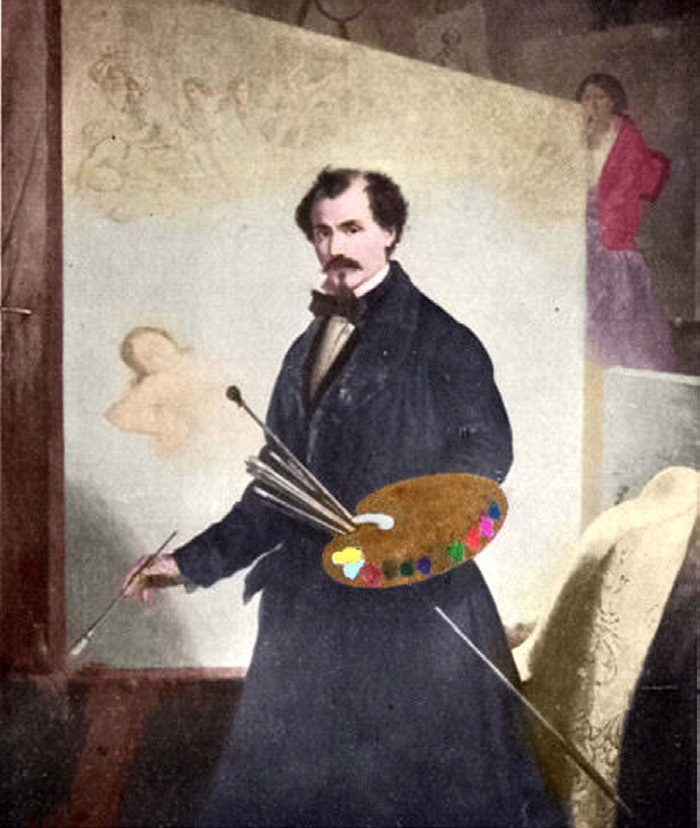
Baldassare Verazzi
Self portrait
I have no further description, at this time

 He returned to Italy and installed himself near Lake Maggiore, and the landscape of that area proved a new source of inspiration for paintings that he then produced with his son Serafino (1875–1945). He died in Lesa, aged 67. More on Baldassare Verazzi


Please visit my other blogs: Art CollectorMythologyMarine ArtPortrait of a Lady, The OrientalistArt of the Nude and The Canals of VeniceMiddle East Artistsand 365 Saints, also visit my Boards on Pinterest

Images are copyright of their respective owners, assignees or others. Some Images may be subject to copyright

I don't own any of these images - credit is always given when due unless it is unknown to me. if I post your images without your permission, please tell me.

I do not sell art, art prints, framed posters or reproductions. Ads are shown only to compensate the hosting expenses.

If you enjoyed this post, please share with friends and family.

Thank you for visiting my blog and also for liking its posts and pages.

Please note that the content of this post primarily consists of articles available from Wikipedia or other free sources online.


Wednesday, January 6, 2021

10 Works, Today January 5th is Theodoor Verstraete's day, #005


Théodore Verstraete (1850–1907) 
High tide, c. 1851-1907
Oil on canvas
Height: 66.5 cm (26.1 in); Width: 80.5 cm (31.6 in)
Administration communale Saint-Josse-ten-Noode

Theodoor Verstraete, also spelled Theodor Verstraete and Théodore Verstraete (5 January 1850 – 8 January 1907) was a Belgian Realist painter and printmaker who is known for his landscapes depicting life in the countryside as well as his paintings of the Belgian coastal landscape. He has been called the 'poet of rural life' who depicted the humble life of the people in the countryside with empathy.

Théodore Verstraete  (1850–1907)
To the vigil, c. 1889-1890
Oil on canvas
Height: 172 cm (67.7 in); Width: 294 cm (115.7 in)
Royal Museum of Fine Arts Antwerp 

Verstraete initially showed an inclination for music and accompanied his parents on their theatre tours including a trip in 1860 to the Netherlands. He was also keen on drawing. In 1867 he commenced his studies at the Antwerp Academy.

Théodore Verstraete  (1850–1907)
Plowing the field
Oil Edit this at Wikidata
Height: 103.5 cm (40.7 in) Width: 113.6 cm (44.7 in)
Museum of Fine Arts, Ghent

From 1873 to 1878 Verstraete attended the free workshop of Jacob Jacobs, which was linked to the Academy. That year he got married. He relied for his finances on aid from his mother as well as his work as a drummer and decorative painter at the theatre. He was living in Brussels.

Theodor Verstraete (Belgian, 1851–1907)
Meisje met veldbloemen/Girl with wild flowers
Oil on canvas
51 x 35 cm. (20.1 x 13.8 in.)
Private collection

Verstraete showed his first canvases at the Antwerp Salon of 1876 or 1877. From that time onwards, he regularly contributed to exhibitions. He achieved his first success in 1882 with his painting Dusk, which was awarded an honorable mention in Paris and a gold medal in Antwerp.

Théodore Verstraete  (1850–1907)
After the rain, c. 1891
Oil on canvas
Height: 113.3 cm (44.6 in); Width: 176.2 cm (69.3 in)
Royal Museum of Fine Arts Antwerp

In 1878 Verstraete left the Academy and went to work the next year in a picturesque house in Brasschaat, near Antwerp. His house was built in the middle of nature in the Campine region of Belgium. From here he traveled around in his caravan to paint the surrounding landscapes. He only visited his family, presumably still living in Brussels, on the weekends. Verstraete was called the 'painter of Brasschaat' and other painters working with him or receiving training from him were considered to be members of the so-called 'School of Brasschaat' of landscape painting.

Théodore Verstraete  (1850–1907)
The holy food for the journey
Oil on canvas
Height: 73.1 cm (28.7 in); Width: 122 cm (48 in)
Bavarian State Painting Collections

Verstraete was, in 1883, a co-founder of the Antwerp group of artists called 'Wees U Zelf' ('Be yourself'). The manifest of the group argued for maintaining the tradition. Verstraete was in 1891 a co-founder in Antwerp of the artist association 'De XIII', which aimed to liberate art of the reigning academism. It planned to organize annual exhibitions (salons) in Antwerp as well as group exhibitions. During its existence the association, which was disbanded in 1899, organized three salons.

Théodore Verstraete  (1850–1907)
Blankenberge, September
Oil on canvas
34 x 54 cm
Private collection

Blankenberge is a town and a municipality in the Belgian province of West Flanders. The municipality comprises the town of Blankenberge proper and the settlement of Uitkerke.

Blankenberge is a main characteristic of this one is that it is a national and to a certain extent international seaside resort. More on Blankenberge

The financial situation of Verstraete improved after he was introduced in 1886 to art collector and patron Henri Van Cutsem. Van Cutsem encouraged Verstraete to travel to various places in the Netherlands such as Hansweert, Leiden, Utrecht and Schoore in Zeeland, where he etched and painted. Theodoor Verstraete also spent time in Blankenberge on the Belgian coast where Van Cutsem owned a villa and invited his artist friends to visit. 

Theodoor Verstraete
Fishermen’s wives at the beach
Oil on canvas
31.5 x 62.5 cm 
Private collection

Verstraete was fascinated with the mobile spectacle of water and air near the sea. While the relationship with Van Cutsem resulted in a considerable improvement of Verstraete's finances, he was in 1893 struck by a stroke, which possibly led to blindness and inability to speak. This signaled the end of the artistic career of Verstraete.

Theodoor Verstraete
Fishermen's Houses in the Dunes
Oil on canvas
98 x 130.5 cm.
Private collection

The destitute Verstraete could thereafter only survive financially through the support of his patron Henri Van Cutsem, who gave him after 1904 a monthly stipend. Van Cutsem also regularly bought from Verstraete paintings, which he later returned to the artist. The retrospective exhibitions of 1895 in Zaal Verlat and in 1906 were also a welcome source of income.

Theodor Verstraete (Belgian, 1851–1907)
Paysage de neige au crépuscule/Snowy landscape at dusk, c. 1888
Oil on Canvas
32 x 54 cm. (12.6 x 21.3 in.)
Private collection

During his last years Theodoor Verstraete continued to suffer from ill health and mental disability. He died on 8 January 1907. More on Theodoor Verstraete


Tuesday, January 5, 2021

12 Works, January 4th is Augustus Edwin John's day, #004

Augustus John OM 1878–1961
Lyric Fantasy, c.1913–14
Oil paint and graphite on canvas
2380 × 4720 mm
Tate

This is one of four murals commissioned in 1909 to decorate the hall of the house in Chelsea. John designed the composition using his own family and friends as models, including at the right his wife Ida, who had recently died. It was painted from a full size drawing. John then painted out a figure at the centre, and suggested alterations to compensate.

Lyric Fantasy was not displayed, nor given its title, until 1940. John devoted his early career to these decorative murals, which he based on drawings and colour sketches. More on this work

Augustus Edwin John OM RA (4 January 1878 – 31 October 1961)
was a Welsh painter, draughtsman, and etcher. For a time he was considered the most important artist at work in Britain.

At the age of seventeen he briefly attended the Tenby School of Art, then left Wales for London, studying at the Slade School of Art, University College London. He became the star pupil, and even before his graduation he was considered the most talented draughtsman of his generation.

Augustus Edwin John (1878–1961)
Moses and the Brazen Serpent, c. 1898
Oil on canvas
H 149.9 x W 213.4 cm
UCL Art Museum

According to the Bible, Nehushtan was a metal serpent mounted on a staff that Moses had made, by God’s command, to cure the Israelites of snake bites while wandering in the desert. 

In 1898, he won the Slade Prize with Moses and the Brazen Serpent. John afterward studied independently in Paris.

James Dickson Innes (1887–1914)
Welsh Landscape, c. 911–1914
Oil on board
H 30.5 x W 38.1 cm
The Stanley & Audrey Burton Gallery, University of Leeds

This painting is a view of Arenig Fawr in North Wales. Augustus John and his friend James Dickson Innes both worked around Arenig near Bala in 1911/1912. The mountain is the subject of pictures by Innes in the National Museum of Wales, Tate Gallery, Fitzwilliam Museum, Glynn Vivian Art Gallery, Swansea and numerous other public collections. Arenig Fawr (2,800 ft) is the only mountain in Wales with twin peaks. More on this painting

Over a period of two years from around 1910 Augustus John and his friend James Dickson Innes painted in the Arenig valley, in particular one of Innes's favourite subjects, the mountain Arenig Fawr. 

Early in 1901, John married Ida Nettleship (1877–1907). The need to support Ida, led him to accept a post teaching art at the University of Liverpool. The couple had five sons. 

Augustus John OM 1878–1961
Robin, c.1912
Oil paint on canvas
451 × 305 mm
Tate

Robin was the third son of Augustus John and his wife Ida; he was eight when this portrait was painted. John often used his family as models, particularly for his less conventional work. In this intimate study, the boy’s long tousled hair suggests both freedom and ambiguity of gender. The close-up perspective also disturbs the boundaries of distance usually maintained in portraiture.

Robin’s consciousness of being scrutinised by his father could be interpreted as betraying resentment or unease. The two had a difficult relationship. Robin’s silences often infuriated John, who declared his son ‘hardly utters a word and radiates hostility’. More on this painting

Augustus John OM 1878–1961
Dorelia Standing before a Fence, c.1903–4
Oil paint on canvas
2020 × 1220 mm
Tate

Augustus John met Dorothy 'Dorelia' McNeill in early 1903 (lot 107) and later that year she moved in with the artist, his wife and his family, becoming John's muse, fulfilling his fantasies of womanhood. Michael Holroyd comments in Augustus John a Biography, The Years of Innocence, London, 1974, I, pp. 148-9: 'She was, of course, hypnotically beautiful - almost embarrassingly so, Will Rothenstein found: 'one could not take one's eyes off her'... In his portraiture, Augustus was like a stage director, assigning his subjects all sorts of dramatic roles. Dorelia, it seems, acquiesced in them, fitted each of them to perfection - mother, mistress, little girl, phantasm, goddess, seductress, wife. She became all things to him; she was everywoman'. In a rare display of bitterness Ida writes to Dorelia in 1905: 'You are the one outside who calls a man to apparent freedom and wild rocks and wind and air'. John's domestic life was an extraordinary tangle of passions and Dorelia continued to live in a ménage à trois with Augustus and Ida. She gave birth to two sons, Pyramus and Romilly, before Ida's death in 1907. More on Dorelia

Augustus John OM 1878–1961
Washing Day, c.1915
Oil paint on canvas
406 × 302 mm
Tate

Augustus John first became well known for his drawings, usually full length studies of women of his own family or of models in striking poses. In Provence in 1910 he began to paint small oil sketches of figures and landscapes, directly in bright colours onto wooden panels. There were intended as studies for paintings, but were commercially very successful. Ocasionally, as in 'Washing Day', he used the same procedure for a domestic subject. His mistress, Dorelia, the model for his best drawings, here wears the brightly coloured clothes she designed and made herself, and which set a fashion for a 'gipsy' style of dress. More on this painting

In February 1910, John visited and fell in love with the town of Martigues, in Provence. The connection with Provence continued until 1928, by which time John felt the town had lost its simple charm, and he sold his home there.

Augustus John OM, 1878–1961
Dorelia and the Children at Martigues, c. 1910
Oil, panel
Fitzwilliam Museum, Cambridge, UK

John was, throughout his life, particularly interested in the Romani people, Gypsies, and sought them out on his frequent travels around the United Kingdom and Europe, learning to speak various versions of their language. Later on he became the President of the Gypsy Lore Society, a position he held from 1937 until his death in 1961.

Augustus John OM, 1878–1961
A portrait study of a gypsy girl holding a large ewer
Oil on canvas
25" x 20"
Private collection

Sold for £24,000 GBP in Sep 2015

In December 1917 John was attached to the Canadian forces as a war artist and made a number of memorable portraits of Canadian infantrymen. The end result was to have been a huge mural for Lord Beaverbrook and the sketches and cartoon for this suggest that it might have become his greatest large-scale work. 
Augustus John OM, 1878–1961
Fraternity
Oil on canvas
Imperial War Museum

With his rank, Augustus John had the use of a staff car and a driver and loved patrolling the Vimy Front. It wasn’t long before he found a spot he thought would make a good subject — an old chateau converted into a battery position — for the final huge painting, Canadians Opposite Lens. 

He drew and painted sketches of Canadian soldiers for the huge commission he’d taken on. With his Fraternity: 3 Soldiers one of many great sketches.

Augustus John, (1878–1961)
The Canadians opposite Lens, before 1919 
Oil on canvas
Height: 3.7 m (12.1 ft); Width: 12 m (13.1 yd) Edit this at Wikidata
Canadian War Museum

Augustus John, (1878–1961)
Detail; The Canadians opposite Lens, before 1919 
Oil on canvas
Height: 3.7 m (12.1 ft); Width: 12 m (13.1 yd) Edit this at Wikidata
Canadian War Museum

Augustus John, (1878–1961)
Detail; The Canadians opposite Lens, before 1919 
Oil on canvas
Height: 3.7 m (12.1 ft); Width: 12 m (13.1 yd) Edit this at Wikidata
Canadian War Museum

After two months in France he was sent home in disgrace after taking part in a brawl. Lord Beaverbrook, whose intervention saved John from a court-martial, sent him back to France where he produced studies for a proposed Canadian War Memorial picture, although the only major work to result from the experience was Fraternity. In 2011, the Duke and Duchess of Cambridge finally unveiled this mural at the Canadian War Museum in Ottawa. This unfinished painting, The Canadians Opposite Lens, is 12 feet high by 40 feet long.

Although known early in the century for his drawings and etchings, the bulk of John's later work consisted of portraits. Those of his two wives and his children were regarded as among his best. He was known for the psychological insight of his portraits, many of which were considered "cruel" for the truth of the depiction.

Augustus John OM, 1878–1961
Madame Suggia, c. 1920–3
Oil paint on canvas
1867 × 1651 mm
Tate

Guilhermina Suggia was Portuguese, but lived in London from 1914. She was a well-known musician, particularly because a female cello soloist was then a rarity. The portrait was begun for the newspaper proprietor Edward Hudson, who had given Suggia the Montagnana cello that she plays. However the commission lapsed, and John continued the painting for himself. He started again twice, each time choosing a dress of a different colour, a larger canvas and a pose in more extreme profile. More on this painting

By the 1920s John was Britain's leading portrait painter. John painted many distinguished contemporaries, including T. E. Lawrence, Thomas Hardy, W. B. Yeats, Aleister Crowley, Lady Gregory, Tallulah Bankhead, George Bernard Shaw, the cellist Guilhermina Suggia, the Marchesa Casati and Elizabeth Bibesco. Perhaps his most famous portrait is of his fellow-countryman, Dylan Thomas, whom he introduced to Caitlin Macnamara, his sometime lover who later became Thomas' wife. Portraits of Dylan Thomas by John are held by the National Museum Wales and the National Portrait Gallery.

It was said that after the war his powers diminished as his bravura technique became sketchier. One critic has claimed that "the painterly brilliance of his early work degenerated into flashiness and bombast, and the second half of his long career added little to his achievement." However, from time to time his inspiration returned, as it did on a trip to Jamaica in 1937. 

He continued to work up until his death. His last work being a studio mural in three parts, a French peasant in a yellow waistcoat playing a hurdy-gurdy while coming down a village street. More on Augustus Edwin John

Artist John on a 1928 Time magazine cover
Published 10 September 1928


Please visit my other blogs: Art CollectorMythologyMarine ArtPortrait of a Lady, The OrientalistArt of the Nude and The Canals of VeniceMiddle East Artists365 Saints365 Days, and Biblical Icons, also visit my Boards on Pinterest and my art stores at  deviantart and Aaroko

Images are copyright of their respective owners, assignees or others. Some Images may be subject to copyright

I don't own any of these images - credit is always given when due unless it is unknown to me. if I post your images without your permission, please tell me.

Ads are shown only to compensate the hosting expenses.

If you enjoyed this post, please share with friends and family.

Thank you for visiting my blog and also for liking its posts and pages.

Please note that the content of this post primarily consists of articles available from Wikipedia or other free sources online.


Monday, January 4, 2021

12 Works, Today January 3rd is August Robert Ludwig Macke's day #003

August Macke  (1887–1914)
Landscape with Cows and Camel, c. 1914
Oil on canvas
Height: 47 cm (18.5 in); Width: 54 cm (21.2 in)
Kunsthaus Zurich 

August Robert Ludwig Macke (3 January 1887 – 26 September 1914)
was a German Expressionist painter. He was one of the leading members of the German Expressionist group Der Blaue Reiter (The Blue Rider). He lived during a particularly innovative time for German art: he saw the development of the main German Expressionist movements as well as the arrival of the successive avant-garde movements which were forming in the rest of Europe. Like a true artist of his time, Macke knew how to integrate into his painting the elements of the avant-garde which most interested him.

August Macke  (1887–1914) 
Two Girls, c. 1913
Oil on canvas
130.0 x 100.0 cm
Städel Museum, Frankfurt

Two girls in the evening hustle and bustle of a big city. Everything is in motion. Persons and objects dissolve into crystalline geometric forms. Figures appear double, coloured lines cut through the scene, cones of light glare between the buildings. Macke was impressed by the way the Italian Futurists had glorified speed and technology in their paintings. Yet he did not reduce his composition entirely to abstract forms. The girls contemplate the goings-on but do not merge with their surroundings. More on this painting

Shortly after August's birth the family settled at Cologne, where Macke was educated at the Kreuzgymnasium (1897-1900). In 1900, when he was thirteen, the family moved to Bonn, where Macke studied at the Realgymnasium.

August Macke  (1887–1914)
Landscape on the Teggernsee with a reading man, c. 1910
Oil on canvas
21.6 × 23.6 in (54.9 × 59.9 cm)
I have no further description, at this time

The first artistic works to make an impression on the boy were his father's drawings, Japanese prints and the works of Arnold Böcklin. In 1904 Macke enrolled at the Kunstakademie Düsseldorf. During this period he also took evening classes under Fritz Helmut Ehmke (1905), did some work as a stage and costume designer at the Schauspielhaus Düsseldorf, and visited northern Italy (1905) and Netherlands, Belgium and Britain (1906).

Macke lived most of his creative life in Bonn, with the exception of a few periods spent at Lake Thun in Switzerland and various trips to Paris, Italy, the Netherlands and Tunisia. 

August Macke  (1887–1914)
Kairouan (III), c. 1914
Watercolor 
Height: 22.5 cm (8.8 in); Width: 29 cm (11.4 in)
Westphalian State Museum of Art and Cultural History

In Paris, where he traveled for the first time in 1907, Macke saw the work of the Impressionists. In Paris he also met Edouard Manet, Degas, Toulouse-Lautrec, Pissarro and Parisian life. His style was formed within the mode of French Impressionism and Post-impressionism and later went through a Fauve period. In 1909 he married Elisabeth Gerhardt.

August Macke  (1887–1914)
Portrait of the artist's wife with a hat, c.1909
Oil on canvas
Height: 49.7 cm (19.5 in); Width: 34 cm (13.3 in)
Westphalian State Museum of Art and Cultural History 

August Macke, (1887–1914)
Portrait with Apples (Portrait of the Artist's Wife), c. 1909
Oil on canvas
66.0 × 59.5 cm
Lenbachhaus, Munich, Germany

Macke's meeting with Robert Delaunay in Paris in 1912 was to be a sort of revelation for him. Delaunay's chromatic Cubism influenced Macke's art from that point onwards. His Shops Windows can be considered a personal interpretation of Delaunay's Windows, combined with the simultaneity of images found in Italian Futurism.

August Macke  (1887–1914)
Rokoko, 1912
Oil on canvas
89 × 89 cm (35 × 35 in)
National Gallery of Norway 

The reason this work is titled Rokoko is that the work has a distinct The Swing vibe to it. You can see a man and a woman engaging in a secret rendezvous while a man in the front is completely oblivious but also adding to ~the mood~ by playing whatever instrument that is. It’s all very fluffy and light. There is one notable difference between Rokoko and The Swing and that’s the style in which it’s created. Rokoko has minimal detail and maximum emotion. The Swing, on the other hand, is all about the details…every last phallic detail. More on this work

August Macke  (1887–1914)
Shop Window, c.1912
Oil on canvas
Height: 106.8 cm (42 in); Width: 82.8 cm (32.5 in)
Sprengel Museum,  Hanover, Germany

The exotic atmosphere of Tunisia, where Macke traveled in April 1914 with Paul Klee and Louis Moilliet was fundamental for the creation of the luminist approach of his final period, during which he produced a series of works and also as part of Fauvism. 

August Macke  (1887–1914)
Market in Tunis, c. 1914
Watercolor on paper
Künstlergruppe, Berlin

The paintings concentrate primarily on expressing feelings and moods rather than reproducing objective reality, usually distorting colour and form.

The legendary trip to Tunisia made by August Macke, Paul Klee and Louis Moilliet is widely discussed by art historians as being a critical moment in the development of 20th Century colourism, but what is less often discussed is the fact that the three young artists only spent fourteen days there. These were two weeks of constant sketching and painting and endless discussions about form and colourism, inspired by the boyish enthusiasm generated amongst a close group of friends travelling together and working abroad. The impact of this expedition on all three artists was immense. The trip had a lasting effect on the direction of Klee's work from this moment on, Moilliet executed his only important work here and Macke, who died later the same year as a soldier in the German army, painted his most brilliant oils and watercolours during and immediately after this trip. More on this painting

August Macke  (1887–1914)
Galloping hussars, c. 1913
Oil on canvas
37.5 x 56.1 cm
Thyssen-Bornemisza National Museum, Madrid

The horsemen seem to magically dematerialize, melting into the background and moving from sharp figures to simple squiggles, until they become little more than a sea of ​​sparkling dots advancing towards battle and possibly death.

According to Vriesen, the work was painted in the artist's studio in Bonn in 1913 and the theme may derive from his volunteer enlistment in the 160th Infantry Regiment in 1908. 

Macke paints this canvas after his first stint in the army, which he voluntarily enlisted. More on this painting

Macke's career was cut short by his early death in the second month of the First World War at the front in Champagne, France, on 26 September 1914. 

August Macke
Farewell, c. 1914
Oil, cardboard
101 x 130.5 cm
Museum Ludwig, Cologne, Germany

One of Macke's last paintings was the unfinished work above. "With absolute clarity," Vriesen states, "the picture reflects the gloom and numbness that befell public life" before the first year of war was out, "the mood of uncertainty and disquiet which took possession of Macke as well."

A year after The Milliner’s Shop he was drafted into the German Army. The artists of the Western World had called for the destruction of the old world. Sub-consciously the empires that protected them agreed. As if by compulsion, they committed group suicide. The trenches were dug and August was posted to the French province of Champagne. A few weeks later he was dead, killed in action. Mowed down alongside 200,000 anonymous others. He was 27 years old. More on this painting

His final painting, Farewell, depicts the mood of gloom that settled after the outbreak of war. This was also the same year that he painted the famous painting Türkisches Café in München (1914). More on August Robert Ludwig Macke


August Macke, (1887–1914)
Türkisches Café, c. 1914
Oil on panel
Height: 60 cm (23.6 in); Width: 35.5 cm (13.9 in)
Lenbachhaus, Munich


Please visit my other blogs: Art CollectorMythologyMarine ArtPortrait of a Lady, The OrientalistArt of the Nude and The Canals of VeniceMiddle East Artists365 Saints365 Days, and Biblical Icons, also visit my Boards on Pinterest and my art stores at  deviantart and Aaroko

Images are copyright of their respective owners, assignees or others. Some Images may be subject to copyright

I don't own any of these images - credit is always given when due unless it is unknown to me. if I post your images without your permission, please tell me.

Ads are shown only to compensate the hosting expenses.

If you enjoyed this post, please share with friends and family.

Thank you for visiting my blog and also for liking its posts and pages.

Please note that the content of this post primarily consists of articles available from Wikipedia or other free sources online.


A note to the readers of Zaidan Gallery

    A note to the readers of Zaidan Gallery It is with great sadness that we share the news that the author of this blog,  Henry Zaidan (194...